
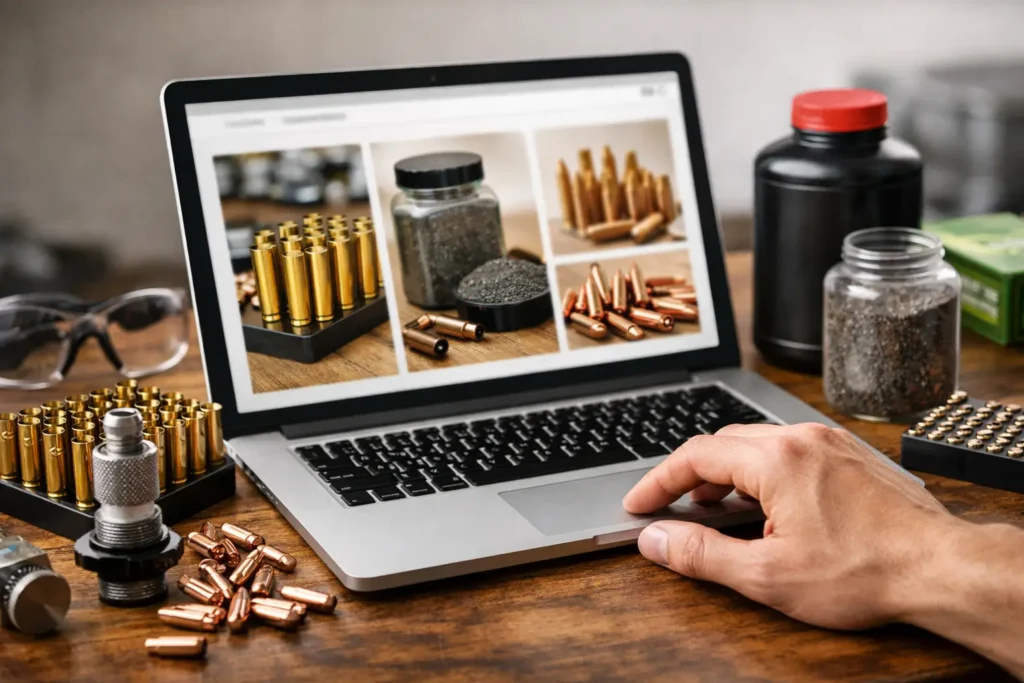
A good load can come apart long before it reaches the bench. It happens when a primer substitution gets treated like a minor detail, when a powder name looks familiar enough to click, or when an out-of-stock scramble pushes a component decision that should have been slower and more deliberate. This online reloading component buying guide is built for reloaders who already know what they are doing and want to buy with the same discipline they apply to load development.
Buying components online is efficient, but it also removes the part-counter conversation that sometimes catches a mismatch before it lands in your cart. That means the burden shifts back where it belongs – on exact product selection, verified data, and a clear understanding of what can and cannot be substituted safely. For serious reloaders, that is not a drawback. It is simply part of doing the job right.
What matters most in an online reloading component buying guide
The first priority is not price. It is correctness. Primers and smokeless powders are not generic consumables, and the wrong choice can create anything from inconsistent ignition to unacceptable pressure changes. Online ordering works best when you shop by precise specification, not by broad category.
That starts with primer class. Large rifle and small rifle are not interchangeable. Large pistol and small pistol are not interchangeable. Magnum variants should never be treated as standard equivalents unless your published load data supports that exact combination. The same logic applies to specialty classes such as shotshell primers and 50 BMG primers, where dimensional fit and ignition characteristics are tied directly to the application.
Powder requires the same level of discipline, and often more. Brand familiarity helps, but it is not enough. Similar sounding products can behave very differently, and burn rate assumptions based on name recognition are where expensive mistakes begin. If you are shopping IMR, Hodgdon, Winchester, Ramshot, Accurate, Alliant, Vihtavuori, or Shooters World, the rule stays the same – buy the exact powder your data calls for, or go back to the manual and work from approved data for the powder you can actually source.
Buy by load data, not by availability pressure
When supply gets tight, reloaders naturally become more flexible. That flexibility has limits. A product being in stock does not make it a valid replacement, and an online listing should never become the reason a load changes direction.
The better approach is to treat your manual and tested data as the decision maker, then use online inventory to match what is already proven for your cartridge, bullet weight, and intended performance window. If you cannot source your preferred component, the next step is not guesswork. It is finding a published alternative and starting over with the appropriate workup.
This is where experienced buyers save time. They usually keep a short list of approved powders for each cartridge and a narrow band of acceptable primer options based on prior testing. That gives them room to adapt without drifting outside safe and repeatable boundaries.
Primers: small differences, real results
Primer selection tends to look simple online because the categories are clean. In practice, primer choice can affect pressure behavior, ignition consistency, velocity spread, and cold-weather reliability. That is especially true in precision rifle loads and hard-to-light ball powder applications.
Standard versus magnum is the obvious dividing line, but cup hardness and brand-specific behavior matter too. A reloader running a tuned competition trigger may care about ignition sensitivity in a way that a hunting rifle owner does not. A shooter loading for semi-auto platforms may care more about primer cup characteristics and margin against slamfire risk. Neither concern is theoretical. They are part of matching the component to the firearm and the use case.
For online buying, the practical move is to check four things before purchase: the exact primer size, standard or magnum designation, the intended cartridge family, and whether your existing load data supports that primer. If one of those four is unclear, it is not ready for checkout.
Smokeless powder: where precision starts
Powder choice is where performance is built. Velocity, pressure curve, temperature behavior, metering characteristics, and case fill all start here. That is why online powder shopping should feel less like browsing and more like confirming.
For a high-volume pistol reloader, clean metering and consistent charge weights may matter most. For a precision rifle shooter, temperature stability and low extreme spread might carry more weight. For a hunter, dependable field performance across varying conditions is usually the deciding factor. None of those priorities are wrong. They just lead to different powders, even within the same cartridge.
Brand reputation matters because established powder lines have known behavior and broad data support. That is a real advantage when you are buying online. A focused inventory built around proven names makes decision-making faster because it reduces noise. You are not sorting through novelty. You are selecting from products reloaders already trust for repeatable results.
How to judge an online seller
A strong online reloading component buying guide should also address the seller, because the source matters almost as much as the SKU. Reloaders are not just buying a product. They are buying confidence that the product is authentic, accurately listed, properly handled, and actually available.
Real-time stock status is one of the most useful signals. It reduces backorder uncertainty and lets you plan around actual inventory rather than hopeful inventory. Clear category structure helps too, especially when you are looking for a specific primer class or powder line and do not want to waste time filtering through unrelated gear.
Shipping and payment clarity also matter. Components are regulated and shipping expectations should be stated plainly. A dependable seller makes the transaction straightforward, from checkout to fulfillment, without forcing the customer to guess what happens next. That operational competence is part of the product experience.
For reloaders in Canada, this matters even more because supply can be uneven across regions and certain components go scarce fast. A specialized retailer with in-stock ordering, trusted brands, and fast national fulfillment is solving a real problem, not just listing products.
Common mistakes when buying online
The most common mistake is buying by partial match. That means choosing a primer because the size looks right while missing the magnum designation, or selecting a powder because the brand is familiar while ignoring the exact product name. The second mistake is assuming a forum anecdote is load data. It is not. The third is panic buying components for future use without verifying that they fit any published load path you actually intend to run.
Another mistake is over-prioritizing bulk value without considering test history. A case of primers or multiple pounds of powder only makes sense if you already know the component performs in your system. Otherwise, you may be buying quantity before you have bought certainty.
There is also a timing issue. The best online buyers do not wait until they are fully out of a critical component. They maintain enough depth in proven primers and powders to avoid rushed substitutions. That is not stockpiling for its own sake. It is protecting load consistency.
A better way to build your next order
Start with your manuals, your current recipes, and your firearm-specific notes. Confirm the exact primer and powder you want before you open a browser. Then check stock, brand, packaging size, and any shipping or payment details that affect how quickly the order can be completed.
If you are testing a new component, keep the order proportional to the purpose. Buy enough to evaluate properly, not so much that you are forced to justify a mediocre result because too much money is already sitting on the shelf. If you are replenishing a proven load, that is the time to buy with more confidence.
This is also where a specialist retailer earns its keep. A focused catalog built around primers and smokeless powder is usually easier to shop accurately than a general outdoor store trying to be everything at once. Lee Reloading Canada is one example of that specialist model – performance-driven inventory, clear component categories, and a process built for reloaders who know exactly what they need.
The art of reloading is not just in the press stroke or the final group. It shows up earlier, in the discipline to buy the right component the first time. Shop that way, and every order does more than fill your bench – it protects the consistency you worked to build.