
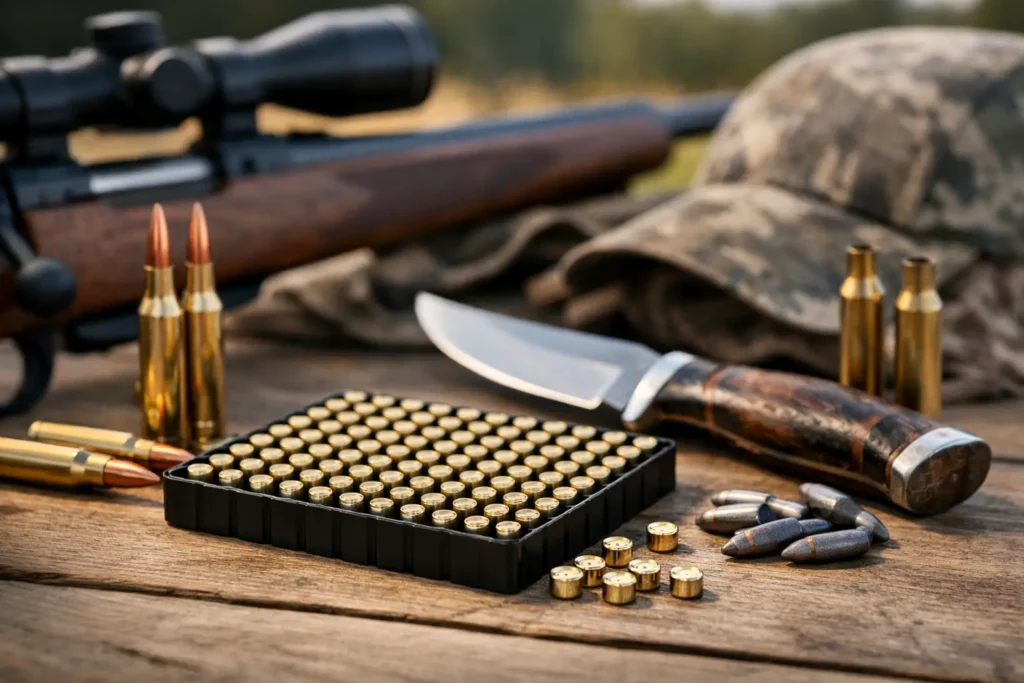
A hunting load can look perfect on the bench and still fail its only real test when the temperature drops, the rifle has been carried all day, and a shot finally presents itself. Federal primers for hunting are valued because ignition consistency is not a cosmetic detail. It is the first event in every cartridge, and it influences whether a carefully developed load delivers the accuracy and confidence you expect in the field.
For reloaders, the right question is rarely, “What is the best primer?” It is, “Which Federal primer is specified or safely supported by my published load data, cartridge, powder, and intended conditions?” That distinction protects both performance and safety. Primer selection is part of a complete load system, not an isolated upgrade.
Why Federal Primers Matter in Hunting Loads
A primer initiates the powder charge, but its role reaches beyond simply making a cartridge fire. Primer output, cup characteristics, sensitivity, and consistency can affect pressure behavior, velocity uniformity, and accuracy. In a hunting rifle, those qualities matter because field shots are often taken from imperfect positions and at unknown distances. Your ammunition should remove variables, not add them.
Federal has long been a recognized choice among rifle reloaders because its primer lines cover common applications clearly: standard and magnum large rifle, standard and magnum small rifle, match-designated options, pistol primers, shotshell primers, and specialized 50 BMG components. That breadth helps reloaders select a primer class that fits the cartridge and published recipe rather than forcing a substitute that may not belong in the load.
Reliable ignition is especially relevant when hunting in cold weather or using cartridges with larger powder charges. Still, “more ignition” is not automatically better. A magnum primer can change the pressure and velocity characteristics of a load. The correct choice is the one called for in current data from a reputable manual or powder manufacturer.
Federal Primers for Hunting: Match the Class First
The primer size and type are determined by the cartridge case and the published load data. Start there, then consider your rifle, powder, and hunting environment.
Large Rifle Primers
Federal 210 large rifle primers are commonly associated with standard large-rifle cartridges using data that specifies a standard large rifle primer. Cartridges such as the .308 Winchester, .30-06 Springfield, and many classic big-game rounds may use this primer class, depending on the exact recipe.
Federal 210M primers are match-designated large rifle primers. Many precision-minded reloaders choose match primers when they are supported by their load work because consistency from round to round is a priority. Match designation does not override load data, and it does not guarantee tighter groups in every rifle. It is a component choice to test safely within a documented load plan.
Large Rifle Magnum Primers
Federal 215 and 215M primers are large rifle magnum options. They are frequently considered for published loads involving magnum rifle cartridges, larger case capacities, and certain slower-burning powders. The 215M is the match-designated version.
For hunters loading cartridges such as the 7mm Remington Magnum, .300 Winchester Magnum, or other larger-capacity designs, the temptation is to view a magnum primer as a universal answer for cold weather. That is not a safe shortcut. Use the exact primer type named in current data whenever possible. If a component substitution is permitted by a reputable data source, treat it as a new load development process and work within the stated guidelines.
Small Rifle Primers
Federal 205 small rifle primers fit loads that call for a standard small rifle primer. They are relevant to many varmint, predator, and smaller-game cartridges, as well as certain modern sporting rifle cartridges where compatible published data specifies that primer class.
Federal 205M small rifle match primers serve reloaders pursuing a high degree of ammunition uniformity. As with any match primer, the benefit depends on the rifle, brass preparation, powder choice, seating consistency, and the quality of the load-development process. A premium primer cannot correct inconsistent brass, worn dies, or a charge weight outside proven data.
Cold Weather, Powder Choice, and Ignition Confidence
Hunting conditions create a different standard than informal range use. A load that groups well on a mild afternoon should also be evaluated for the conditions in which it will be carried. Cold temperatures, long waits in a blind, moisture exposure, and repeated cycling of ammunition through the rifle can all reveal weaknesses in component selection or ammunition handling.
Primer choice must remain tied to published data, but powder choice is part of the same conversation. Some powders are known for more stable behavior across temperature changes than others. When building a hunting load, select a powder and primer combination that is specifically supported in current data, then validate the finished ammunition under safe, realistic conditions.
That validation should focus on practical outcomes: reliable firing, repeatable point of impact, acceptable velocity consistency, and accuracy from the positions you are likely to use. A hunting load does not need to win a benchrest match. It needs to perform predictably when the shot matters.
Do Not Treat Primer Substitution as a Minor Change
During periods of limited supply, reloaders may find the correct primer difficult to source. This is where discipline matters most. Primers are not interchangeable simply because they share a physical size. A standard and magnum primer are different components. Primers from different manufacturers can also produce different results in the same cartridge.
If your established recipe calls for a Federal 210, replacing it with a different large rifle primer should not be viewed as a direct continuation of the same load. Consult current, reputable published data. Follow the component manufacturer’s guidance, observe all applicable laws, and do not exceed published maximums. If no safe data supports the combination, wait for the correct component.
Avoid mixing primer lots in a single batch of hunting ammunition. Keep components labeled, store them in their original packaging, and record the primer product and lot information in your load notes. When a load proves itself at the range, those records make it possible to reproduce it with confidence rather than starting over before the next season.
Practical Checks Before Loading Hunting Ammunition
The most dependable hunting ammunition is assembled with a repeatable process. Inspect brass carefully, confirm the primer pocket is clean and undamaged, and seat primers uniformly according to your equipment manufacturer’s instructions. A primer that is improperly seated can create reliability problems that have nothing to do with the primer brand itself.
Before loading, verify the cartridge, bullet weight, powder, charge range, and primer designation against your current manual. Confirm that the data source is appropriate for the exact components in use. Pay close attention to cartridge variants with similar names, as well as differences in bullet construction and case capacity.
After loading, use a measured confirmation process rather than assumptions. Check overall cartridge dimensions, inspect each finished round, and test-fire only in a safe environment. If you change the primer, powder lot, brass, bullet, or seating depth, recognize that you may have changed the load’s behavior. Hunting ammunition deserves that level of control.
Selecting Federal Primers With Purpose
For a hunter who reloads, Federal primers offer a clear path across common rifle applications: standard large rifle, magnum large rifle, standard small rifle, and match-designated variants where the data and your load development support them. The practical advantage is not choosing the most expensive option or the strongest ignition source. It is choosing the correct component consistently.
Lee Reloading Canada serves reloaders who know that dependable components are part of ethical field preparation. When the proper Federal primer is in stock, secure enough for your proven load plan, not for an untested substitution. The art of reloading is perfected through careful records, published data, and ammunition you trust before opening day.
A final range session with your actual hunting ammunition, in conditions close to the season ahead, is one of the best ways to turn reliable ignition into genuine field confidence.
