
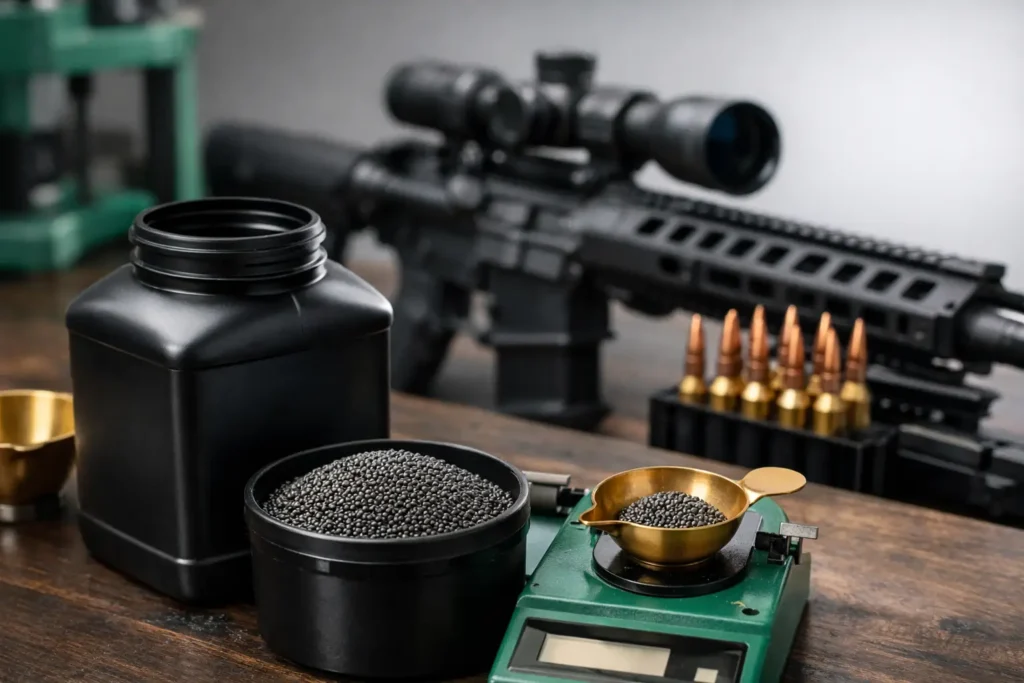
A good Ramshot TAC powder review should begin at the powder measure, not the chronograph. TAC has earned a strong following because it flows cleanly and predictably through volumetric equipment, making it a practical choice for reloaders who want consistent charge dispensing without sacrificing rifle-grade performance.
Ramshot TAC is a spherical, double-base smokeless rifle powder built around versatility. It is frequently considered for popular .22-caliber and .30-caliber rifle platforms, particularly where reliable cycling, clean metering, and repeatable results matter. Its appeal is straightforward: it can support efficient loading sessions while still giving the experienced handloader room to pursue accurate field and range ammunition.
What Ramshot TAC Is Known For
TAC’s defining trait is its fine spherical grain structure. Compared with many extruded powders, it generally moves through powder measures with less bridging and fewer cut kernels. That matters to anyone loading more than a small batch at a time. A charge weight that dispenses consistently helps reduce one variable before the cartridge ever reaches the firing line.
This does not remove the need to verify charges on a dependable scale. It does, however, make TAC especially attractive for disciplined reloaders using progressive presses, case-activated measures, or high-volume single-stage workflows. The powder’s handling characteristics can save time while maintaining the deliberate quality control that rifle ammunition demands.
TAC is also valued for its broad published application range. Many reloaders associate it with .223 Remington and 5.56 NATO-type applications, as well as selected .308 Winchester and other medium rifle cartridges. The right choice always depends on the exact cartridge, bullet construction and weight, case capacity, primer, barrel, and published data source. A powder’s reputation in one setup is not a substitute for validated data in another.
Ramshot TAC Powder Review: Field Strengths
The strongest case for TAC is balance. It is neither a niche powder chosen for only one narrow purpose nor a shortcut around proper load development. It is a versatile propellant that often makes sense for shooters who want one powder capable of serving several common rifle needs, provided approved data supports each combination.
Metering that suits volume loading
Powder handling is often where spherical propellants show their value. TAC’s small granules tend to settle consistently in a measure, helping reloaders maintain a steady rhythm. For service-rifle shooters, competitors, and high-volume range users, that can be a meaningful advantage over stick powders that may require more frequent adjustments or closer attention to charge variation.
Consistent metering also supports better process control. When the measure throws predictably, it is easier to spot an unusual charge, track component use, and maintain a repeatable loading routine. The benefit is operational rather than glamorous, but dependable ammunition is built on those details.
Useful versatility across rifle platforms
TAC is often purchased by reloaders looking to cover common semi-automatic and bolt-action rifle applications without accumulating a cabinet full of partially used powders. That flexibility can be valuable when component availability is uneven or when a shooter maintains several rifles with different roles.
Still, versatility has limits. TAC may be an excellent fit for one cartridge and merely adequate for another. A precision bolt rifle built around a particular heavy-for-caliber bullet may respond better to a different burn rate or powder geometry. Likewise, a handloader seeking the lowest possible muzzle velocity variation in a specialized long-range setup may prefer a powder selected for that exact cartridge rather than an all-around performer.
Practical performance in changing conditions
Reloaders often ask whether TAC is suitable for ammunition used across changing seasonal conditions. The honest answer is that every powder-and-load combination should be tested under the temperatures and conditions in which it will be used. Spherical powders can be highly effective, but environmental changes, lot variation, chamber dimensions, and component substitutions all deserve respect.
For hunting ammunition or match loads that may travel from a cool morning to a warm afternoon, verify performance before the event. Watch for changes in velocity, point of impact, function, and pressure indicators. This is not unique to TAC. It is simply the standard expected of careful handloaders who want confidence when the shot matters.
Where TAC May Not Be the First Choice
TAC is not automatically the best answer because it meters well. Cartridge capacity and intended pressure range should guide the decision. Some large-capacity cases may perform better with a slower propellant, while smaller cartridges may call for a faster option. Published load data is the starting point, not an optional reference after the components are on the bench.
It is also worth separating clean metering from easy load development. A powder can dispense beautifully and still require careful testing to find an accurate, reliable combination in a specific rifle. Barrel harmonics, bullet seating depth within published limits, neck tension, brass condition, and primer selection can all influence results. TAC reduces friction in the loading process, but it does not eliminate the work of confirming a load in your firearm.
Shooters focused on extreme long-range precision may have different priorities than those loading for practical rifle matches or general field use. If the objective is dependable function and solid accuracy in a common rifle cartridge, TAC’s strengths are compelling. If the objective is to optimize a highly specialized platform at the edge of a cartridge’s useful range, compare multiple appropriate powders instead of assuming one product will cover every requirement.
Component Selection and Safe Use
The best results with TAC begin with controlled components and current, manufacturer-approved data. Use the exact case, bullet, primer class, and cartridge specifications listed by the data source whenever possible. Changing any one of those items can affect pressure and performance, even when the powder remains the same.
Start at the published starting charge and work up only according to the data provider’s instructions. Inspect brass carefully, keep powders clearly labeled, avoid mixing propellants, and use a scale to confirm your dispensing equipment. If a load produces unusual recoil, sound, extraction, or visible pressure signs, stop and investigate rather than continuing through a batch.
For semi-automatic rifles, reliability deserves the same attention as group size. A load that prints well but does not cycle consistently, locks back unpredictably, or throws brass erratically has not completed the job. Test ammunition with the magazines, conditions, and firing cadence that reflect its intended use.
Who Should Consider Ramshot TAC?
TAC is a strong candidate for the reloader who values efficient metering, broad rifle utility, and a powder that fits a deliberate high-volume workflow. It makes particular sense for shooters loading common rifle cartridges for training, practical competition, general range use, or field applications supported by current published data.
It is less compelling for anyone choosing powder solely by popularity or attempting to duplicate another shooter’s results without verification. Every rifle is its own system. The most useful powder is the one that delivers safe, repeatable performance with your components and your documented loading process.
For serious reloaders, TAC’s value is not a single headline velocity or a claim that it solves every cartridge problem. Its value is the confidence that comes from smooth handling, consistent process control, and proven potential in the right rifle application. Keep the data current, keep the scale close, and let careful testing determine whether TAC earns a permanent place on your bench.