
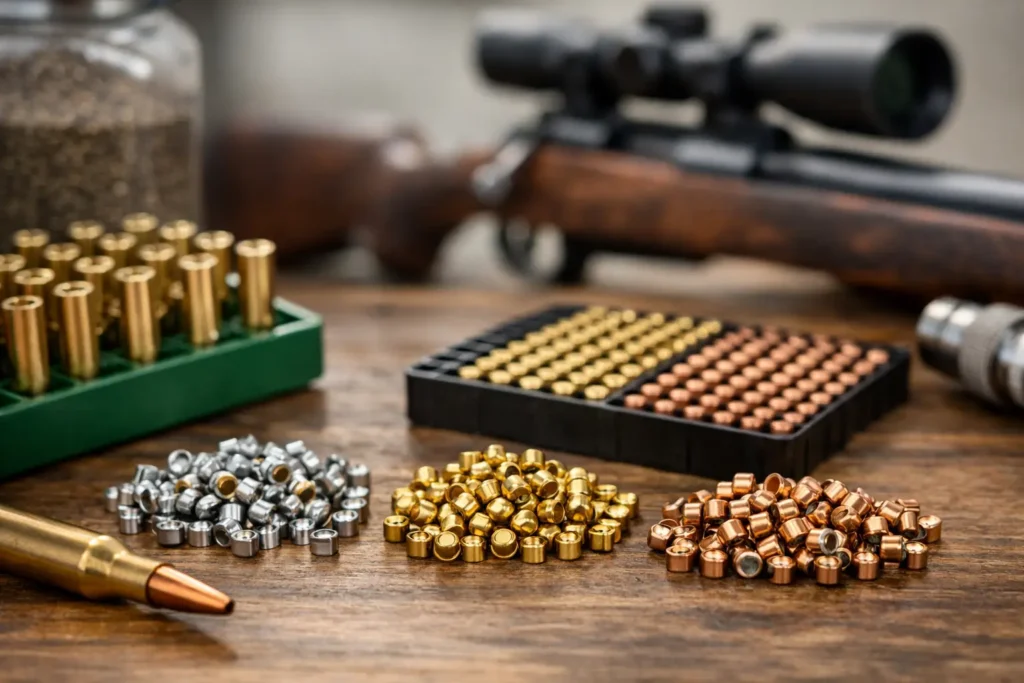
A load that groups tight with one primer can open up fast when you swap to another. That is why understanding how to choose rifle primers matters. Primer choice affects ignition consistency, pressure behavior, velocity spread, and in some rifles, whether the firing pin strike gives you clean, repeatable ignition at all.
For experienced reloaders, the mistake is rarely buying a “bad” primer. It is assuming primers are interchangeable because they fit the same pocket. They are not. The right choice starts with your cartridge, your load data, your rifle, and the pressure window you are working in.
How to choose rifle primers without guessing
Start with the simplest rule first – use the primer type specified in your published load data whenever possible. If the data calls for a standard large rifle primer, that is your baseline. If it calls for a magnum primer or a small rifle primer with a specific bullet and powder combination, there is usually a reason tied to ignition characteristics, case volume, or pressure.
From there, narrow the decision through four factors: primer size, standard versus magnum strength, cup hardness, and brand-to-brand behavior. None of these exists in isolation. A primer that works well in a mild .308 Winchester target load may not be the best choice for a cold-weather magnum hunting load, and a primer that handles pressure well in an AR-platform cartridge may feel unnecessary in a low-pressure bolt gun recipe.
Start with the correct primer size
Rifle primers are not one-size-fits-all. The cartridge determines whether you need a small rifle primer, large rifle primer, or in specialized cases, something outside the common categories such as 50 BMG primers. The first decision is mechanical fit. If the primer pocket is cut for small rifle, use small rifle. If it is cut for large rifle, use large rifle.
That sounds obvious, but size alone does not finish the job. Some modern cartridges blur expectations. A cartridge with a relatively large powder charge may still use small rifle primers by design. That does not mean it needs a hotter primer. It means the case was engineered around a specific primer pocket and ignition system. Follow the brass and the data, not assumptions based on cartridge size.
If you are working with mixed brass, inspect carefully. Primer pocket size differences can show up within the same chambering depending on manufacturer or case design. Treat that as a sorting issue, not a place to improvise.
Standard vs magnum primers
This is where most of the real decision-making happens. Standard rifle primers are appropriate for many cartridges and loads, especially when using powders that ignite easily and fill levels that are well behaved. Magnum rifle primers deliver a hotter, longer ignition flame. That can help with large case capacity, slower-burning powders, dense ball powders, and low-temperature conditions.
The trade-off is pressure. A magnum primer can raise pressure and change burn characteristics enough that a safe standard-primer load is no longer a safe magnum-primer load. It can also alter accuracy. Sometimes it tightens extreme spread and standard deviation. Sometimes it does the opposite.
If your powder charge uses a slow powder in a larger case, or if your application is hunting in cold weather, magnum primers may be the right tool. If you are assembling a moderate target load with a powder known for easy ignition, a standard primer often gives all the consistency you need without adding unnecessary ignition energy.
The key point is not that magnum is better. It is that magnum is more appropriate in certain conditions. When changing from standard to magnum, back off and work up again with current published data.
Cup strength matters more than many reloaders admit
Primer cup thickness and hardness affect both safety margin and ignition reliability. This matters most in higher-pressure cartridges, semi-auto rifles, and rifles with different firing pin energy.
A softer primer can ignite very easily, which may be useful in rifles with lighter firing pin strikes. But in a semi-auto platform with a free-floating firing pin, a more sensitive primer may increase concern about slamfire risk if the platform, brass prep, and seating depth are not all correct. A harder cup can offer better resistance in those applications, but only if your rifle delivers enough firing pin energy for dependable ignition.
That is why primer choice in cartridges like .223 Remington or 5.56 NATO often goes beyond simple size. Some reloaders prefer small rifle primers with tougher cups for AR-style rifles, particularly when running higher-pressure loads or military-style platforms. In a bolt-action varmint rifle, that same level of cup hardness may be less critical.
This is also one reason brand changes deserve caution. Two small rifle primers may look interchangeable on paper, but cup hardness and sensitivity can differ enough to change performance in the field.
Brand differences are real
Reloaders tend to talk about primers in broad categories, but brand-specific behavior is part of serious load development. Different primer lines can vary in brisance, sensitivity, dimensional consistency, and cup construction. Those differences show up on the chronograph, on the target, and sometimes on the bolt lift.
When you find a load that shoots well, the primer is part of that recipe. If supply forces a substitution, treat it as a component change rather than a simple replacement. That means reducing the load, confirming function, and checking for pressure signs and velocity shifts.
This is especially true when you are loading near the upper end of published data or tuning for precision. A primer swap can change the node enough to move a proven load out of its sweet spot.
Match the primer to the application
A practical way to think about how to choose rifle primers is to match the primer to the job, not just the cartridge.
For precision target loads, consistency tends to lead the conversation. You are looking for low velocity variation, repeatable ignition, and a primer that works well with your chosen powder and charge range. Sometimes that ends with a standard primer. Sometimes a magnum primer gives better uniformity, particularly with certain powders. The rifle decides, and the data confirms it.
For hunting loads, environmental reliability matters as much as group size. A primer that gives stable ignition in cold weather with a full case of slow powder may be worth more than a tiny accuracy advantage from a milder primer on a warm bench day.
For high-volume semi-auto shooting, reliable ignition and appropriate cup strength often move to the front. You still want accuracy, but you also want a primer that behaves well under the operating conditions of the platform.
What to do when your preferred primer is unavailable
Even disciplined component planning runs into supply gaps. When your usual primer is out of stock, resist the urge to substitute casually. Choose the closest equivalent in the correct size and intended class, then go back to the bench like it is a new load.
That means reviewing current load data, reducing the charge as appropriate, and testing in small increments. Watch for the usual signs – velocity changes, cratered or flattened primers, ejector marks, sticky extraction, and any shift in group behavior. If ignition becomes erratic, your substitute may not be the right match for that powder or pressure range.
This is where buying from a specialist source helps. Serious reloaders do not just want a box that says rifle primer. They want the right class, trusted brands, and dependable inventory so a proven load can stay as close to proven as possible.
Common mistakes when choosing rifle primers
The most common mistake is treating primers as interchangeable within the same size. The second is changing primer type without changing the load workup. The third is ignoring the rifle itself.
Another frequent issue is chasing a primer based on reputation alone. A primer that performs exceptionally in one cartridge and powder combination may be mediocre in another. There is no universal best primer, only the best fit for a specific load.
Seating also matters. Even the right primer can cause trouble if it is not seated correctly. Primers should be seated fully and consistently below flush using proper technique and clean primer pockets. Poor seating can mimic component problems that are really process problems.
A reliable way to make the final choice
If you want a disciplined process, keep it simple. Start with published data. Use the correct primer size for the brass. Choose standard or magnum based on the data, powder type, case capacity, and expected conditions. Factor in cup strength if you are loading for a semi-auto or a rifle with known ignition characteristics. Then test for velocity, pressure, and accuracy instead of assuming the label tells the whole story.
That approach is slower than guessing, but it is how dependable ammunition gets built. In reloading, the primer is a small component with outsized influence. Choose it with the same care you give powder selection and bullet seating, and the rest of the load has a much better chance to perform exactly the way you intended.
The best primer is the one that lights your chosen powder safely, consistently, and on demand in your rifle – every time you close the bolt and press the trigger.
