
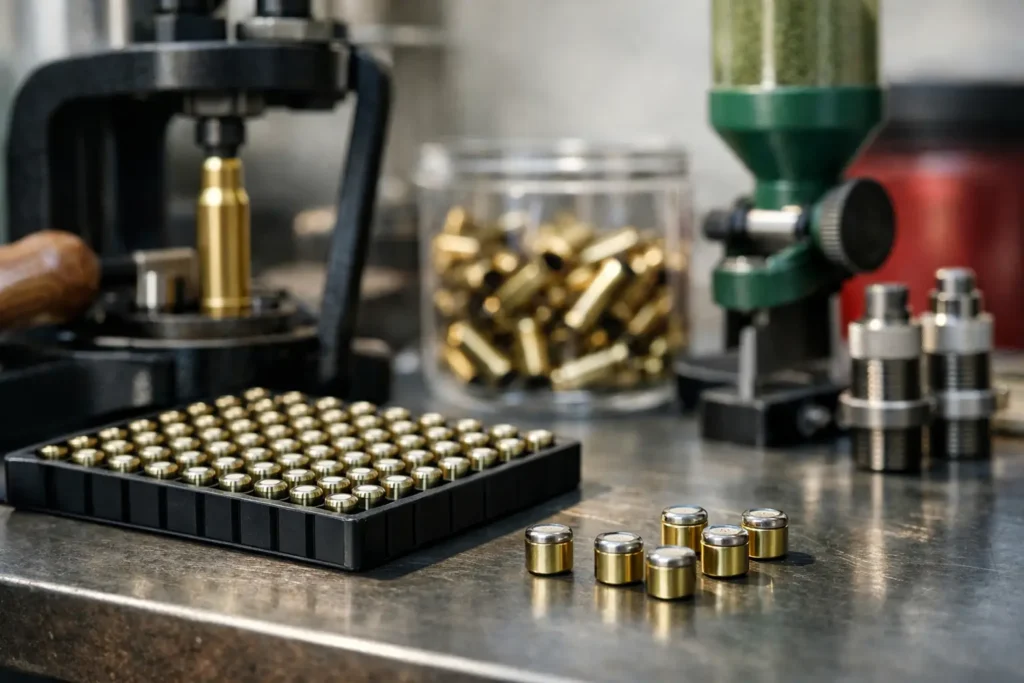
A primer is the smallest component on the loading bench, but it can have an outsized effect on a cartridge’s behavior. When a load is already built around proven brass, a carefully selected bullet, and a familiar powder, ignition consistency becomes the final variable worth scrutinizing. This Federal primer review looks at why the brand remains a serious consideration for reloaders who expect dependable firing, predictable performance, and a component they can buy with confidence.
Federal has earned its place on benches used for hunting ammunition, match-focused rifle loads, practical pistol ammunition, and high-volume range use. The appeal is not a single magic feature. It is a combination of broad primer coverage, a long-standing reputation for reliable ignition, and premium options for reloaders who want to tighten up every controllable part of their process.
Federal Primer Review: What Stands Out
Federal primers are widely recognized for consistent ignition across a broad range of applications. In practical terms, that means reloaders can expect a primer that lights the powder charge reliably when it is correctly matched to the cartridge, powder, firearm, and published load data. Consistent ignition supports more uniform velocity and pressure behavior, though no primer can compensate for inconsistent brass preparation, variable powder charges, or poor bullet seating.
The product line also gives reloaders meaningful choice. Federal offers standard and magnum primers in common rifle and pistol sizes, along with match-grade options and specialized primers for shotshell and large-caliber applications. That range matters because a one-size-fits-all approach to primers rarely delivers the best result. A mild standard primer may be appropriate for one established load, while a larger-capacity case or slower-burning powder can call for a magnum option specified in reliable data.
Federal’s reputation for relatively sensitive, dependable ignition is another reason many reloaders keep the brand in rotation. That characteristic can be useful in rifles with lighter firing-pin strikes, but it also reinforces the need for disciplined primer handling and proper seating. Primers should be seated fully and uniformly below flush according to sound reloading practice, never forced into damaged or improperly prepared pockets.
Primer Types for the Loads You Build
Federal’s catalog covers the primer classes most reloaders encounter, including small pistol, large pistol, small rifle, large rifle, magnum rifle, magnum pistol, shotshell, and 50 BMG. The correct choice begins with the cartridge specification, not with what happens to be available on the shelf.
Rifle Primers
For standard rifle cartridges, small rifle and large rifle primers are selected according to the case design and published recipe. Federal’s standard rifle options are commonly used for general hunting and target loads, while magnum versions are intended for applications where tested data calls for a more energetic ignition source.
Match-grade Federal Gold Medal primers are especially familiar to precision-oriented reloaders. Their value is consistency from primer to primer, not a guaranteed accuracy upgrade in every rifle. Some rifles and load combinations show measurable improvements when a match primer is substituted within properly developed data. Others may show little difference. The only responsible way to determine the result is to test carefully while following established load data.
A practical consideration is cup hardness. Firearm design, firing-pin energy, and primer selection all interact. A primer that performs flawlessly in one bolt rifle may not be the preferred choice for every semi-automatic platform. Reloaders working with rifles that have free-floating firing pins should pay close attention to primer seating, case condition, and the component guidance appropriate to their platform.
Pistol Primers
Federal small pistol and large pistol primers cover a large share of handgun reloading needs, from controlled range practice to serious competition and field use. Standard pistol primers are typically the right starting point when the manual specifies them. Magnum pistol primers have a defined purpose and are not simply a premium substitute for standard versions.
When a recipe specifies a magnum primer, use that class. When it specifies a standard primer, do not assume a magnum equivalent can be dropped in without consequences. Primer substitution can change pressure and velocity behavior. The right approach is to use tested data for the exact primer type whenever possible, or treat any component change with the caution it deserves.
Standard, Magnum, or Match: Choosing the Right Federal Primer
The most useful Federal primer is the one that matches your documented load. That sounds basic, but primer availability can tempt reloaders to treat every version of the same size as interchangeable. They are not.
Standard primers are designed for the broad middle of ordinary applications. They are often appropriate for established loads using powders and case capacities that do not require a hotter ignition source. Magnum primers are generally selected when published data calls for them, particularly in some larger cases, cold-weather applications, and loads using powders that benefit from stronger ignition. The details depend on the cartridge and the tested recipe.
Match primers belong in a different category. They are aimed at reloaders pursuing a high level of lot-to-lot and shot-to-shot consistency. For precision rifle work, that may justify the additional cost. For bulk practice ammunition, the return may be less clear. A reliable standard Federal primer can be the smarter purchase when the goal is safe, dependable volume rather than extracting the smallest possible group.
This is where the trade-off becomes straightforward: buy the primer that suits the purpose of the ammunition. A prairie rifle load, a hunting rifle zeroed for one dependable field load, and a high-volume handgun practice load do not necessarily demand the same component tier.
Performance Depends on the Entire Load
No fair review of primers should suggest that the primer alone determines accuracy. Primer choice is one part of a system that includes brass capacity, neck tension, bullet construction, seating depth, powder selection, charge weight, barrel condition, and the firearm itself. A Federal primer can deliver excellent results, but it should be evaluated within that whole system.
For reloaders comparing primers, keep the test controlled. Use the same brass lot, bullet, powder, cartridge overall length, and careful case preparation. Change one component at a time and evaluate results over enough shots to avoid drawing conclusions from a single good group or an unusually fast chronograph string. Record the exact primer product and lot number with your load notes.
Be especially cautious when changing between brands. Even primers with the same physical size can produce different results. If a component substitution is necessary, return to reliable published data and work within its stated limits. The goal is not to chase a number at the expense of safety. It is to establish a load that performs predictably in your firearm.
Handling, Storage, and Inspection
Federal primers should arrive and remain in their original packaging until they are needed. Store them in a cool, dry location away from heat sources, open flame, and incompatible materials. Keep different primer types clearly separated and labeled. A small pistol primer and a small rifle primer may appear similar at a glance, but they are not interchangeable components.
Before priming, inspect cases for clean, undamaged primer pockets. A pocket that is loose, crimped without being properly prepared, or contaminated can create problems that have nothing to do with primer quality. During seating, aim for a uniform result and stop if resistance feels abnormal. Forcing a primer is never a solution.
Reloaders should also avoid mixing primers from different packages or lots in one carefully documented batch. Keeping components organized makes later troubleshooting far easier. When ammunition is intended for field use or a match, confidence comes from knowing exactly what went into it.
Is Federal the Right Primer Brand for You?
Federal is a strong option for reloaders who prioritize trusted ignition performance and want access to standard, magnum, and match-oriented choices within one established brand. Its broad lineup makes it easier to stay within the component class required by your preferred cartridges and published data.
The deciding factor is still application. A high-volume shooter may place the most weight on steady availability and a reliable standard primer. A precision rifle shooter may be more interested in Federal Gold Medal options and carefully recorded lot performance. A hunter may value a proven load that delivers reliable ignition after being carried through changing weather and field conditions.
For serious reloaders, component selection is not about finding one brand that does everything better than every alternative. It is about building a repeatable process around components you trust. When Federal primers match your cartridge requirements and tested load data, they offer the kind of dependable ignition that lets the rest of your load development show its true potential.