
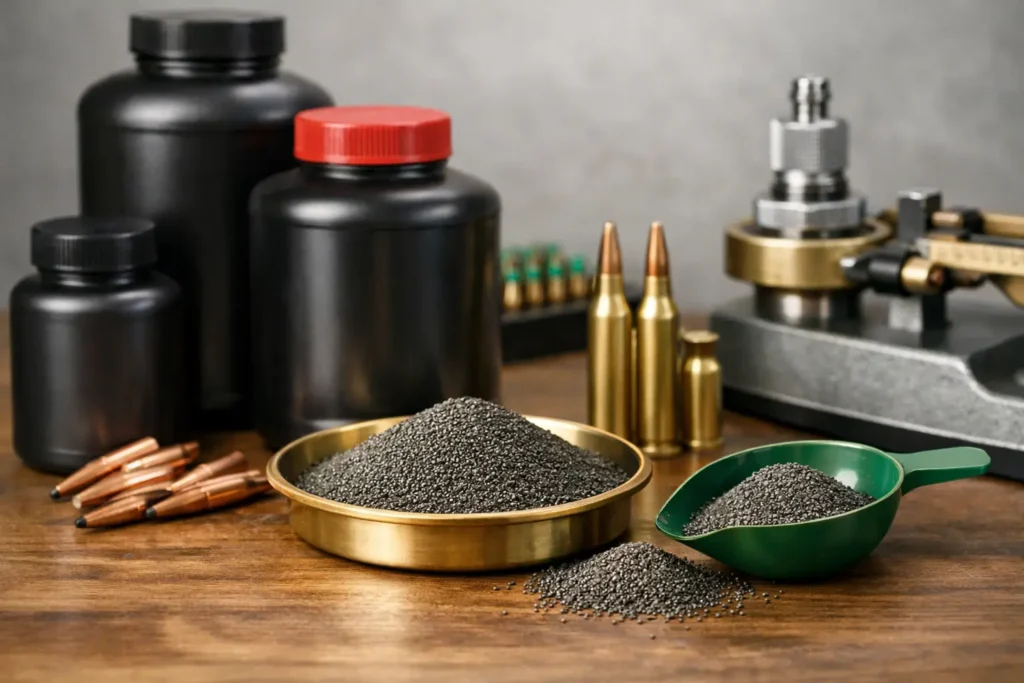
The wrong powder choice usually shows up before you ever reach the target. Maybe the velocity spread is wider than it should be. Maybe the load meters poorly, leaves more residue than expected, or never delivers the consistency your rifle or pistol is capable of. If you are figuring out how to choose smokeless powder, the real question is not which brand is best in general. It is which powder matches your cartridge, bullet weight, pressure window, and performance goal.
For experienced reloaders, powder selection is where accuracy, reliability, and field performance start to separate. Primers matter. Brass matters. Bullet design matters. But powder is the engine of the load, and small differences in burn characteristics can change everything from ignition behavior to recoil feel.
How to choose smokeless powder for your application
The safest and most efficient way to choose powder is to start with published load data, not shelf popularity or forum hype. A powder can be excellent in one cartridge and a poor fit in another. Even within the same cartridge, the right choice may shift depending on bullet weight, barrel length, and whether you are loading for match use, hunting, or high-volume range work.
If your goal is precision rifle performance, you will usually prioritize consistency across temperature swings, stable velocities, and clean pressure behavior near your target node. If you are loading pistol ammunition, meterability and reliable cycling may matter more than squeezing out a few extra feet per second. For shotshell applications, the relationship between powder, hull, wad, primer, and shot charge becomes even more exact. That is why powder choice should always begin with a specific load recipe category, not a vague idea of wanting something versatile.
Start with published data, then narrow the field
Reloaders who get repeatable results tend to work backward from trusted data. First identify your cartridge, bullet weight, and bullet type. Then look at the powders listed in current published data from reputable sources. That short list is your real starting point.
From there, compare powders based on what you want the load to do. Some options are listed because they deliver top velocity. Others are included because they give broad usability, good case fill, or stable accuracy over a practical range. A powder that appears across many bullet weights in your cartridge often offers flexibility. A powder that shows exceptional results in a narrow window may be the better choice for a dedicated load.
This is also where brand familiarity helps, but only to a point. Hodgdon, IMR, Winchester, Alliant, Ramshot, Accurate, Vihtavuori, and Shooters World all offer proven options. The right decision is less about loyalty and more about matching the powder’s behavior to the data and the job.
Burn rate matters, but it is not the whole story
Burn rate is one of the first filters reloaders use, and for good reason. Faster powders generally suit lower-capacity cases, lighter bullets, and many pistol applications. Slower powders are often better for larger rifle cases and heavier bullets where pressure needs to build over a longer acceleration curve.
Still, burn rate charts are only rough guides. Powders close to each other on a chart can behave quite differently in real loads. Grain shape, bulk density, temperature sensitivity, and lot-to-lot consistency all affect practical performance. Two powders with similar relative burn rates may meter differently, fill the case differently, and produce different standard deviations in the same rifle.
That is why burn rate should help you narrow the list, not make the final decision by itself.
Match the powder to the cartridge and bullet weight
A common mistake is choosing a powder because it worked well in a different caliber with similar recoil or velocity goals. Smokeless powder selection is more specific than that. Cartridge volume, bore diameter, bullet weight, seating depth, and operating pressure all change the equation.
In rifles, lighter bullets often perform best with powders that reach useful pressure efficiently without wasting case capacity. Heavier bullets usually benefit from slightly slower powders that maintain a smoother pressure curve. Magnum cartridges typically need slower-burning powders to make full use of their case volume, while many standard cartridges reach their best balance with medium burn rate options.
In pistols, the decision often comes down to balancing clean ignition, manageable recoil impulse, and reliable function. A powder that produces excellent accuracy but inconsistent cycling in your platform is not the right powder for that use. Competitive shooters may prefer one feel in recoil. Defensive practice loads may call for another. The same cartridge can support both, but not always with the same powder.
Consider metering, case fill, and loading workflow
Performance on paper is only part of the picture. Good powder selection should also support a safe, repeatable loading process.
Ball powders often meter very consistently through powder measures, which makes them attractive for progressive loading and high-volume production. Extruded powders can deliver outstanding accuracy, especially in rifle loads, but some meter less uniformly depending on kernel size and equipment setup. Flake powders can be effective in many handgun and shotshell applications, though they may bring their own handling quirks.
Case fill matters as well. A load with healthy case fill can promote more uniform ignition and make charge errors easier to spot. Very low fill ratios can sometimes lead to inconsistent ignition behavior, depending on the cartridge and powder. On the other hand, compressed loads are not automatically a problem if they are within published data, but they do require attention to seating consistency and overall loading discipline.
If you are producing a lot of ammunition, your ideal powder may not be the one with the last bit of theoretical accuracy. It may be the one that meters predictably, ignites consistently, and supports efficient quality control.
Temperature stability and real-world use
Not every load lives a climate-controlled life. Hunters, long-range shooters, and anyone storing or using ammunition across changing conditions should pay close attention to temperature behavior.
Some powders hold velocity and pressure more consistently across hot and cold environments. Others can shift enough to matter, especially near the upper end of published data. If your ammunition may sit in a truck during a cold morning and then spend the afternoon in direct sun, this is not a minor detail.
For range-only use at moderate temperatures, a wider group of powders may perform well. For field ammunition where point of impact and pressure stability matter under changing conditions, temperature sensitivity deserves more weight in the decision.
Availability should influence the choice, but not override safety
There is the ideal powder, and then there is the powder you can actually buy consistently. Serious reloaders know supply matters. A load that depends on a hard-to-find powder can be frustrating to maintain, especially if you are trying to preserve a tuned rifle recipe or keep a high-volume pistol setup running with minimal change.
That said, availability should shape your shortlist, not justify improvising outside published data. Substitute components only when supported by tested load data. Different powders are not interchangeable by appearance, burn rate, or brand family. Smokeless powder demands exact identification and exact data.
For many buyers, that is where a specialized source makes a difference. A focused retailer such as Lee Reloading Canada is built around the component categories reloaders actually shop by, which makes it easier to compare trusted powder lines and buy with confidence when inventory is available.
How to choose smokeless powder without chasing myths
A few ideas tend to lead reloaders off course. One is the belief that the highest velocity powder is automatically the best. Sometimes it is. Often it is not. Accuracy nodes, brass life, recoil characteristics, and ignition consistency may point to a different option.
Another is assuming a cleaner-burning powder is always superior. Cleanliness can be a useful trait, but not if it comes at the cost of accuracy or function in your setup. The same goes for popularity. A powder may be widely used because it is versatile and available, not because it is optimal for your exact load.
The best powder is usually the one that gives predictable pressure behavior, repeatable velocities, and the performance you need in your firearm with your chosen components. That answer is often practical rather than glamorous.
Build around repeatability
Once you narrow your powder choices, test with purpose. Change one variable at a time. Watch for pressure signs, track velocity, and pay attention to group shape, not just group size. A load that prints one small cluster and then throws unexplained fliers may be less useful than a slightly slower load that stays repeatable over time.
Repeatability is what turns a promising combination into a trusted one. That applies at the bench and in the field.
Choose powder the same way you would choose any critical component – by data, by application, and by whether it performs consistently in the real world. When the load feels settled, the chronograph agrees, and the target confirms it, you are no longer guessing. You are building ammunition with purpose.