
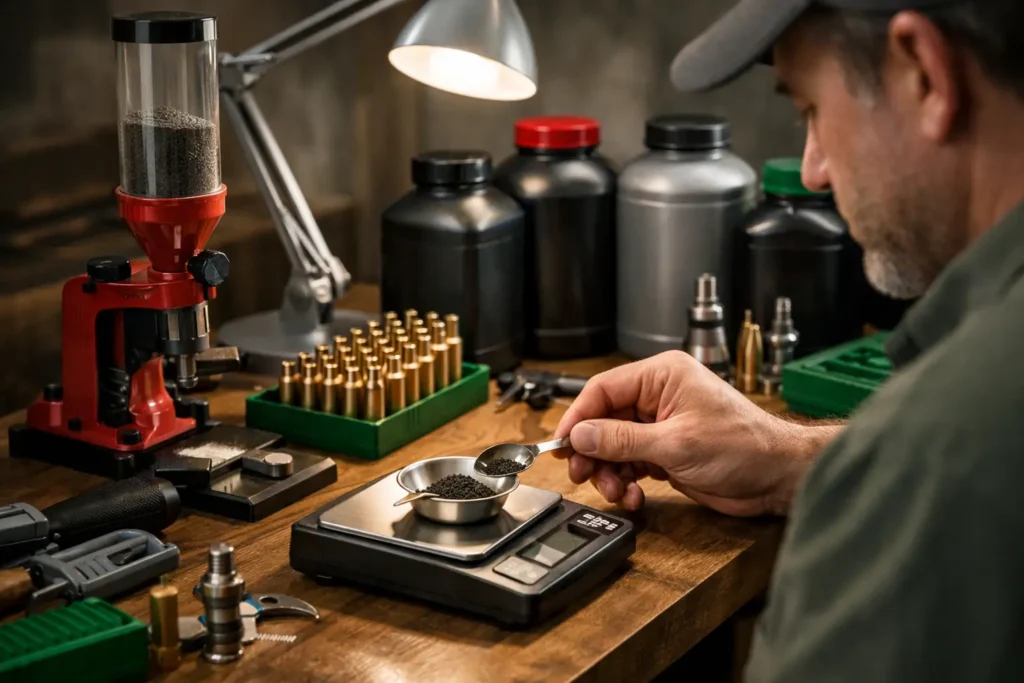
A powder measure can throw the same setting all afternoon, yet the actual charge weight may still vary more than your load calls for. When reloaders ask what powder meters consistently, the useful answer is not a single brand or burn rate. It is a combination of powder geometry, measure design, operating technique, and the tolerance required for that cartridge.
For high-volume pistol ammunition, a small variation may fall comfortably within a safe, published load range and produce excellent field performance. For a precision rifle load being developed near a specific velocity or accuracy node, the same variation may justify weighing each charge. The goal is not simply fast dispensing. It is repeatable charge control.
What Powder Meters Consistently?
Spherical, or ball, powders generally meter with the greatest consistency through most volumetric powder measures. Their small, rounded granules flow smoothly into the metering cavity, settle predictably, and shear cleanly when the rotor or drum turns. This is why many reloaders favor spherical propellants for progressive presses and high-volume loading sessions.
Fine-grain double-base powders often share those characteristics. They move freely through narrow powder passages and tend to produce low charge-to-charge variation when the measure is set up correctly. That does not mean every spherical powder behaves identically. Granule size, coatings, static, humidity, and the specific measure can all affect the result. Still, as a broad rule, spherical powders are the easiest class to meter accurately by volume.
Flake powders can also meter very well, particularly in measures with a clean, well-fitted drum. Their broad, flat shape may bridge or stack less uniformly than ball powder in some setups, but many flake propellants deliver dependable throws for handgun and shotshell applications. A powder measure that works beautifully with one flake powder may be less consistent with another, so a verification series remains necessary whenever components change.
Extruded powders, often called stick powders, are usually the most challenging to meter. Long kernels can catch at the edge of the metering cavity, causing the measure to cut kernels during operation. The resistance can feel inconsistent, and the cut kernels may create a wider spread in thrown weights. Short-cut extruded powders often improve the situation substantially, but they rarely flow as freely as a fine spherical powder.
The practical takeaway is straightforward: if rapid, repeatable volume charging is the priority, spherical powders are usually the first place to look. If a specific extruded powder delivers the accuracy, temperature stability, or pressure behavior your rifle load needs, its slower metering behavior may be an acceptable trade-off.
Powder Shape Is Only Part of the Equation
A powder does not meter consistently in isolation. It meters through a particular tool, under particular conditions, using a particular operator routine. The same propellant can show excellent uniformity in a quality drum measure and wider variation in a poorly adjusted rotor, worn linkage, or powder-through expander setup.
Metering cavities work by filling a fixed volume. Anything that changes how completely that cavity fills can change the thrown charge. Powder column height is one example. As the hopper empties, pressure on the powder entering the cavity can change. A baffle helps maintain more consistent pressure and is particularly valuable during longer loading sessions.
Static can also affect light granules, especially in dry conditions or with plastic hoppers. Powder clinging to the hopper wall is more than an annoyance. It changes the flow pattern feeding the measure. Keep the equipment clean, use only manufacturer-approved cleaning practices, and avoid introducing oils or household chemicals into any component that contacts powder.
The measure itself matters. A fine-powder rotor may be better suited to small charges, while a larger cavity can be more stable for higher-volume rifle charges. Clearances, finish quality, and the geometry of the metering chamber all influence how smoothly a powder flows and how cleanly it is cut off.
Consistent Operation Produces Consistent Throws
Even a premium powder measure cannot compensate for an inconsistent handle stroke. Operate the measure with the same full movement and the same deliberate rhythm on every cycle. At the top of the stroke, allow the cavity to fill. At the bottom, allow it to empty completely. Do not tap the handle sometimes and skip that step at other times.
Before charging cases, cycle the measure several times to settle the powder and establish a stable fill pattern. The first throws after filling a hopper should not be assumed to represent the eventual average. Throw and return several charges to the hopper, then begin checking charge weights.
A disciplined verification routine should include these steps:
- Confirm the intended charge against current, published load data from the powder or bullet manufacturer.
- Set the measure below the intended value, then make small adjustments upward while checking with a suitable scale.
- Weigh multiple consecutive throws, not just one throw that happens to match the target.
- Recheck at regular intervals, after a hopper refill, and whenever the loading rhythm or equipment setting changes.
Never rely on a volume setting alone, even if the setting was correct during a previous session. Lot changes, powder changes, environmental conditions, and accidental adjustment can all affect results. A scale is the final check on what the measure is actually delivering.
Match Your Standard to the Cartridge and Purpose
The definition of consistent depends on what you are loading. A high-volume 9mm practice load may be well served by a powder that throws very uniformly through a progressive press. The efficiency gain is meaningful, provided each component and charge remains within tested data and your periodic scale checks confirm stable operation.
For a hunting rifle, many reloaders balance speed with a desire for low variation across a batch. A short-cut extruded powder may take more attention at the measure but offer desirable performance across changing temperatures. In that case, throwing a slightly light charge and trickling to final weight can be a practical workflow.
Precision rifle handloaders often choose a powder for the cartridge’s tested performance first, then decide how to dispense it. If the best-performing powder is difficult to meter, weighing charges individually can remove a variable from the process. There is no advantage in choosing an easier-metering powder if it does not meet the accuracy, velocity, or pressure requirements established by published data and careful load development.
Shotshell reloaders have their own priorities. Consistent bushing performance, proper powder selection for the hull and wad combination, and exact adherence to published recipes are essential. Small changes in components are not interchangeable simply because the charge volume looks similar.
Powder Measure Setup and Maintenance
Start with a clean, dry measure that has been inspected according to its manufacturer instructions. Confirm that the rotor, drum, or charge bar moves freely and returns fully. Check that the hopper is secure, the adjustment is locked, and the powder path is free of residue.
Keep only one powder on the bench at a time. Label the hopper if powder remains in it during a brief interruption, but best practice is to return unused powder to its original labeled container at the end of the session. This protects powder identity, reduces contamination risk, and prevents the kind of mix-up that no careful scale check can correct.
Use the same measuring method every time. If you use a baffle, use it consistently. If you settle the measure with a deliberate motion, make it part of every cycle. Small procedural differences can become measurable differences in charge weight.
Choose Powder for Performance First
Metering behavior is a legitimate purchasing factor, especially for shooters who load in volume. It should not be the only factor. Start with current published data for your cartridge, bullet weight, primer, and intended application. Then compare the powders listed for suitable pressure characteristics, expected velocity, temperature behavior, availability, and metering compatibility with your equipment.
Recognized powder lines from Hodgdon, IMR, Winchester, Alliant, Ramshot, Accurate, Vihtavuori, and Shooters World offer options across spherical, flake, and extruded formats. The right choice is the powder supported by tested data that delivers the performance standard your load requires.
A powder measure is a production tool, not a substitute for verification. Select a propellant that fits the job, establish a repeatable operating routine, and let regular scale checks confirm every batch is being built with the precision your shooting demands.
