
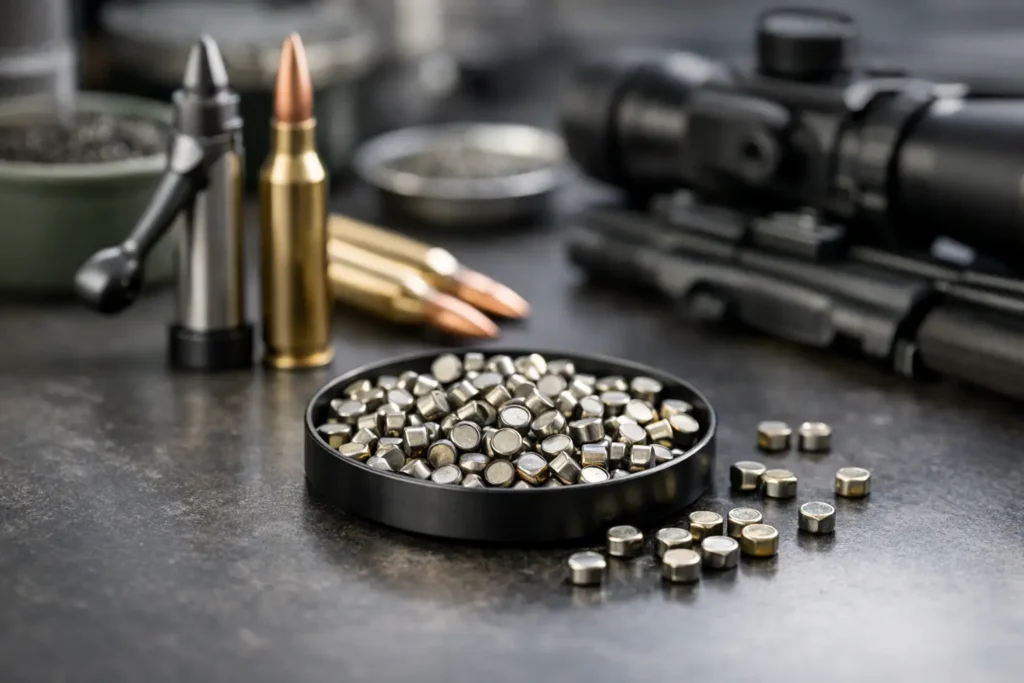
A load can look perfect on paper and still fall apart at the bench if the primer is wrong. That is why understanding small rifle primer uses matters to anyone loading for cartridges that depend on consistent ignition, controlled pressure behavior, and dependable field performance.
Small rifle primers are built for rifle cartridges that use a small primer pocket and typically operate at higher pressures than pistol rounds. They are not just a smaller version of a large rifle primer, and they are not a casual substitute for small pistol primers. In practical terms, they are used to ignite the powder charge in many popular centerfire rifle cartridges while standing up to the firing pin impact and chamber pressure those loads generate.
What small rifle primer uses actually cover
The core job is simple – ignite the powder charge with enough consistency to support stable velocities and reliable combustion. But in reloading, simple jobs have real consequences. A primer affects ignition timing, pressure rise, and in some combinations even how a load behaves across temperature swings.
Common small rifle primer uses include standard centerfire rifle cartridges built around small primer pockets, especially varmint, target, and intermediate rifle loads. Think of cartridges in the .17, .20, and .22 centerfire class, along with many modern sporting rifle cartridges that call specifically for small rifle primers. They are also used in some high-volume training and competition loads where consistency matters just as much as cost control.
That does not mean every cartridge with a similar case head can share the same primer choice. Primer selection always follows published load data and the cartridge manufacturer’s specification. The same powder charge under the same bullet can behave differently when the primer changes.
Why small rifle primers are different
A small rifle primer has to do two things well. It has to produce consistent ignition, and it has to tolerate rifle pressure. That second point is where many mistakes start.
Compared with small pistol primers, small rifle primers generally use a harder cup. That harder cup is meant to resist primer flow, piercing, or other pressure-related issues in rifle applications. In rifles with free-floating firing pins, cup hardness can also play into safe handling and reliable chambering. This is one reason experienced reloaders avoid treating primer classes as interchangeable just because the diameter appears similar.
Primer brisance also matters. Some small rifle primers are standard, while others are magnum-rated for more energetic ignition. Magnum versions are often chosen for harder-to-ignite spherical powders, heavier charges, or colder weather use. Standard versions may be a better fit for moderate charges and powders that ignite easily. The right choice depends on the cartridge, powder type, ambient conditions, and the exact data source you are using.
Common cartridges that use small rifle primers
Many reloaders first run into small rifle primer uses when loading .223 Remington or 5.56 NATO-type platforms. That is a major category, but it is far from the only one. Cartridges like .204 Ruger, .222 Remington, .17 Remington, and .22 Hornet also commonly use small rifle primers, though each cartridge has its own pressure profile and preferred component combinations.
Some newer precision and competition cartridges also use small primer pockets by design, even when case capacity suggests a different expectation. In those setups, reloaders often pursue better ignition consistency, lower extreme spread, or stronger primer performance under pressure. The point is not that one primer size is universally better. The point is that the cartridge was engineered around a specific primer type, and the load should respect that.
If you are loading for semi-auto rifles, primer choice becomes even more deliberate. Reliable ignition matters, but so does cup strength and compatibility with the platform’s firing system. A primer that performs well in a bolt gun load may not be the best fit in an AR-style rifle if the application or pressure range changes.
Small rifle primer uses in precision loading
For precision shooters, the primer is part of the consistency equation, not an afterthought. Small rifle primers are often selected for loads where velocity uniformity, repeatable ignition, and low shot-to-shot variation are priorities.
That does not mean the primer alone creates accuracy. Case prep, powder charge control, neck tension, seating depth, and barrel condition still do the heavy lifting. But the primer can support or undermine the rest of the system. If a load shows unexplained velocity spread, one variable worth testing is the primer brand or primer type, always within published data.
There is also a practical trade-off here. Some rifles show a clear preference for one primer over another, while others do not care much at all. Chasing the last fraction of an inch on paper can be worthwhile for competition, but less useful for a general-purpose coyote or range load. The intended use of the ammunition should guide how far you go in primer testing.
Standard vs magnum small rifle primers
This is one of the most misunderstood areas in reloading. Magnum does not simply mean better. It means hotter or more energetic ignition, and that can change pressure and velocity.
Standard small rifle primers are often a strong fit for many common extruded powder loads and moderate charge weights. Magnum small rifle primers may be preferred when ignition needs more energy, especially with spherical powders, larger case volumes within the small-primer category, or cold-weather hunting conditions.
The trade-off is straightforward. More primer energy can improve ignition reliability in difficult conditions, but it can also raise pressure or alter the load’s behavior enough that your previous charge weight is no longer valid. That is why changing from standard to magnum primers requires a return to published data and a careful work-up, not a quick swap.
What small rifle primers are not for
The most important limitation is simple: they are not universal replacements. A small rifle primer should not be substituted wherever a small primer pocket exists unless the load data specifically supports it.
Small pistol and small rifle primers may appear similar in size, but they are built for different operating conditions. The same goes for large rifle and large pistol categories, where dimensional and performance differences matter. Using the wrong primer can create misfires, slam-fire risk, pierced primers, erratic pressure, or inconsistent ignition.
Shotshell primers are a separate category entirely, and 50 BMG primers are in their own class. Even within the rifle family, standard and magnum types are not automatic stand-ins for one another. Precision starts with matching the exact component class to the application.
Choosing the right primer for the load
When evaluating small rifle primer uses for a specific build, start with the manual, not the shelf. Cartridge spec comes first, then published load data, then the exact primer designation listed for that recipe.
After that, think about the application. A prairie dog load assembled for warm-weather shooting may favor one combination. A winter predator load or a high-round-count semi-auto setup may favor another. Powder choice matters a great deal here. Some powders are easy to light and forgiving. Others are less so, especially when temperatures drop.
Brand consistency matters too. Experienced reloaders know that changing primer brands can move a load enough to justify retesting. That does not make one brand universally superior. It means every primer has its own characteristics, and reliable ignition comes from tested combinations, not assumptions.
For buyers who want dependable supply and trusted component lines, retailers focused on reloading components make that process easier. A specialist source like Lee Reloading Canada serves reloaders best when inventory is clear, brands are authentic, and the buying process supports fast decisions without guesswork.
Safety and storage still matter
Even the best primer choice means little if handling is sloppy. Primers should be stored in their original packaging, kept dry, and protected from heat, impact, and contamination. Seating depth matters as well. A high primer can create reliability and safety problems, while damaged primers should never be forced into service.
During load development, treat any primer change as a component change, because that is exactly what it is. Watch for pressure signs, but do not rely on them alone. The safer practice is to reduce and work back up whenever a primer substitution is introduced, using current published data from reliable sources.
The practical value of understanding small rifle primer uses is not academic. It shows up every time a round lights cleanly, cycles properly, and prints where it should. Pick the primer the cartridge was designed to use, match it to the powder and conditions, and let consistency do the rest.