
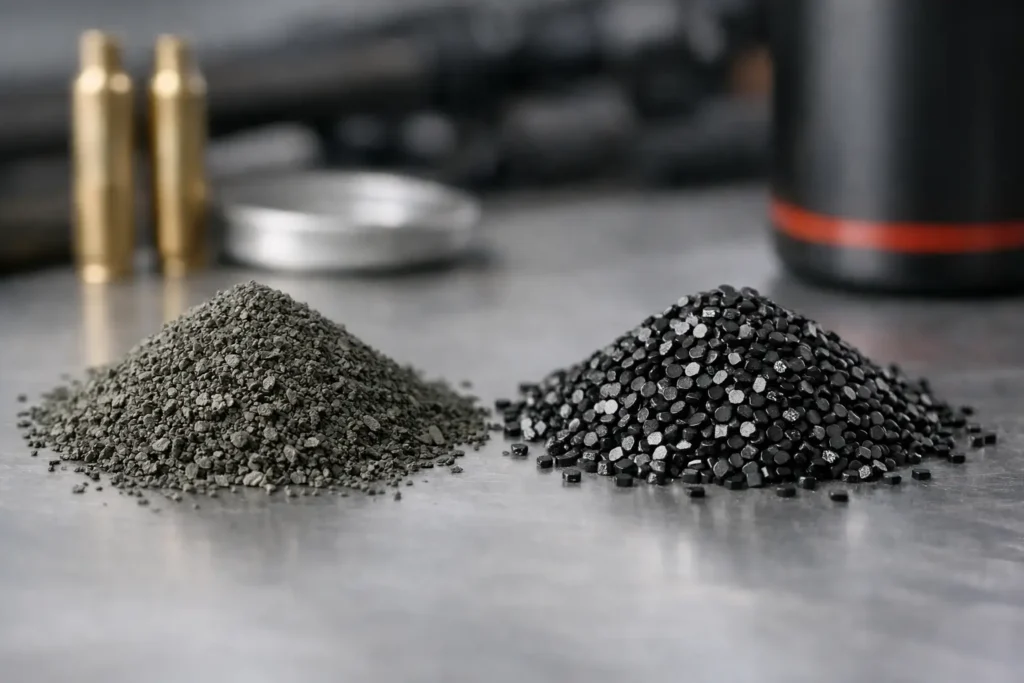
If you are weighing single base vs double base powder for a load workup, the real question is not which one is better in the abstract. It is which one gives you the pressure curve, velocity window, temperature behavior, and shot-to-shot consistency your cartridge actually wants. That distinction matters more than the label on the jug.
For experienced reloaders, this topic tends to get simplified too much. Single-base powders are often treated as the “accuracy” option, while double-base powders get framed as the “speed” option. There is some truth there, but it leaves out enough nuance to cause bad assumptions at the bench. Powder choice is always a system decision – cartridge, bullet weight, barrel length, intended use, ambient conditions, and published data all matter.
What single base vs double base powder really means
The difference comes down to energetic content. Single-base smokeless powder is built primarily on nitrocellulose. Double-base powder contains nitrocellulose plus nitroglycerin. That added nitroglycerin increases energy density, which is why double-base powders often produce higher velocity potential for a given application.
That sounds simple, but the practical effect is broader than raw speed. More energy can influence how a powder meters, how it performs across temperatures, and how sharply it develops pressure in certain cartridges. Two powders with similar burn rates on a chart may still behave differently because the chemistry behind them is not the same.
For the handloader, this is where component selection stops being academic. Powder is not just fuel. It shapes recoil character, barrel heat, fouling pattern, and how forgiving a load feels as conditions change.
How single-base powders tend to behave
Single-base powders are often chosen when reloaders want predictable pressure behavior and a reputation for excellent consistency. Many rifle powders favored for precision work fall into this category, especially where stable performance over a wider temperature range is a priority.
That does not mean every single-base powder is automatically more accurate. Accuracy comes from a load that harmonizes with the rifle, bullet, seating depth, and ignition system. Still, single-base formulations often earn trust in applications where low extreme spread and steady point of impact matter more than squeezing out every last foot per second.
They can also be attractive in cartridges where pressure rises quickly and the margin for error is narrow. A powder that delivers the needed velocity without pushing too hard, too fast, can make load development easier to read. You may see flatter trends as charges increase, or at least fewer surprises if you stay inside published data.
In practical terms, many reloaders associate single-base powders with disciplined, precision-oriented performance. That reputation is deserved, but it is not universal. Manufacturing quality, deterrent coatings, grain geometry, and lot consistency still play major roles.
How double-base powders tend to behave
Double-base powders bring more energy to the table, and that is usually the first reason reloaders look at them. In many pistol cartridges, magnum revolver applications, and some rifle loads, they can provide excellent velocity and efficient case fill. That combination is a big reason double-base powders are common across a wide swath of high-performance data.
They also often meter very well, especially in spherical or ball powder form. For progressive loading and higher-volume production, that matters. A powder that drops consistently through a measure can tighten process control and reduce one source of variation.
The trade-off is that double-base powders can be less forgiving in some setups, particularly when pushing upper-end charges or working in environments with large temperature swings. That does not make them unsafe or unsuitable. It means they reward careful load development, attention to pressure signs, and a firm commitment to current published data.
Some double-base powders are exceptionally well behaved and have earned loyal followings for both accuracy and field reliability. Others are better thought of as application-specific tools. The chemistry gives them potential advantages, but it does not remove the need to match the powder to the cartridge.
Burn rate, pressure, and why labels are not enough
A common mistake in the single base vs double base powder discussion is assuming the base chemistry tells you everything you need to know. It does not. Burn rate still matters, and so does how that powder reaches peak pressure in your specific chamber.
A relatively fast double-base powder in a small case can feel very different from a slower single-base powder in a larger rifle cartridge, even if both are operating within safe limits. One may deliver excellent velocity with sharper recoil and a tighter pressure window. The other may produce a smoother impulse and wider load-development comfort zone.
This is why burn rate charts are starting points, not substitutions. Powders that appear close on paper are not interchangeable, and base type is never a license to swap components outside tested data. If a manual specifies a powder, primer, bullet, and charge range, treat that combination as a pressure-tested recipe, not a suggestion.
Temperature stability and field performance
Temperature behavior is one of the more practical reasons reloaders care about powder type. If your ammunition sits in a hot truck during summer varmint season or gets carried into freezing deer camp conditions, velocity and pressure can shift. Those shifts may be modest, or they may be enough to change point of impact and safety margin.
Single-base powders often carry a stronger reputation for temperature stability, especially in rifle applications. That is one reason they remain popular among precision shooters and hunters who demand reliable performance across changing weather.
But again, it depends. Modern powder engineering has blurred some of the old assumptions. Certain double-base powders perform very well over varied temperatures, while some single-base powders may not behave exactly as reloaders expect in every cartridge. What matters is the actual product line, your load, and your testing.
If your ammunition will see broad seasonal swings, it makes sense to favor powders known for stable field performance. A few rounds over the chronograph in mild weather do not answer that question by themselves.
Metering, fouling, and barrel heat
At the loading bench, metering consistency can matter as much as chemistry. Many double-base spherical powders flow beautifully through powder measures, which is a real advantage for pistol reloaders and anyone loading in quantity. Some extruded single-base powders offer superb ballistic consistency but may require more care to throw uniform charges.
Fouling and heat are also part of the picture. Higher-energy powders can contribute to different fouling patterns and barrel temperature behavior, particularly during long strings. For a hunting rifle fired cold, that may not matter much. For a competition gun or a high-round-count range session, it can matter quite a bit.
These are not blanket rules. They are tendencies. The right powder is the one that performs well in your firearm, within safe pressure limits, while fitting the way you actually load and shoot.
Which is better for rifle, pistol, and magnum loads?
For many precision rifle applications, single-base powders remain a strong choice because they are often associated with consistency, stable pressure behavior, and dependable long-range performance. That is why reloaders chasing low standard deviation frequently start there.
For many pistol cartridges, double-base powders are extremely common because they deliver strong energy, compact charge weights, and efficient metering. In magnum handgun and certain high-performance rifle loads, that extra energy can be especially useful.
Still, there is no hard boundary. Plenty of double-base powders shoot exceptionally well in rifles, and not every pistol handloader needs the characteristics of a double-base option. Cartridge design and published data decide the shortlist far better than generalizations do.
The safest way to choose between them
Start with current load data from reputable sources and let the cartridge narrow the field. Then think about your actual goal. If you want maximum practical consistency across weather changes, a single-base option may be attractive. If you need higher velocity potential, efficient metering, or a proven performer in your pistol setup, a double-base powder may make more sense.
After that, test like a disciplined handloader. Watch velocity, group shape, pressure signs, and case condition. Track ambient temperature. Pay attention to how the powder meters and whether the load stays predictable over repeated sessions. The right answer usually appears on the target and over the chronograph, not in online arguments.
For reloaders buying by brand and application, this is where a specialized source matters. Lee Reloading Canada focuses on performance-driven powder lines because serious handloaders do not need vague advice – they need authentic, in-stock components that match tested data and intended use.
Single base vs double base powder is not a contest with one winner. It is a choice between two useful toolsets. Pick the one that supports safe pressure, reliable ignition, and the kind of performance you actually need, and your load development gets a lot more straightforward.