
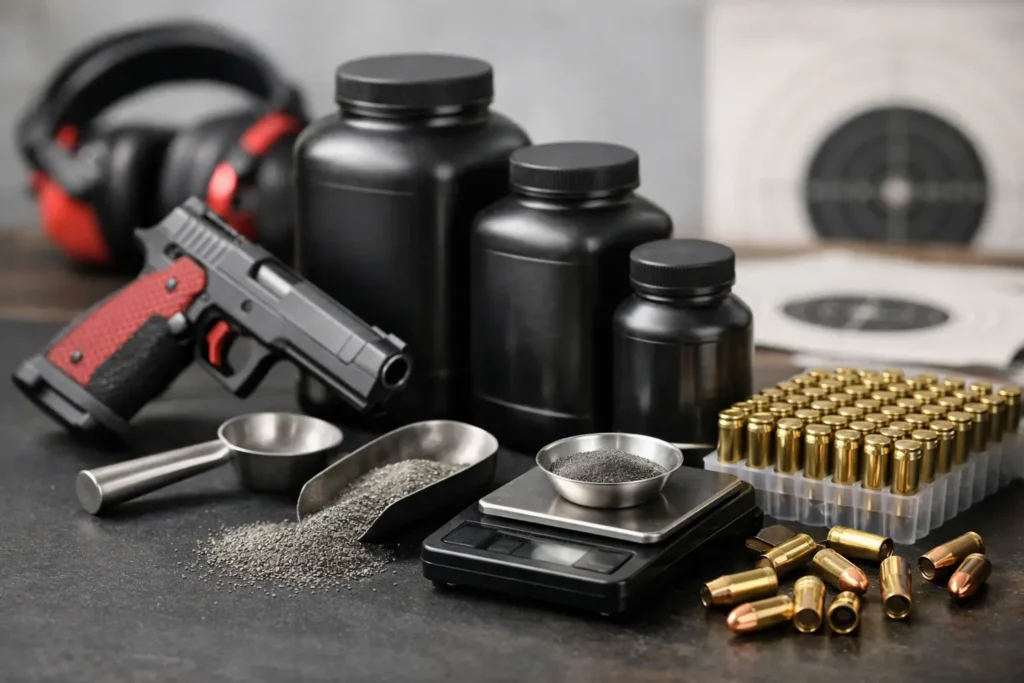
When a load looks perfect on paper but feels slow leaving the gun, most competitors know where to look next. The top pistol powders for competition are not just about velocity or clean burn. They shape recoil impulse, affect split times, influence sight return, and determine how consistent your ammo stays across a long practice cycle or a major match.
For serious pistol reloaders, powder choice is less about chasing a single “best” option and more about matching burn rate and charge behavior to the cartridge, bullet weight, power factor, and shooting style. USPSA, IPSC, Steel Challenge, and action-oriented club matches all place slightly different demands on your ammunition. A powder that feels excellent in a soft-shooting 9mm minor load may not be the right answer for .40 S&W major, and a powder that meters beautifully on a progressive press may still fall short if the recoil signature does not track with your gun setup.
What matters most in competition powder selection
Competitive pistol ammo lives or dies on consistency. Extreme spreads matter, but so does practical consistency – how uniformly a powder meters, how steadily it ignites with your chosen primer, and how predictably it performs when your loading session runs into the thousands.
Burn rate is the first filter. Faster powders often support lighter charges, lower cost per round, and a snappy but efficient impulse. Slower powders can provide a flatter push, especially in major-caliber applications, and sometimes produce a more forgiving pressure curve with heavier bullets. Neither is automatically better. The right answer depends on what you need the gun to do under speed.
Metering is the second filter, especially for high-volume reloaders. Fine spherical powders usually meter with excellent uniformity through most powder measures. Large flake powders can still produce excellent ammunition, but they may require more attention if you are trying to hold very tight charge-to-charge variation on a progressive setup.
Then there is cleanliness. Competitive shooters sometimes overrate it, but only to a point. A powder does not need to leave your pistol spotless to be a strong match choice. It does need to avoid excessive residue that can affect function over long stages, practice days, or major round counts between cleanings.
Top pistol powders for competition by use case
Hodgdon Titegroup
Titegroup remains one of the most common competition powders for a reason. It is dense, economical, and well suited to 9mm, .38 Super, .40 S&W, and other common pistol cartridges. It meters very well, produces reliable performance with relatively small charge weights, and has long been a standard for shooters building efficient minor power factor loads.
Its main trade-off is feel. In many setups, Titegroup delivers a sharper recoil impulse than some slower alternatives. That is not a flaw so much as a characteristic. Some shooters like the fast return and direct response. Others prefer a softer push, especially in tuned competition guns.
Winchester 231 and Hodgdon HP-38
These two are effectively the same powder under different labels, and both remain strong choices for practical pistol loading. They offer broad versatility, solid metering, and a burn rate that works well across a range of standard-pressure and moderate competition loads.
For shooters who want proven performance without chasing an exotic setup, 231 and HP-38 are easy to take seriously. They tend to produce predictable ammo and are especially useful for competitors loading 9mm minor or .38 Special target ammunition. Compared with very fast powders, they can feel a bit more balanced in some guns.
Alliant Sport Pistol
Sport Pistol earned attention quickly because it checks several boxes that matter in match ammo. It meters well, supports clean-burning performance, and often delivers very good consistency in 9mm competition applications. Many shooters also report favorable recoil characteristics compared with some older fast-burning standards.
This is one of the better modern options for competitors who want efficiency without giving up practical shootability. If your goal is a clean-running 9mm load for regular match use, Sport Pistol deserves a close look.
Vihtavuori N320
N320 has a strong reputation in competition circles for good reason. It is clean, consistent, and especially well liked by shooters who prioritize refined recoil behavior and premium-grade lot-to-lot performance. In 9mm, .40 S&W, and .45 ACP target or match loads, it has long been considered a serious powder for serious use.
The trade-off is straightforward: cost and availability can be less forgiving than more common domestic options. For the reloader who wants top-tier consistency and is willing to pay for it, N320 often justifies its reputation.
Vihtavuori N330
If N320 feels a little too fast or sharp for your setup, N330 may be the better fit. It is slightly slower and can produce a smoother impulse in some applications, particularly with heavier bullets or loads tuned closer to major thresholds.
This is not automatically the better powder, but it is often the better-feeling one in guns built around recoil management rather than minimum charge economy. Shooters tuning compensated or optimized pistols sometimes prefer this part of the burn-rate range.
Accurate No. 2 and No. 5
Accurate No. 2 is a classic fast-burning option that meters extremely well and works nicely in many minor-power-factor loads. It is efficient and capable of excellent consistency when matched properly to the cartridge.
Accurate No. 5 moves slower and broadens the use case. It is often considered for shooters who want a softer recoil pulse or more flexibility in cartridges that respond well to a slightly slower powder. If No. 2 feels abrupt in your pistol, No. 5 may be worth testing.
Ramshot Competition and Silhouette
Ramshot Competition is designed with action shooting in mind and has built a following among shooters who want fine metering and dependable performance in target and competition ammunition. It sits in a useful burn-rate window for many common pistol applications.
Silhouette brings a different profile. It is often favored when shooters want strong metering and solid performance in higher-pressure semi-auto loads. Depending on the cartridge and bullet, it can be a very practical option for competitors who want a bit more gas volume and a different recoil texture.
Matching powder to your division and setup
9mm minor
This is where the field gets crowded. Titegroup, Sport Pistol, N320, 231, HP-38, and Accurate No. 2 all make sense depending on what matters most to you. If cost per round and metering are top priorities, the faster dense powders are hard to ignore. If recoil feel and cleanliness matter more, N320 and Sport Pistol tend to stand out.
.40 S&W major
The conversation changes here. Power factor margin, chamber support, pressure behavior, and recoil management all become more critical. Many shooters move toward powders that offer a smoother push and more forgiving performance window with the bullet weights they run. N320 can still work, but slightly slower choices like N330, Accurate No. 5, or Silhouette may fit better depending on the gun.
.38 Super and 9mm major-style applications
This is the area where powder selection becomes highly setup-specific. Gas generation, compensator efficiency, pressure characteristics, and reliable function all matter. Not every powder listed above is appropriate for these specialized loads, and published data is not optional. In tuned race guns, many shooters prefer powders that support the compensator and maintain stable performance across long strings.
How to test top pistol powders for competition the right way
The smartest way to compare powders is to stop chasing opinions and start recording what your pistol actually does. Load small batches with published data, hold bullet and primer choice constant, and test over a chronograph. Then pay attention to what the timer and your sights tell you.
A powder that gives you a perfect standard deviation but returns the dot poorly may not be your best match powder. On the other hand, a load that feels excellent but leaves too little power factor margin is a gamble you do not want to take to a sanctioned match. Reliable ignition, legal velocity, and repeatable handling all need to line up.
It also helps to test under realistic conditions. Match ammo should function when the gun is dirty, when the weather shifts, and when you are shooting fast instead of slow-fire groups. The art of reloading, perfected, comes from repeatable performance rather than one good string on a calm day.
The real answer is usually two powders, not one
Most experienced competitors settle on more than one good option. They may keep an economical powder for practice-volume 9mm and a premium powder for major matches. They may also maintain a backup choice in case availability changes. That approach is practical, especially for reloaders who value trusted brands and consistent access to proven components.
If you are narrowing the field, start with your cartridge and power factor, then choose between efficiency, recoil feel, and metering performance. The top pistol powders for competition all earn their place for different reasons. The right one is the powder that makes your gun track predictably, your ammo chrono reliably, and your loading process stay consistent from the first hundred rounds to the last box before match day.
A good competition load should disappear in use – no surprises on the press, no surprises on the chrono, and no surprises when the buzzer goes off.