
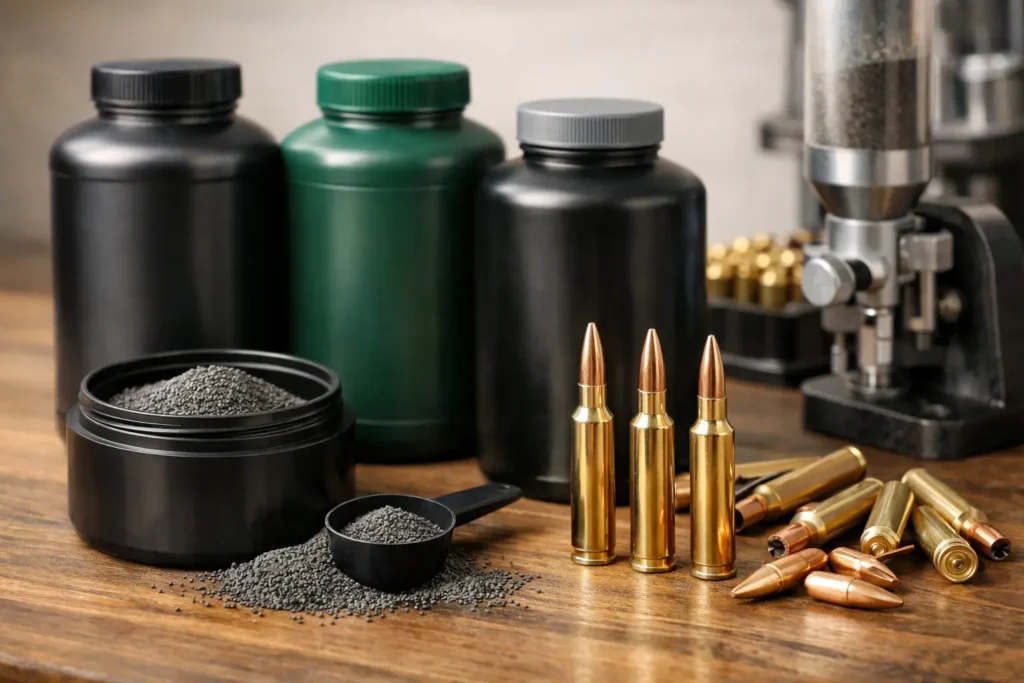
A .308 load that groups tight in one rifle can turn ordinary fast when the powder is wrong for the bullet, barrel, or job. That is why reloaders keep coming back to the same question: what are the best powders for 308 reloads when you want consistent velocity, stable ignition, and field-ready accuracy?
The short answer is that there is no single best powder for every .308 Winchester load. There are, however, a handful of proven performers that keep showing up on serious benches for good reason. Case fill, burn rate, metering, temperature behavior, and bullet weight all matter, and .308 is flexible enough that a powder can be excellent in one role and merely acceptable in another.
What makes the best powders for 308 reloads
The .308 Winchester rewards powders that sit in the middle burn-rate range and produce efficient pressure with 150 to 175 grain bullets. That usually points reloaders toward classic extruded rifle powders and a few well-chosen spherical options. The best choice often comes down to how you use the rifle.
If your priority is precision with 168 or 175 grain match bullets, you will usually lean toward powders known for low extreme spreads and predictable node behavior. If you load for deer season with 150 or 165 grain hunting bullets, you may care more about broad accuracy, clean burn, and stable field performance across changing temperatures. If you run a gas gun and load in volume, metering and production speed become more important.
A good .308 powder should also deliver practical load density. Powders that fill the case well tend to be easier to work with and often produce more consistent ignition than very light charges in a roomy case. That does not mean compressed loads are automatically better, but it does mean .308 tends to perform best with powders that feel like they belong there.
Best powders for 308 reloads by use case
Varget
Varget remains one of the first names mentioned in serious .308 discussions because it has earned that position. It performs exceptionally well with 155, 168, and 175 grain bullets, and it has a long track record in both bolt guns and semi-autos. Accuracy is often excellent, and its temperature stability is one of the reasons precision shooters trust it.
The trade-off is familiar. Varget does not meter as smoothly as fine spherical powders, and availability can be inconsistent when demand spikes. Still, if your priority is match-grade consistency, it is hard to leave Varget off the short list.
IMR 4064
IMR 4064 is another classic .308 performer, especially with 168 and 175 grain bullets. Many reloaders have found excellent accuracy with it in traditional bolt rifles, and it has the kind of reputation that only comes from years of repeatable results. When a powder keeps delivering tight groups across many rifles, it stays relevant.
Its weakness is convenience. IMR 4064 is a long-cut extruded powder, so it can be slower and less pleasant to meter through some powder measures. If you hand trickle for precision loads, that may not matter. If you are trying to turn out larger batches, it probably will.
Hodgdon H4895
H4895 is one of the most versatile powders in the .308 family. It works well across a broad range of bullet weights and tends to produce reliable, balanced performance without being overly finicky. It is often a smart choice for shooters who want one powder that can cover practice, hunting, and general-purpose rifle work.
It also has a reputation for forgiving load development. That does not replace proper testing, but it does make H4895 appealing if you are tuning a rifle that sees multiple bullet types. In many rifles, it offers an excellent middle ground between precision potential and practical flexibility.
IMR 4895
IMR 4895 deserves separate mention because it has deep roots in service rifle and .308-class loading. It performs particularly well with traditional bullet weights and is still a strong option for M1A, AR-10, and similar gas-gun applications where pressure curve matters as much as top-end speed.
Compared with some newer powders, IMR 4895 may not always be the first choice for shooters chasing the smallest possible velocity variation. But for dependable function and solid all-around .308 performance, it remains a serious contender.
Reloder 15
Reloder 15 has long been associated with accurate .308 match ammunition, especially in the 168 to 175 grain range. It can produce very strong accuracy and useful velocity, and many precision reloaders still regard it as one of the best-performing powders in this cartridge.
Where it gets more situational is temperature behavior. Some shooters report more sensitivity than they want when conditions shift from summer range work to late-season hunting or winter steel. If your shooting is done in a fairly narrow temperature window, that may be a minor concern. If your rifle has to perform across seasons, it deserves more attention.
Winchester 748
Winchester 748 is a practical choice for 147 to 150 grain bullets and for reloaders who value metering efficiency. As a spherical powder, it runs smoothly through measures and supports higher-volume loading better than many stick powders. For bulk .308 or general-purpose semi-auto ammunition, that can be a real advantage.
Its performance ceiling for precision work may not match the top extruded powders in every rifle, and some loads can be more temperature sensitive. But when you want respectable accuracy, clean workflow, and dependable production speed, W748 makes sense.
CFE 223
CFE 223 has become popular for shooters who want good velocity and easy metering in .308, especially with lighter to midweight bullets. It can be a strong fit for high-volume loading and modern sporting rifles, and it often gives a bit of speed without demanding much from your loading process.
Like other spherical powders, it should be evaluated carefully for your rifle and your climate. Some rifles shoot it extremely well. Others prefer a more traditional extruded option. That is the recurring theme with .308 – good powders are common, but the right powder is still rifle-specific.
Vihtavuori N140 and N150
For reloaders who prioritize consistency and refined lot-to-lot performance, Vihtavuori powders deserve attention. N140 is especially well suited to standard .308 bullet weights and often delivers excellent accuracy. N150 can be attractive with heavier bullets or longer barrels where a slightly slower burn rate helps.
These powders are often chosen by shooters who are willing to pay for predictability. They are not always the cheapest route to a good .308 load, but they can be among the most satisfying when precision is the goal.
Matching powder to bullet weight
With 147 to 150 grain bullets, W748, CFE 223, H4895, and Varget all make sense depending on whether you value speed, metering, or tighter precision. For 165 to 168 grain bullets, .308 often hits its comfort zone, and this is where Varget, IMR 4064, Reloder 15, H4895, and N140 tend to shine.
Once you move into 175 grain bullets, many reloaders favor Varget, IMR 4064, Reloder 15, and N150 because they support the pressure curve and consistency needed for longer-range performance. That said, barrel length and chamber dimensions can shift the picture. A powder that looks ideal on paper still needs to prove itself on target and over the chronograph.
Bolt gun or gas gun changes the answer
In a bolt rifle, you can often focus more narrowly on extreme spread, group size, and where the rifle finds its accuracy node. In a gas gun, function becomes part of the equation. Powders that are excellent in a bolt gun may still work in a semi-auto, but port pressure and cycling behavior matter.
That is why IMR 4895, H4895, Varget, and similar powders remain strong choices for service-style rifles and AR-10 platforms. They have a long history of balancing accuracy with reliable operation. If your .308 is a semi-auto, do not choose powder by group size alone.
A practical way to choose
If you want one safe starting point for a precision-minded .308 load, start by looking at Varget or H4895. If you prefer a more traditional classic and do not mind slower metering, IMR 4064 is still hard to beat. If you load in volume and want smoother measure performance, W748 or CFE 223 may fit your bench better.
The smartest move is to narrow your selection to two or three powders that match your bullet weight and rifle type, then test them properly. Use published data, keep your brass and primers consistent, and evaluate more than just group size. Velocity spread, pressure signs, and real-world reliability tell the full story.
Powder choice in .308 is less about chasing a magic name and more about matching the powder to the job. The art of reloading is perfected in small decisions, and this is one of the biggest ones. When the powder fits the bullet, the rifle, and the way you actually shoot, the load usually tells you quickly.