
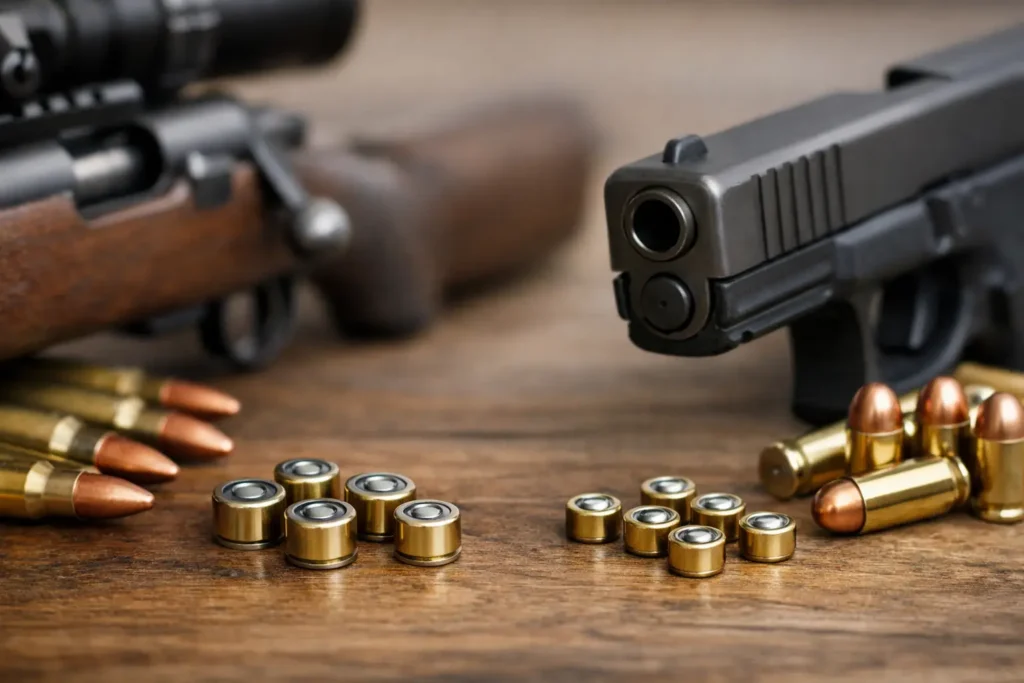
A primer may be the smallest component on your bench, but it has an outsized effect on whether a load fires consistently and safely. The question of rifle primers versus pistol primers is not simply about diameter or what happens to be available. Primer design must match the cartridge, firearm, pressure range, and published load data.
For experienced reloaders, this distinction is fundamental. For those building their component inventory, it is one of the easiest places to make an expensive – and potentially unsafe – assumption. Reliable ignition, every time, begins with using the primer specified for the load.
Rifle Primers Versus Pistol Primers: The Core Difference
Rifle and pistol primers are engineered for different operating conditions. Although both create the initial flame that ignites the powder charge, they are not interchangeable categories. The major differences involve cup construction, sensitivity, dimensions, and ignition characteristics.
Rifle primers generally use a harder, thicker cup than pistol primers. This is especially relevant in rifles with firing systems that can leave a light mark on the primer as the bolt closes. A firmer cup helps reduce the risk of an unintended discharge from a free-floating firing pin while still providing dependable ignition when struck by the firing pin under normal operation.
Pistol primers usually have thinner, more sensitive cups. Most handguns use shorter, lighter firing-pin strikes than centerfire rifles, so the primer must be designed to respond reliably within that system. A pistol primer may ignite readily in a handgun but can be a poor fit for a rifle action, even when its diameter appears similar.
The practical rule is straightforward: select the primer type called for in current, published load data for your exact cartridge and components. Do not treat small rifle and small pistol, or large rifle and large pistol, as substitutes based on name or appearance.
Cup Strength Matters More Than It Looks
Primer cup strength is one of the most meaningful distinctions between these component classes. Rifle cartridges often operate at substantially higher pressures than handgun cartridges, and rifle primer cups are built with those conditions in mind. Their construction is intended to withstand firing, chamber pressure, and extraction without excessive deformation or leakage when used in an appropriate load.
A pistol primer installed in a rifle cartridge can create problems beyond simple ignition reliability. Its softer cup may be more vulnerable to piercing, flattening, or other signs of stress in a cartridge and firearm system designed around a rifle primer. That can affect shooter safety, action cleanliness, and case inspection.
The reverse substitution has its own risks. A rifle primer’s harder cup may not fire reliably in a handgun with a lighter strike. A click instead of a shot is not merely inconvenient during a match, a hunt, or a training session. It can complicate safe range handling and undermine confidence in the ammunition.
Cup thickness is not identical across all manufacturers or primer lines, either. Product-specific construction varies, which is one reason brand changes should be handled with the same discipline as any other component change. A reliable reloading practice includes working from tested data and observing the results carefully rather than assuming every primer with the same size label behaves the same way.
Size Labels Do Not Make Primers Interchangeable
The terms small and large refer to primer pocket diameter, but the label does not authorize cross-category substitution. Small rifle and small pistol primers are close enough in general size that they can be confused, while large rifle and large pistol primers have different dimensions that typically prevent an improper fit.
That difference in fit is a useful safeguard, not a reason to force anything. Primers should seat correctly in clean, properly prepared primer pockets. A primer that will not seat normally, sits proud of the case head, or feels wrong during the seating process deserves immediate attention. Stop and identify the component, brass, and tooling issue before proceeding.
Small rifle and small pistol primers demand particular care because visual confirmation alone is not enough. Keep primer packaging on the bench, label loading blocks, and return unused primers to their original packaging. Mixing trays, loose primers, or partially labeled containers creates avoidable uncertainty at the exact stage where component control matters most.
Ignition Characteristics and Powder Charges
Primer selection also affects how a powder charge begins to burn. The primer’s flame and brisance influence ignition, especially in cartridges using larger powder charges, slower-burning propellants, or conditions where consistent ignition is harder to achieve. This does not mean a hotter primer is automatically better. It means the primer is part of the tested load combination.
Standard rifle primers are commonly specified for many centerfire rifle cartridges. Magnum rifle primers are designed to provide a more energetic ignition event for applications where published data calls for them, often involving larger-capacity cases or specific powder types. Standard and magnum pistol primers follow the same general principle within handgun cartridges.
Changing from standard to magnum, from magnum to standard, or from one primer brand to another can alter pressure and velocity. The effect may be modest in one load and meaningful in another. Temperature, powder type, case capacity, bullet seating depth, and firearm configuration all influence the outcome.
That is why a primer change should never be treated as a minor inventory substitution. Use current manufacturer data that names the appropriate primer class. If a component change is necessary, reduce the load appropriately within the limits of trusted data and work up carefully while monitoring for pressure indicators. Never exceed published maximums.
Choosing the Right Primer for Your Cartridge
The correct choice begins with the cartridge specification, not with a general preference for a brand or a desire to use what is already on hand. Check your reloading manual or powder manufacturer data for the exact cartridge, bullet weight, powder, and primer type. Then match that information to the headstamp and primer pocket in the brass you are preparing.
For a typical centerfire rifle load, use the specified small rifle or large rifle primer. For a handgun load, use the specified small pistol or large pistol primer. If the data calls for a magnum version, use that category rather than assuming a standard primer will provide equivalent results.
There are specialized exceptions, including cartridges that may use small rifle primers in certain brass configurations or competitive handgun loads where experienced reloaders use particular components under published data. These are not casual substitutions. They require compatible brass, suitable firearm ignition, and carefully developed load data. The cartridge case and tested recipe remain the authority.
Inspection Is Part of Primer Selection
Primer selection does not end when the box is opened. Before loading, inspect brass for the correct primer pocket size, signs of loose pockets, excessive crimp residue, corrosion, or case damage. A primer pocket that no longer holds a primer securely is not a problem to solve with extra seating force or a different primer type. It is a reason to remove that case from service.
After firing, inspect primers as part of your normal case evaluation. Primer appearance can offer useful context, but it should never be read in isolation as a precise pressure gauge. Flattening, cratering, piercing, leakage, and difficult extraction must be evaluated alongside the load data, firearm, brass condition, and chronograph results where available.
Consistency comes from controlling the full system. Quality brass preparation, verified powder charges, correct bullet seating, trusted data, and the proper primer all work together. A premium primer cannot compensate for a poorly controlled process, but the wrong primer can compromise a carefully assembled load.
Stock the Primer Types You Actually Use
For reloaders who work across rifle and handgun cartridges, organized inventory is more than a convenience. Separate small rifle, large rifle, small pistol, large pistol, and magnum variants clearly. Purchase enough of a proven primer lot to support a meaningful run of your established load when supply permits, then record lot numbers and performance notes in your load log.
Lee Reloading Canada focuses on the components serious reloaders look for when dependable ignition and repeatable results matter. Whether you are preparing hunting ammunition, match loads, or high-volume practice rounds, component authenticity and clear primer selection protect the work you put into every cartridge.
The best primer is not the hottest, hardest, or easiest one to find. It is the exact primer your tested load calls for, seated correctly in sound brass and fired from a compatible platform. Keep that standard at the bench, and your loads start with the consistency they need to perform downrange.
