
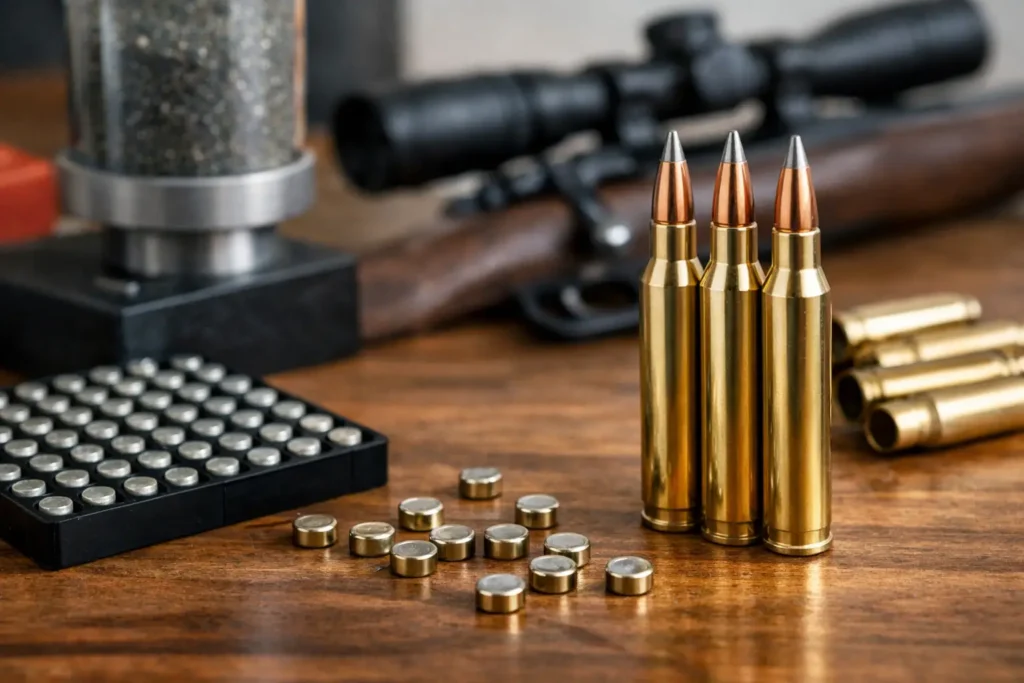
A load that groups well in mild weather can start acting unpredictable the moment temperatures drop, powder charges get denser, or a slow-burning powder enters the equation. That is usually when reloaders start asking, when should I use magnum primers? The short answer is that magnum primers are meant for situations where you need a hotter, more energetic ignition. The better answer is that they should be used only when your data, powder choice, cartridge, and real-world conditions justify them.
What magnum primers actually do
A magnum primer does not simply make a load “better” or “more powerful.” Its main job is to deliver a hotter and sometimes longer-duration flame to ignite the powder charge more reliably. That extra ignition energy can be useful when the powder is harder to light, when the case has a large powder column, or when environmental conditions work against consistent ignition.
That matters because ignition quality affects more than whether the round fires. It can influence pressure development, velocity spread, and shot-to-shot consistency. In some loads, a magnum primer tightens performance. In others, it raises pressure without improving accuracy at all.
This is why experienced reloaders do not treat primer selection as an afterthought. Primer choice is part of the load, just like powder charge, bullet weight, seating depth, and case prep.
When should I use magnum primers for rifle loads?
The most common place for magnum rifle primers is in magnum rifle cartridges with large case capacity and substantial powder charges. Cartridges such as the .300 Winchester Magnum, 7mm Remington Magnum, and .338 Winchester Magnum often use slow-burning powders that benefit from stronger ignition. In those combinations, a magnum primer can help light the charge more uniformly from shot to shot.
Slow spherical powders are another classic case. Ball powders can be less forgiving to ignite than many extruded powders, especially in cooler conditions. If your published data specifies a magnum primer with a spherical rifle powder, there is a reason for it. Reliable ignition, every time, starts with following the recipe that was pressure-tested for that exact combination.
Cold weather is where magnum primers often earn their keep. A hunting load that performs in summer range conditions may not ignite with the same consistency in late-season temperatures. If the load uses a slow powder or a large case, the stronger ignition of a magnum primer can reduce hesitation, improve burn consistency, and limit velocity swings.
That said, not every large rifle cartridge needs one. A .30-06 with the right standard primer and an appropriate powder can perform beautifully. A .308 Winchester loaded with a medium-burn extruded powder often gains nothing from a magnum primer. Bigger case volume and slower powder can point you toward magnum primers, but they do not automatically require them.
When should I use magnum primers for pistol loads?
Magnum pistol primers are typically used for magnum revolver cartridges and heavy charges of slower pistol powders. Think .357 Magnum, .44 Magnum, or .454 Casull with powders that are designed around higher-pressure, high-performance handgun loads. In that role, the hotter primer helps establish a cleaner and more uniform powder burn.
This is especially relevant with powders such as H110 and Winchester 296, where published data frequently calls for magnum pistol primers. Those powders are known for best performance near the upper end of their intended charge range, and primer strength is part of that system.
Where reloaders get into trouble is assuming a magnum pistol primer is an upgrade for any handgun cartridge. It is not. In many standard-pressure pistol rounds, including 9mm, .38 Special, or .45 ACP, switching to a magnum primer can increase pressure and change performance without offering any practical benefit. If your load data specifies a standard primer, stay with it unless you are working from tested data that says otherwise.
Powder type matters as much as cartridge type
If there is one variable that drives primer choice more than people expect, it is powder behavior. Extruded stick powders often ignite readily with standard primers, depending on burn rate and case design. Spherical or ball powders can be more resistant, and that is where magnum primers often show a clear advantage.
This is why two loads in the same cartridge may want different primers. One .223 Remington load using an easy-to-ignite powder may run perfectly with a standard small rifle primer. Another load using a denser spherical powder may produce better consistency with a magnum or hotter small rifle primer, but only if the data supports it.
Primer selection should always be tied to the exact powder, not just the headstamp on the case.
The pressure trade-off you cannot ignore
The extra ignition energy from a magnum primer can raise chamber pressure. Sometimes the increase is modest. Sometimes it is meaningful enough to flatten primers, alter bolt lift, or push a previously safe load into a pressure range you do not want.
That is why primer substitutions deserve the same caution as powder substitutions. If you move from a standard primer to a magnum primer, you are changing a critical component. Even when every other part of the load stays the same, the internal ballistics can shift.
For practical purposes, that means you should reduce and work back up whenever changing primer type, especially in loads already operating near the upper end. Chronograph data can be very useful here. A surprising jump in velocity after a primer change is often your first clue that the load is behaving differently.
Signs magnum primers may help
There are situations where magnum primers make technical sense, even before you open a manual. If you are loading a large-capacity magnum cartridge, using a slow-burning powder, shooting in freezing conditions, or working with a spherical powder known to prefer stronger ignition, a magnum primer is worth expecting in published data.
You may also see practical indicators during testing. Wide extreme spreads, occasional weak-sounding ignition, excess unburned powder, or inconsistent velocities in cold temperatures can all point to an ignition issue. That does not automatically mean you should switch primers, but it does mean the load deserves a closer look.
The answer still comes back to tested data. Good load development is not about guessing what sounds stronger. It is about matching components that have been shown to work together safely.
When not to use magnum primers
Magnum primers are usually the wrong choice when the load data calls for standard primers and the cartridge uses moderate charges of easily ignited powder. They can also be unnecessary in precision-oriented rifle loads where a standard primer produces lower velocity spread and better accuracy.
Some reloaders assume more flame equals more consistency. In reality, too much primer can disturb the initial powder burn, particularly in smaller cases or lighter charges. In those setups, the hotter primer may make the load less consistent instead of more.
This is one reason benchrest and precision shooters often test primer options carefully rather than defaulting to the hottest one available. The art of reloading, perfected, depends on matching ignition strength to the job instead of overshooting it.
A safer way to make the decision
If you are evaluating when should I use magnum primers, start with published load data from the powder manufacturer or a current manual. Look at the exact cartridge, bullet weight, powder, and primer specification. If the recipe calls for magnum primers, use them. If it calls for standard primers, do not improvise unless you are prepared to reduce and rework the load carefully.
Then consider your use case. A summer target load and a late-season hunting load may not have the same ignition demands. If you are loading for field reliability in harsh weather, component choice should reflect that. If you are loading for tight groups at controlled temperatures, your best primer may be the one that gives the lowest spread, not the hottest flame.
For reloaders buying components online, this is where product discipline matters. Choose primers by application, not by availability alone. If you do need magnum primers, source the exact class your data requires and keep your load records current when supply conditions force a change.
Lee Reloading Canada serves a lot of shooters who already know this firsthand: component consistency is not a luxury in reloading. It is part of safe, repeatable performance.
The bottom line on magnum primer use
Use magnum primers when the cartridge, powder, weather, and published data point in that direction. That usually means large-capacity rifle rounds, slower powders, many spherical powders, magnum handgun cartridges, and cold-weather applications where ignition reliability matters. Do not use them as a blanket substitute for standard primers, and do not assume they improve every load.
The right primer is the one that gives your load safe pressure, consistent ignition, and dependable field performance. If there is any doubt, let the data make the decision, then confirm it on the bench before you trust it in the field.