
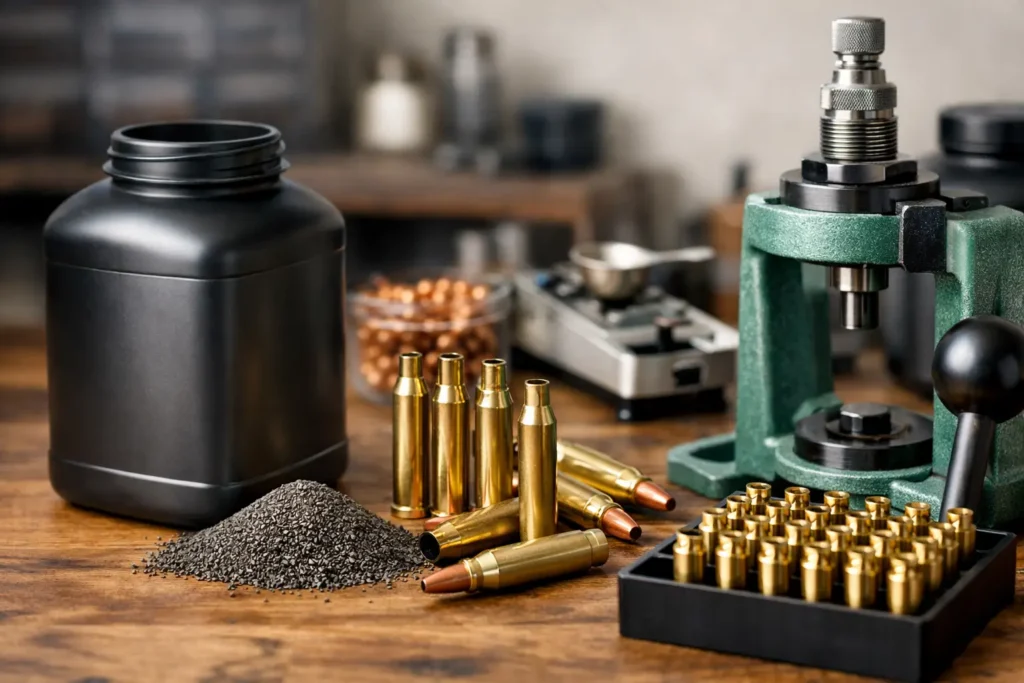
A useful Shooters World powder review starts with a practical question: does a particular powder match the cartridge, firearm, and shooting job you actually have? For reloaders who want dependable ignition, clean function, and repeatable velocity, Shooters World has earned attention by offering a broad smokeless-powder lineup that covers common rifle, pistol, and specialized applications. The value is not that one label solves every loading problem. It is that the line gives careful handloaders several legitimate options when burn rate, metering behavior, and published data align.
What Shooters World Powder Brings to the Bench
Shooters World powders appeal to reloaders looking for purpose-built choices instead of vague, one-size-fits-all positioning. The catalog includes powders aimed at high-volume pistol ammunition, intermediate rifle cartridges, precision-oriented rifle loads, magnum rifle applications, and specialty uses. That range matters when component availability is uneven and a reloader needs alternatives without compromising on safe, data-supported selection.
The brand is often discussed in terms of value, availability, and practical performance. Those are valid strengths, but they should be viewed through a more demanding lens: how consistently does the powder measure, how well does it fit the published pressure and velocity window for the cartridge, and how reliably does it perform in the intended firearm? A powder that is excellent for a progressive press and recreational pistol shooting may not be the right choice for a bolt rifle built around small extreme spreads. Likewise, a powder that performs well near a rifle cartridge’s useful operating range may not be appropriate for reduced loads.
Shooters World offers enough variety that the product name and published application matter. Similar-looking powders or powders with nearby burn rates are not interchangeable.
Shooters World Powder Review: Performance Factors That Matter
Metering and load-to-load uniformity
For many reloaders, metering is where powder quality becomes visible. Fine-grained spherical or ball-style powders often flow smoothly through volumetric measures, which can be especially attractive for bulk pistol ammunition and semi-automatic rifle cartridges. Consistent throws reduce production interruptions and make it easier to maintain a controlled loading process.
That does not mean every application should be judged by speed at the press. Extruded powders can offer excellent performance in cartridges where case fill, temperature behavior, and velocity consistency matter more than rapid metering. The correct approach is to assess the specific Shooters World product, not make a blanket judgment about the brand.
Even with a powder that meters well, verify charges during setup and throughout a loading session. Powder measure settings can drift, bridging can occur, and a small variation may matter greatly in cartridges with narrow pressure margins. A smooth powder drop is a convenience, not a substitute for disciplined quality control.
Burn-rate fit is more important than brand loyalty
The most reliable way to select any Shooters World powder is to start with current, manufacturer-published load data for the exact cartridge and bullet weight you intend to use. Burn-rate charts can help identify a general neighborhood, but they are not loading data and do not establish safe substitutions.
A faster powder may suit lower-capacity pistol cartridges or certain compact rifle applications, while a slower powder may be a better fit for larger rifle cases and heavier bullets. That broad principle is useful, but it never replaces tested data. Case capacity, bullet construction, seating depth, primer choice, barrel length, and chamber dimensions all affect results.
This is also where experienced reloaders avoid a common mistake: choosing a powder solely because it is said to be similar to another product. Similar burn rate does not mean identical density, energy, pressure curve, or charge weight. Use the data listed for the actual Shooters World powder on the bench.
Cleanliness and firearm function
Clean-burning performance is often mentioned in user feedback, particularly by shooters who load substantial quantities for range use. In practice, cleanliness is affected by more than the powder. Operating pressure, charge level, bullet type, firearm action, suppressor use, and lubricant all influence residue and fouling.
A powder that leaves acceptable residue in one handgun can feel noticeably dirtier in another firearm with a different action cycle or gas system. The better benchmark is functional reliability over a meaningful firing session. Watch for consistent cycling, normal ejection, stable point of impact, and no unusual pressure indicators. Those results tell you more than a single impression after a short string.
Temperature and lot awareness
Hunters and precision rifle shooters should pay close attention to temperature behavior. Ammunition developed in mild conditions can produce different velocities and pressure signs in severe heat or cold. Some Shooters World products may be strong candidates for a given rifle setup, but field validation is still the reloader’s responsibility.
Lot-to-lot variation deserves the same respect. When opening a new container, do not assume the established charge will perform exactly like the previous lot. Confirm it with current published data and a careful work-up. Record the powder name, lot number, primer, case, bullet, cartridge overall length, and test conditions. That documentation turns a promising load into a repeatable process.
Where Shooters World Powders Can Make Sense
Shooters World is particularly worth considering when you need a powder that aligns with a defined use case and published data is available for your components. High-volume handgun reloaders may prioritize smooth metering and reliable cycling. AR-pattern rifle shooters may focus on consistency through a powder measure, gas-system function, and practical accuracy. Bolt-rifle shooters may put greater weight on velocity consistency and performance across expected field temperatures.
The brand can also be a sensible option for reloaders who are willing to test alternatives methodically rather than waiting indefinitely for one familiar product. Component shortages have made flexibility valuable, but flexibility must stay inside the boundaries of verified data. A new powder is an opportunity to develop a sound load, not a reason to transfer a favorite charge from another propellant.
For shoppers comparing options, begin with the cartridge and bullet combination, then check current data availability. Next, consider the intended firing volume, the type of powder measure you use, expected weather conditions, and whether your priority is bulk production, match consistency, or hunting reliability. That order prevents impulse buying and keeps the purchase connected to the actual job.
Trade-Offs to Consider Before Buying
No powder line is universally best. Shooters World powders may offer a strong fit for some cartridges while another manufacturer has more extensive historical data, a preferred temperature reputation, or a product better matched to a specific niche. Reloaders with long-established loads may reasonably choose continuity, particularly before a major match or hunting trip.
Availability can also influence the decision, but it should not become the only decision. If the powder in stock has no current published data for your exact application, it is not the right substitute. The same standard applies when a powder appears close on a burn-rate chart but lacks tested data for the bullet weight or cartridge configuration being loaded.
Storage and purchase quantity deserve thought as well. Buy an amount that makes sense for your verified load development and expected shooting schedule, then store it in its original labeled container according to applicable safety requirements. Never mix powders, never relabel an unknown container, and keep powder away from heat, open flame, and incompatible materials.
A Better Way to Evaluate Your First Container
Treat the first container as a controlled evaluation. Select one cartridge application, consult current manufacturer data, and begin at the published starting charge. Work up carefully while checking velocity, accuracy, function, and normal pressure behavior. Change one variable at a time when possible. If you alter the bullet, primer, case brand, seating depth, or powder lot, treat that change with appropriate caution.
Chronograph data can be valuable, but it is only part of the picture. A load with an impressive average velocity is not automatically the best load if it produces poor groups, inconsistent cycling, or unwanted pressure signs. The goal is balanced field performance: safe operation, reliable ignition, usable accuracy, and results that repeat when conditions change.
Shooters World powder is best judged the same way any serious reloading component should be judged – by its fit in a carefully documented load, not by its name on the container. Start with current data, test with discipline, and let your rifle, pistol, or shotgun tell you whether that powder has earned a permanent place on your bench.
