
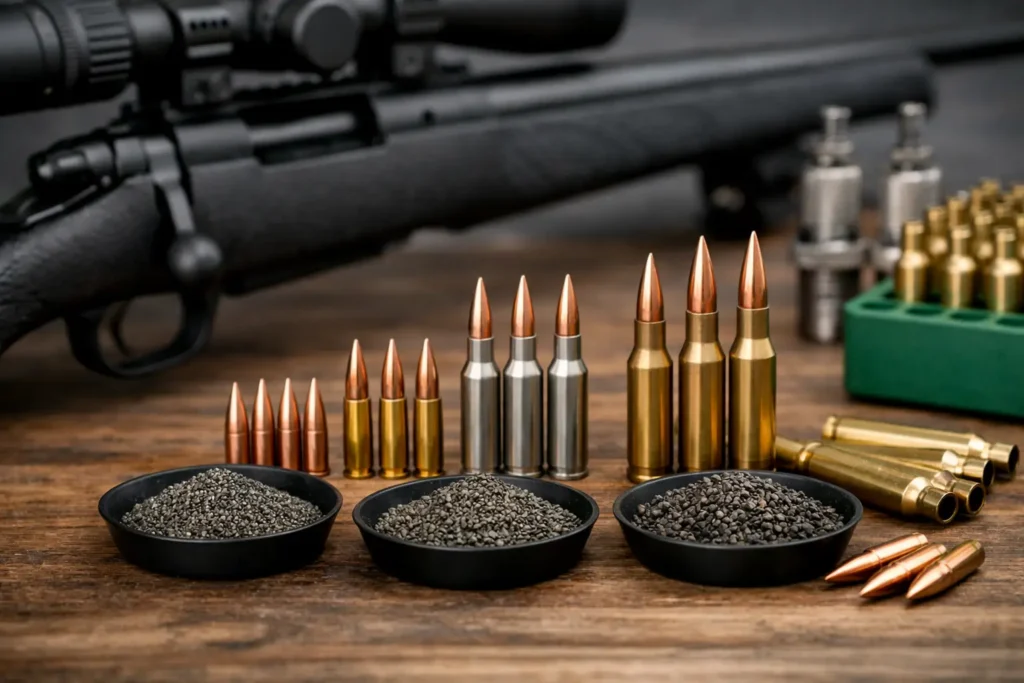
A load that groups beautifully with a 55 grain bullet can turn erratic, dirty, or overpressure when you move to 69 or 77 grains. That is why a rifle powder guide by bullet weight matters. Bullet mass changes how quickly pressure builds, how long the bullet stays in the bore, and which powders produce the most consistent velocity and accuracy in a given cartridge.
For experienced reloaders, bullet weight is not the only variable, but it is one of the fastest ways to narrow the field. If you are choosing between multiple proven powders for the same cartridge, bullet weight often tells you whether to start with a faster powder, a medium burn rate option, or a slower powder that better supports heavier projectiles.
Why bullet weight changes powder choice
As bullet weight increases within the same caliber, resistance to movement generally increases as well. Heavier bullets accelerate more slowly, which means pressure can rise differently than it does with lighter bullets. That changes the powder behavior you want inside the case.
Lighter bullets usually perform best with powders that build pressure efficiently without needing excessive dwell time in the bore. Heavier bullets often benefit from powders that maintain pressure over a slightly longer curve. That does not mean every light bullet needs a fast powder or every heavy bullet needs a slow one. Case capacity, barrel length, seating depth, and intended velocity all matter. Still, bullet weight is a reliable first filter.
This is where many reloaders save time. Instead of comparing every powder on the shelf, they match the bullet class to a sensible burn rate range, then confirm data in a current manual from the powder manufacturer or bullet maker.
Rifle powder guide by bullet weight: the practical approach
Think in weight bands, not single bullet numbers. Most rifle cartridges have a light-for-caliber range, a middle range, and a heavy-for-caliber range. Those bands help you identify powders that are more likely to deliver stable ignition, useful case fill, and repeatable field performance.
For light-for-caliber bullets, reloaders often lean toward faster or medium-fast rifle powders. These powders can generate efficient pressure with lighter projectiles and often give excellent performance in shorter barrels or varmint-style loads where flat trajectory matters. If the powder is too slow for the application, you may end up with incomplete burn, more muzzle flash, or velocity spreads that are wider than expected.
For midweight bullets, the sweet spot is often medium burn rate powder. This is where many general-purpose hunting and target loads live. You usually get a good balance of velocity, pressure, and accuracy, and powder selection tends to be broad. In many cartridges, this weight range offers the most forgiving load development.
For heavy-for-caliber bullets, slower powders frequently become more attractive. A heavier bullet can make better use of a powder that maintains pressure longer through the barrel. The result can be more consistent velocity and less abrupt pressure behavior than you might see if you forced the load with a powder that is too fast. In some cartridges, especially larger-capacity cases, the heavier bullet and slower powder combination is where the best long-range performance shows up.
Burn rate is only part of the story
Burn rate charts are useful, but they are not loading recipes. Powders that sit close together on a burn rate chart can behave quite differently depending on cartridge geometry, bullet construction, and primer choice. That matters when you are switching between brands such as Hodgdon, IMR, Winchester, Ramshot, Accurate, Alliant, Vihtavuori, or Shooters World.
Case fill is a major part of the equation. A powder that matches the bullet weight well often provides a practical load density. Too little fill can sometimes contribute to inconsistent ignition, while an overly compressed load may create its own set of variables. Many reloaders prefer combinations that give strong consistency without forcing them to the edge of compression unless the published data clearly supports it.
Barrel length also affects what “best” means. A slower powder may shine with a heavy bullet in a 24 inch barrel but lose some of its advantage in a compact hunting rifle. Likewise, a lighter bullet paired with a medium powder may be ideal in one setup but leave velocity on the table in another. The powder is not good or bad on its own. It is good or bad for a specific bullet weight in a specific rifle.
Common bullet-weight patterns across popular rifle categories
Small-caliber, high-velocity cartridges such as .223 Remington often show the bullet-weight relationship clearly. Light bullets commonly pair well with faster or medium powders that support clean, efficient performance. As bullet weights move into the 69 to 77 grain range, many reloaders shift toward powders that better support heavier match bullets and maintain consistency at distance.
In .308 Winchester, the pattern is similar but broader. Lighter hunting bullets may perform very well with medium burn rate powders, while 168 to 175 grain bullets often favor powders that have long been associated with accurate service rifle and precision loads. Push into heavier bullet classes, and slower options can become more relevant depending on barrel length and application.
Magnum cartridges exaggerate the effect. With rounds like 7mm Remington Magnum or .300 Winchester Magnum, heavy bullets typically reward slower powders because the case capacity is built to use them. Trying to drive heavy bullets with a powder that is too fast can narrow your load window quickly. In these cartridges, proper powder selection by bullet weight is not just about performance. It is a major part of staying within safe pressure limits.
How to use a rifle powder guide by bullet weight safely
Start with the exact cartridge, exact bullet weight, and preferably the exact bullet design listed in a trusted load manual. Then compare powders that fall into the appropriate performance range for that bullet class. If several powders are listed, consider your goal first. A hunting load, a match load, and a high-volume practice load may not point to the same powder even when bullet weight is identical.
Work up in small increments and watch for pressure signs, but do not rely on pressure signs alone as your safety system. Published starting data and careful charge progression matter more. Chronograph data helps too. If a load reaches expected velocity early, that tells you something important even if the brass still looks normal.
Do not forget primer compatibility. Some powder and bullet combinations respond best with a specific primer type, especially in colder conditions or in larger cases. Reliable ignition, every time, is not just a slogan. It is a measurable part of load consistency, particularly when you are using slower rifle powders.
When bullet weight should not drive the decision alone
There are cases where bullet weight is a secondary factor. If you are loading for a gas gun, cycling reliability and port pressure may narrow your powder options before bullet weight does. If you are loading a reduced recoil or reduced velocity load, your powder choice may shift well outside the usual full-power pattern. Copper solids and long-for-weight bullets can also complicate the equation because seating depth and usable case capacity change, even when the scale shows a familiar bullet weight.
Temperature sensitivity is another real-world consideration. Two powders may both fit the same bullet weight range on paper, but one may hold velocity more consistently across hunting season temperature swings. For many reloaders, that difference is worth more than a small gain in top-end speed.
A better way to narrow your powder options
If you want a practical shortlist, begin with three questions. Is the bullet light, middleweight, or heavy for the caliber? Is the rifle built for velocity, precision, or general-purpose field use? And does the powder provide published data with a sensible charge window and good case fill?
That approach keeps the process disciplined. It also reflects how serious reloaders actually shop and test. They are not looking for random experimentation. They are looking for proven combinations that balance safety, accuracy, and repeatable field performance.
For component buyers, availability matters too. A powder that is ideal on paper but impossible to source consistently is hard to build around. That is one reason specialized retailers such as Lee Reloading Canada matter to experienced reloaders who want trusted brands, real inventory, and a straightforward path to keeping proven loads in rotation.
The art of reloading is not picking the fastest powder or the hottest load. It is matching the bullet, cartridge, and powder so the rifle performs the same way when it counts. Start with bullet weight, confirm with published data, and let consistency make the final call.
