
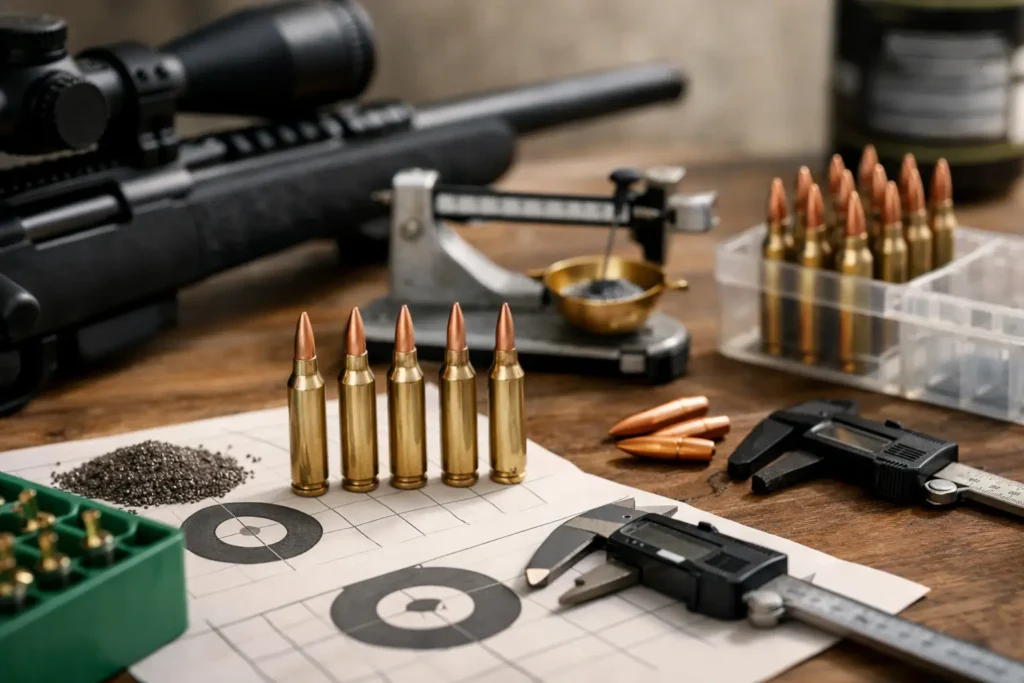
A good .223 handload usually falls apart for ordinary reasons, not mysterious ones. Brass varies more than expected, seating depth gets changed before the powder charge is understood, or a decent group gets mistaken for a true node. This 223 load development example is built around a simple goal – find a safe, repeatable load with components most rifle shooters already understand, then tighten it methodically instead of guessing.
For experienced reloaders, the real value is not the final number on the target. It is the process that gets you there with fewer wasted rounds and fewer false conclusions. A .223 Remington can be forgiving, but it still rewards disciplined testing, especially when you are balancing velocity, accuracy, and dependable ignition across changing temperatures.
What this 223 load development example is trying to do
Let’s use a common setup: a bolt-action .223 Remington with a 1:8 twist barrel, mixed once-fired brass sorted by headstamp, standard small rifle primers, and a 69 grain match bullet. That bullet weight sits in a useful middle ground. It is heavy enough to show what the barrel can really do, but still easy to pair with several proven powders.
The objective here is not to chase maximum speed. It is to build a load that prints consistently, feeds cleanly if needed, and shows stable behavior over a practical round count. For most serious shooters, that is a better end point than squeezing out another 50 fps while the group starts to open.
Powder selection matters because it sets the tone for the whole test. In this example, a medium burn rate rifle powder suited to .223 with 69 grain bullets makes sense. Something in the class reloaders often use for match or general-purpose .223 loads gives enough case fill for consistency without making pressure jumps hard to read. The exact powder can vary based on availability, but the method stays the same.
Start with published data, then narrow the field
The first decision is charge range. Use current published data from the powder manufacturer and verify bullet weight, case type, primer type, and cartridge overall length assumptions. If the published start charge is 22.5 grains and listed maximum is 24.7 grains with a similar bullet, that gives a workable window.
For this example, the initial ladder might be built from 22.8 to 24.4 grains in 0.3 grain increments. That is wide enough to show a trend without burning through components for no reason. If you are working with mixed brass rather than one lot of premium cases, staying a bit off listed maximum early in the process is a sensible move.
Cartridge overall length should also stay conservative at first. A lot of reloaders start adjusting seating depth too early, which muddies the results. In this case, loading to magazine length or to a known safe jump for the rifle gives a stable baseline. You can refine bullet jump later, after the rifle shows where it wants to shoot.
Primer choice should remain fixed through the first round of testing. Changing primers in the middle of a powder evaluation creates more noise than insight. If ignition is good and velocity spreads are reasonable, leave that variable alone until there is a clear reason to revisit it.
Building the first test rounds
For the initial pass, load five rounds at each charge weight. Some reloaders prefer three-round groups to save components, but five tends to expose weak loads faster. A lucky three-shot cluster can waste an afternoon. Five shots tell the truth more often.
Case prep should be consistent, not excessive. Resize uniformly, trim if needed, chamfer, and confirm primer pockets are serviceable. You are looking for reliable ammunition, not benchrest ritual for its own sake. If neck tension varies widely because the brass was not sorted at all, your test data will reflect that.
A chronograph adds real value here. Group size alone can be misleading, especially in .223 where several charges can print acceptably at 100 yards. Velocity data helps identify flat spots, sudden pressure movement, and loads that look promising on paper but are less stable than they appear.
Range results from the example load workup
Let’s say the test is shot at 100 yards in mild conditions from a stable front rest and rear bag. The lower charges, from 22.8 to 23.4 grains, produce modest velocity and acceptable but unremarkable groups around 1.1 to 1.4 MOA. Brass looks normal, primers remain rounded, and bolt lift is easy.
At 23.7 grains, the group tightens to 0.82 MOA and extreme spread drops noticeably. At 24.0 grains, the rifle prints 0.68 MOA with a lower standard deviation than the charges below it. At 24.3 grains, velocity rises as expected, but the group opens back up to just over 1 MOA. At 24.4 grains, the group is similar, and while there are still no serious pressure signs, the brass begins to suggest you are moving out of the calm part of the curve.
That pattern is exactly what a useful test should reveal. Not a miracle load, just a likely node. In this case, 23.9 to 24.1 grains deserves a second look. The mistake would be jumping straight to 24.4 because it is faster. If your rifle already showed a tighter, calmer response lower down, pay attention to that.
Refining the promising node
Now the test gets narrower. Load 10 rounds each at 23.8, 24.0, and 24.2 grains, keeping every other variable fixed. If 24.0 grains repeats with strong accuracy and steady velocity, you have the backbone of the load.
Only after that does seating depth become worth exploring. If the initial overall length was magazine-friendly, try small seating changes in controlled steps. With many .223 rifles, especially factory chambers, dramatic seating depth changes are less useful than reloaders expect. Small adjustments can matter, but they are not a substitute for finding the right powder charge.
Suppose the 24.0 grain load continues to shoot well, but a slight seating depth adjustment shrinks average group size from 0.68 MOA to 0.55 MOA across several groups. That is a meaningful improvement. If another seating depth produces one excellent group and two average ones, it is not actually better. Consistency beats a single photo-worthy target.
What this example shows about .223 load development
The point of a solid 223 load development example is not that everyone should copy one charge weight or one bullet. Barrel length, chamber dimensions, brass capacity, throat geometry, and primer choice all change the outcome. What transfers from rifle to rifle is the sequence.
Start broad enough to locate a stable accuracy window. Keep your variables under control. Use velocity data if you can. Then refine only the load area that already earned your attention. That saves components and usually leads to a better result than chasing internet recipes.
This also highlights the trade-off between precision and practicality. A single-fed bolt gun load can often be seated longer than an AR-compatible load. That may help one rifle, but it may also create a load that is less useful for general shooting. If your real-world use is coyote hunting, training, or magazine-fed match shooting, the best load is the one that performs inside those constraints.
Temperature sensitivity is another part of the equation. A load that looks excellent in mild weather can behave differently in summer heat or winter cold. If your chosen powder line is known for stable performance, that can simplify things, but it does not remove the need to confirm the load under expected conditions. Serious reloaders know that pressure margin is not wasted velocity. It is insurance.
Component quality still drives the result
No method can completely overcome poor component consistency. If your brass varies heavily in internal volume, or your primers show uneven ignition, the target and chronograph will show it sooner or later. Reliable powder metering, consistent primer seating, and trustworthy brand-name components are not luxuries in .223. They are the baseline for meaningful testing.
That is one reason experienced reloaders tend to stay loyal to known powder and primer lines once they find a combination that behaves well. The goal is not novelty. It is repeatability from lot to lot, season to season, and batch to batch. When supply opens up, it makes sense to secure the components that have already proven themselves in your rifle.
If you build your .223 loads this way, you end up with more than a good group. You end up with a load you understand, and that matters far more when the round count starts climbing.
