
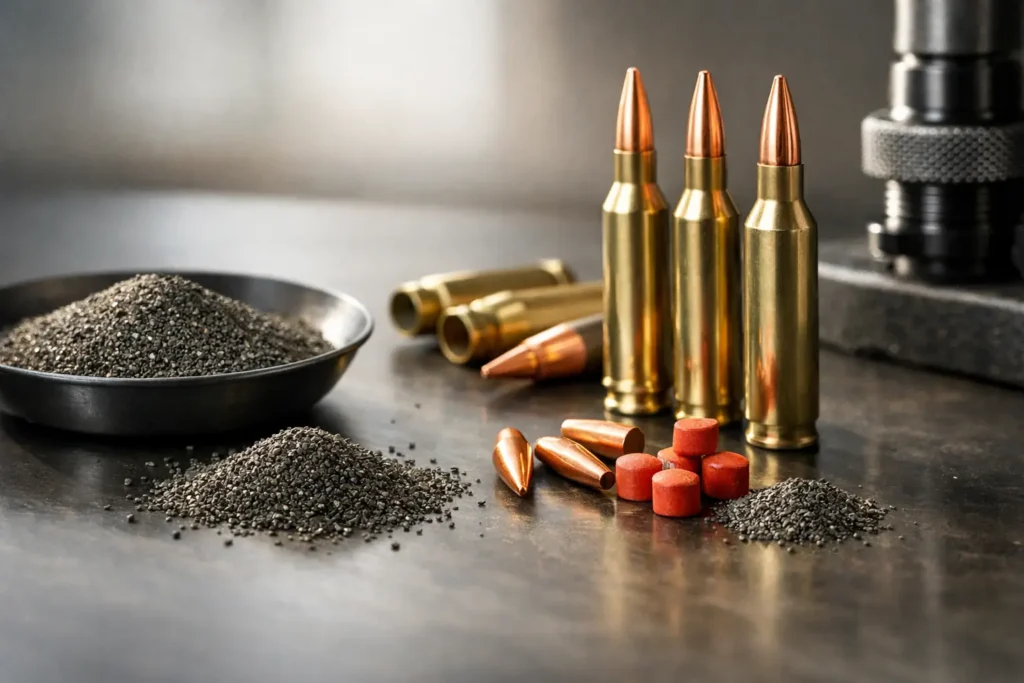
The difference between a load that feels tuned and one that feels off often starts with burn rate. Any serious guide to powder burn speed has to begin there, because burn speed shapes pressure, velocity, recoil character, and how forgiving a load will be in the real world. It is not just a chart-reading exercise. It is a pressure-management decision that affects safety first and performance second.
Reloaders usually talk about powder as fast, medium, or slow, but those labels only help if you understand what they mean inside your cartridge. A faster powder reaches peak pressure earlier in the burn cycle. A slower powder builds pressure over a longer period and typically does its best work when the cartridge has enough case capacity and barrel length to use it well. That sounds simple until you compare different bullet weights, seating depths, and primer choices. Then the answer becomes what it usually is in handloading – it depends.
What powder burn speed really means
Burn speed is the relative rate at which a smokeless powder generates gas under pressure. It is usually discussed through burn rate charts, where powders are arranged from faster to slower. The key word is relative. A chart does not tell you that one powder is exactly 12 percent faster than another, and it does not make powders interchangeable just because they sit near each other on the list.
That distinction matters. Two powders with similar published burn rates can behave differently because of grain shape, deterrent coatings, energy content, bulk density, and how they respond to pressure. A spherical powder and an extruded powder may occupy a similar neighborhood on a chart and still produce different ignition characteristics, metering behavior, and load development results.
For that reason, burn speed is best treated as a starting point for powder selection, not a substitute for tested load data.
Why a guide to powder burn speed matters in load development
Burn speed affects nearly every performance metric reloaders care about. If the powder is too fast for the application, pressure can rise sharply before the bullet has moved enough to create more usable volume in the case. That can produce hard pressure signs long before you reach the velocity you expected.
If the powder is too slow, the load may fail to build pressure efficiently. You can end up with incomplete combustion, larger extreme spreads, more muzzle flash, and less useful velocity than a better-matched powder would deliver. In some cartridges, especially smaller cases or reduced loads, going too slow can create a combination that is simply inefficient.
This is why experienced reloaders do not pick powder by brand loyalty alone. They match burn speed to cartridge size, bullet weight, intended velocity window, barrel length, and use case. A varmint rifle, a heavy-for-caliber hunting load, and a competition pistol may all reward very different burn rate choices even before you consider temperature behavior or metering preferences.
Fast, medium, and slow powders in practical terms
Fast powders are generally suited to lower-capacity cartridges, handgun rounds, and shotgun applications where efficient pressure buildup is needed early. In the right combination, they deliver clean ignition and consistent performance. In the wrong combination, they can reach dangerous pressure levels quickly, especially with deeper seating or heavier bullets.
Medium burn rate powders often occupy the broad middle ground. They are common in many standard rifle and pistol applications because they balance pressure generation and velocity well. For many reloaders, this category offers the best mix of predictable load development, practical case fill, and broad published data support.
Slow powders usually come into their own with larger rifle cases, heavier bullets, and longer barrels. They can produce excellent velocity and smoother pressure curves when the cartridge has enough volume to use them properly. But slow does not automatically mean better. In a cartridge that cannot support them, they may leave performance on the table.
Burn rate charts are useful, but limited
A burn rate chart is a map, not a recipe. It helps you understand the general role of a powder family and can point you toward options that are commonly used in similar applications. It can also help explain why one powder performs better with light bullets while another shines with heavier projectiles.
What it cannot do is give safe substitution guidance. Powders that appear adjacent on a chart are not drop-in replacements. Differences in energy, density, and pressure response can be significant. That is especially true across brands and product lines, whether you are comparing IMR, Hodgdon, Winchester, Ramshot, Accurate, Alliant, Vihtavuori, or Shooters World.
If your preferred powder is unavailable, the right move is to find tested data for the alternative powder and start over with that data set. That may feel slow, but it is faster than correcting a bad assumption.
Matching powder burn speed to cartridge and bullet weight
The most reliable pattern in reloading is that larger cases and heavier bullets often favor slower powders, while smaller cases and lighter bullets often favor faster ones. But that pattern has exceptions, and the exceptions are where careful reloaders earn their results.
Take bullet weight. A heavier bullet generally resists movement longer, which can allow slower powders to build pressure more effectively before the bullet travels down the bore. That often makes slower powders a strong fit for heavy-for-caliber rifle loads. A lighter bullet usually accelerates sooner, and in some cartridges a slightly faster powder can deliver better efficiency and more stable velocity.
Case capacity matters just as much. A powder that performs well in one .30 caliber cartridge may be a poor fit in another because the volume behind the bullet is different. Barrel length also changes the picture. A slower powder may need more barrel to convert gas generation into useful velocity. In a shorter barrel, that same powder can produce extra blast and flash without the expected speed gain.
Pressure, consistency, and the trade-offs reloaders actually feel
Reloaders often chase velocity first and regret it later. The better approach is to look for a powder whose burn speed gives you stable pressure and repeatable ignition in your intended setup. That usually leads to better groups, cleaner brass behavior, and more predictable field performance.
There are always trade-offs. Faster powders can be efficient and economical because smaller charge weights are common, but they may offer less margin for error in some cartridges. Slower powders can fill the case better and sometimes produce more uniform ignition, but they may meter differently or show less flexibility in reduced-performance applications.
Temperature sensitivity can also matter. Some powders hold velocity and pressure more consistently across changing conditions, while others can shift enough to affect practical performance. For hunters and shooters who move from warm benches to cold blinds, that is not a small detail.
Common mistakes when using this guide to powder burn speed
The first mistake is treating burn rate charts like ranking tables where slower always means more power. Powder choice is about fit, not status. The best powder is the one that matches the cartridge and bullet with proven data and delivers the performance you need safely.
The second mistake is substituting by appearance or category. Ball powders do not all behave alike. Extruded powders do not all behave alike. Even powders with similar applications can differ enough that charge weights, case fill, and pressure signs change quickly.
The third mistake is ignoring component interaction. Primer strength, bullet construction, seating depth, neck tension, and brass capacity all influence how a powder behaves. Burn speed is one variable in a larger pressure system.
How to use burn speed information the right way
Start with published data for your exact cartridge, bullet weight, and powder. Then look at where that powder sits in the broader burn rate range for the application. That gives you context. If you see that your chosen powder is on the faster side for a heavy bullet load, you know to pay close attention to pressure behavior. If it sits on the slower side for a short-barreled setup, you know to watch whether it is delivering practical efficiency.
From there, evaluate results honestly. Velocity matters, but so do standard deviation, group size, bolt lift, extraction, primer appearance, and how the load behaves across temperatures. The art of reloading, perfected, is not about chasing one number. It is about building a load that performs the same way when it counts.
For reloaders buying components online, this is also where inventory discipline helps. When a trusted powder line is available, buying with a clear understanding of burn speed and application fit keeps your bench organized and your load development more focused. That is especially valuable when you rely on specialty stock from a focused source such as Lee Reloading Canada.
A good powder choice does not announce itself with hype. It shows up as reliable ignition, stable pressure, and the kind of accuracy that makes the next round feel predictable before you even break the shot.
