
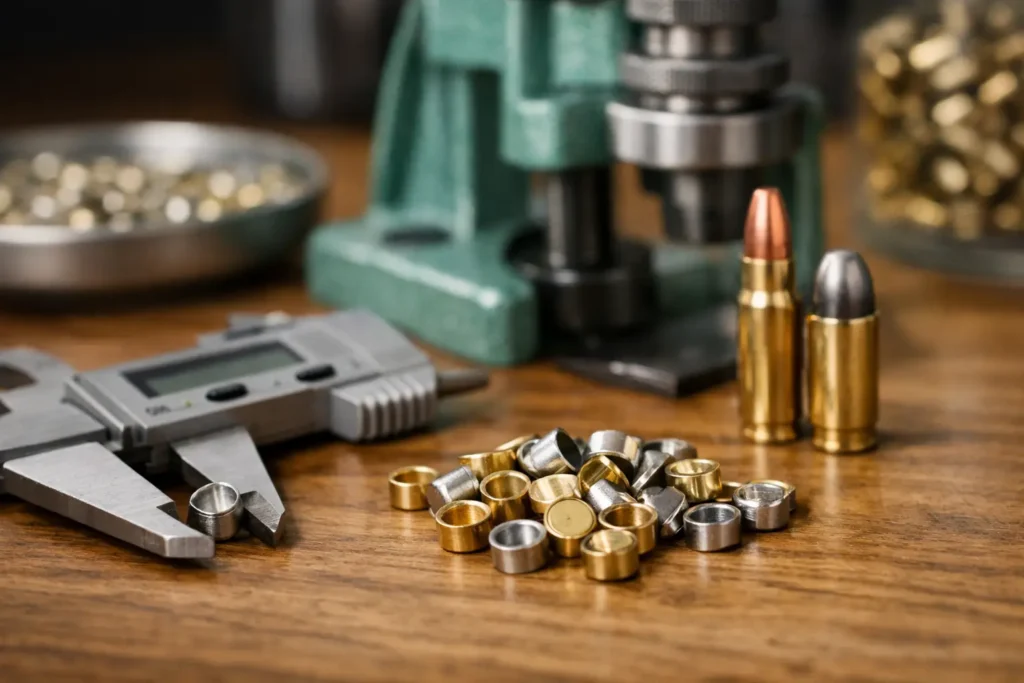
A primer that fits the pocket can still be the wrong primer for the rifle or pistol. This guide to primer cup hardness focuses on the part of primer selection that is easy to overlook: how the cup responds to a firing pin, chamber pressure, and the operating cycle of your firearm. For reloaders pursuing dependable field performance or tight groups, that response matters just as much as primer size and designation.
What primer cup hardness actually means
The primer cup is the thin metal housing that contains the priming compound and anvil. When the firing pin strikes it, the cup must deform enough to compress the priming compound against the anvil and produce reliable ignition. It must also remain strong enough to resist excessive flattening, piercing, or rupturing when the cartridge is fired.
“Hardness” is useful shorthand, but it is not a universal published specification. A primer’s real behavior comes from several related factors: cup alloy, cup thickness, the way the metal has been formed or hardened, anvil design, priming-compound sensitivity, and manufacturing tolerances. Two primers described informally as hard may not react the same way in the same load.
That is why primer cup hardness should not be treated as a ranking from soft to hard. It is a compatibility question. The right primer is the one that ignites consistently in your firearm while matching the cartridge, load data, and operating conditions.
Why cup hardness affects real-world performance
A relatively softer or more easily deformed cup may ignite reliably with a lighter firing-pin strike. That can be useful in a firearm with a reduced-power trigger system, provided the primer is otherwise appropriate for the cartridge and published data. The trade-off is that a cup that deforms more easily can show pressure effects more readily and may be less tolerant of conditions that promote piercing.
A harder or more resistant cup generally requires a more decisive firing-pin strike. It can offer a greater margin against deformation in cartridges and platforms that generate demanding firing conditions. Many reloaders pay close attention to this characteristic in semi-automatic rifles, particularly those with free-floating firing pins, where reducing the chance of an unintended ignition during chambering is a legitimate concern.
However, a hard cup does not make an unsuitable load safe, and a soft cup does not automatically indicate excessive pressure. Primer appearance is influenced by chamber dimensions, headspace, firing-pin hole size, case condition, bolt face support, and the pressure curve of the specific load. Treat the primer as one observation among several, never as a stand-alone pressure gauge.
Hard cups are not the same as magnum primers
This distinction prevents a common purchasing mistake. Magnum primers are designed to provide a different ignition output or flame profile than standard versions, often to support particular case capacities, propellant types, or cold-weather requirements. Cup hardness is about the mechanical characteristics of the primer cup.
Some magnum primers may use a cup that behaves differently from a standard counterpart, but the labels are not interchangeable. Do not substitute a magnum primer simply because you want a tougher cup, and do not assume a standard primer is mechanically softer. Follow published data and the component manufacturer’s application guidance.
Primer cup hardness and firing-pin energy
Reliable ignition depends on the entire firing system. Firing-pin travel, spring condition, strike energy, pin shape, protrusion, cleanliness, and receiver or bolt condition all contribute to how the primer cup is struck. A primer that functions flawlessly in one rifle may produce intermittent misfires in another with a lighter or marginal firing-pin strike.
Before changing primer types to cure light strikes, inspect the firearm. A fouled bolt, weakened spring, excess lubricant in cold conditions, incorrect firing-pin protrusion, or an altered trigger can all reduce ignition reliability. Replacing a primer with one that is easier to ignite may mask a mechanical issue rather than solve it.
This is especially relevant when moving between factory ammunition and handloads. A firearm that has been reliable with one primer family may respond differently when a new lot, brand, or class of primers enters the loading room. Confirm function with a cautious test batch before committing components to a large run.
Selecting primers beyond the label
Start with the primer type specified in your published load data: small rifle, large rifle, small pistol, large pistol, shotshell, or another cartridge-specific class. Size alone is not enough. Rifle and pistol primers can have different cup dimensions and characteristics even where pocket dimensions appear similar, and they should never be treated as casual substitutes.
Once the correct class is established, consider your firearm and purpose. A precision bolt-action rifle with a strong, consistent firing pin may handle a wide range of appropriate rifle primers well. A semi-automatic rifle with a free-floating firing pin may lead you toward primer options commonly selected for that platform, but the choice still has to align with the data for your cartridge and powder.
For handguns, reliable ignition is equally important. Competition pistols with modified springs can be particularly sensitive to primer selection. A primer that reduces failures to fire may seem appealing, but the proper long-term answer is a dependable combination of correctly selected components and a mechanically sound firearm.
When comparing brands, avoid relying on forum shorthand alone. Brand reputation can help narrow the search, but primer construction and sensitivity are not standardized across the industry in a way that makes broad equivalencies safe. Review current manufacturer guidance, use tested data from recognized sources, and document exactly what you load.
A practical process for changing primer types
Changing primer brands or moving between standard and magnum versions is a component change, not a cosmetic one. Even when cartridges assemble normally, ignition characteristics can alter velocity, pressure behavior, and group performance.
Use a disciplined process:
- Confirm the new primer is the correct class and supported by current published load data.
- Reduce and work back up according to the data source when changing any primer component.
- Load a small test batch rather than converting an entire lot of prepared brass.
- Check for reliable ignition, consistent velocity where chronograph data is available, and normal case and primer condition.
- Record primer brand, product designation, lot number, powder, charge weight, bullet, case, overall length, firearm, and environmental conditions.
The goal is not merely to make the cartridge fire. It is to establish a repeatable load that gives the accuracy, velocity consistency, and ignition reliability you expect.
Reading primers without overreading them
Primer inspection is worthwhile, but it needs context. A flattened primer can result from normal pressure in a cartridge with limited headspace clearance. A cratered primer may reflect a firing-pin hole that allows cup metal to flow, not necessarily an overload. A pierced primer deserves immediate attention, but the cause can include excessive pressure, a sharp firing-pin tip, improper protrusion, or a cup and firearm combination that is not well matched.
Pay closer attention to patterns than isolated appearances. If a known load suddenly produces changed primer appearance, hard bolt lift, extraction issues, unusual velocity changes, or case-head marks, stop and investigate. Do not continue firing simply because only one visible sign appears mild.
Primer seating also matters. Primers should be seated consistently to the manufacturer’s recommended condition, typically below flush and firmly against the bottom of the pocket without crushing or damaging the cup. High primers can create ignition and handling concerns, while inconsistent seating changes the relationship between cup, anvil, and firing-pin strike.
The limits of primer appearance
A primer cup that stays rounded and clean is not proof that pressure is low. A cup that looks flat is not proof that pressure is too high. Modern cartridges and firearms vary too much for visual primer reading to replace tested data, careful load development, and a chronograph where appropriate.
The most useful role for primer inspection is quality control. Look for consistent seating, damage during priming, unusual firing-pin impressions, and changes from your established baseline. Those observations can tell you when to pause before a minor issue becomes a reliability problem.
Storage, lot control, and dependable ignition
Primer performance begins before the cartridge is assembled. Store primers in their original packaging, in a cool, dry location away from heat sources, open flame, and unauthorized access. Keep different primer types and lots clearly separated. A mix-up between small rifle and small pistol primers, or between standard and magnum products, can undermine careful load development before the first round reaches the chamber.
Lot control is valuable when consistency matters. A new lot does not automatically require a completely new load, but it does warrant verification, especially for precision shooting, maximum-end data, or ammunition intended for important hunting or match use. Recordkeeping makes these checks faster and protects the repeatability you worked to achieve.
Primer cup hardness is not a detail reserved for specialists. It is part of the ignition system, and the ignition system is where every handload begins. Choose primers by application, follow current data, and let careful testing decide whether a component belongs in your regular load. Reliable ignition, every time, comes from that discipline.
