
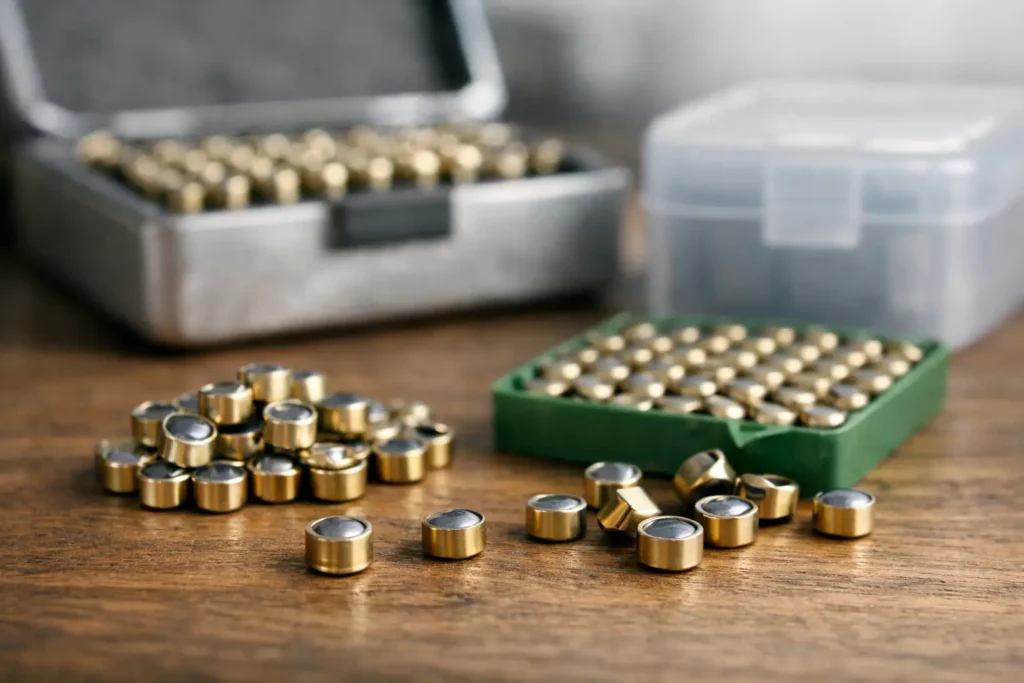
A brick of primers found at the back of a loading cabinet can raise a practical question: how long do primers last before ignition reliability becomes a concern? For reloaders who buy components when they are available, the answer matters. Properly stored primers can remain serviceable for decades, but their condition and storage history matter far more than the date printed on the box.
Primers are manufactured to be stable components, not short-lived consumables. Still, they contain a sensitive priming compound, anvil, cup, and sealing details that can be affected by moisture, heat, contamination, physical damage, and poor handling. When dependable ignition is the standard, storage is part of the reloading process.
How Long Do Primers Last in Storage?
There is no fixed expiration date for modern centerfire primers. In a cool, dry, stable environment and in original factory packaging, quality primers may remain reliable for several decades. Reloaders regularly report satisfactory performance from components that are 20, 30, or more years old when those components were kept correctly.
That does not mean every old primer should be treated as equal. Age alone is a weak predictor of performance. A five-year-old sleeve stored in a damp shed or exposed to repeated summer heat may be less dependable than a 25-year-old sleeve stored inside a climate-controlled loading room.
For practical purposes, primers should be considered long-term inventory when they have remained dry, protected, and unopened or carefully handled. If their storage history is unknown, treat them as unverified components rather than relying on them automatically for a hunting trip, match, or high-volume loading session.
What Primer Shelf Life Really Depends On
Primer longevity comes down to exposure and condition. Moisture is one of the biggest risks because it can compromise the priming compound and cause inconsistent or complete ignition failures. Condensation is especially problematic, so basements, unheated garages, sheds, and vehicles are poor choices for long-term component storage.
High heat can also shorten useful primer life. A single warm day is not likely to ruin a properly packaged sleeve, but prolonged exposure to high temperatures can degrade components over time. Avoid placing primers near furnaces, water heaters, direct sunlight, or any area where temperatures swing sharply through the year.
Contamination is another concern. Oils, cleaning solvents, lubricants, and other chemicals can affect primers if they reach the primer cup or compound. Keep hands clean and dry while handling primers, and do not place loose primers on a bench that has residue from case lube, gun-cleaning products, or powder work.
Physical condition matters as well. A crushed sleeve, damaged trays, corroded cups, or loose primers mixed in an unmarked container all create avoidable uncertainty. Factory packaging is designed to protect individual primers and limit the effects of an accidental ignition. It also preserves the information reloaders need: manufacturer, primer type, lot number, and application.
Store Primers for Reliable Ignition
The best storage plan is straightforward: keep primers in their original packaging, in a cool and dry indoor location, away from heat sources, open flames, and chemical exposure. A dedicated cabinet in a conditioned space is generally a better choice than a garage or utility area.
Avoid transferring primers into jars, bulk containers, or improvised organizers. This can remove the protection provided by factory packaging and makes it easier to lose lot information or mix primer types. Small rifle, small rifle magnum, small pistol, and small pistol magnum primers can look similar while producing meaningfully different results in a load. Clear identification protects both performance and safety.
Keep primers separate from powders and other flammable materials according to applicable local regulations and manufacturer guidance. Storage quantity rules can vary by jurisdiction and building type, so reloaders should understand the requirements that apply where they live. The goal is not simply preserving shelf life. It is maintaining an organized, controlled loading environment.
A few habits make a real difference over the long term:
- Leave primers in their original sleeves and cartons until needed.
- Store them indoors where humidity and temperature remain reasonably stable.
- Keep them away from oils, solvents, cleaners, and damp surfaces.
- Label any opened carton clearly if multiple lots are on hand.
- Inspect packaging periodically for water damage, corrosion, crushing, or rodent damage.
Do Opened Primer Packs Go Bad Faster?
An opened pack does not suddenly become unreliable. If the remaining primers are still in their factory tray, placed back in the carton, and stored correctly, they can last for many years. The concern is not that air reaches them after opening. The concern is added handling and the possibility of contamination, damage, or a lost label.
For reloaders working through several primer types at once, discipline at the bench pays off. Return unused primers to their correct package before switching operations. Do not pour excess primers from a priming tool back into a different sleeve, and never assume similar-looking primers are interchangeable.
This is particularly relevant with magnum primers. Magnum and standard versions may differ in brisance and flame characteristics, and a substitution can affect pressure, velocity consistency, and load development. Reliable ignition begins with selecting the primer specified by the published load data, then maintaining lot control throughout the process.
How to Assess Older Primers Before Loading
Visual inspection can reveal obvious problems, but it cannot prove that an older primer will perform consistently. Look for corrosion, discoloration, crushed cups, damaged trays, water staining, or loose primers that have been exposed to an unknown environment. Any of these signs justify setting the components aside rather than incorporating them into serious loads.
If the packaging appears sound and the storage history is good, older primers may be suitable for use. Start with conservative, published load data and approach the process with the same care used for a new component lot. Do not assume that an older primer lot will behave exactly like a current-production lot, especially when loading near maximum charges or pursuing precision results.
For a component lot of uncertain age or history, it is sensible to evaluate ignition and consistency before relying on it for demanding use. Watch for misfires, delayed ignition, unusual report, velocity variation where chronograph data is available, and changes in group performance. A single successful shot does not establish lot-wide reliability. Consistent performance across a sensible test batch is more meaningful.
If a primer fails to ignite, follow established misfire procedures for the firearm and range environment. Keep the muzzle in a safe direction, allow appropriate time for a possible delayed ignition, and do not immediately open the action or attempt to reuse the cartridge. A suspected primer issue is a reason to pause, inspect the loading process, and avoid guessing at the cause.
When Older Primers Should Not Be Your First Choice
Even well-stored older primers may not be the right choice for every application. For a once-in-a-lifetime hunt, a major match, defensive ammunition, or a precision load with little tolerance for variation, current, known-lot primers provide greater confidence. That is not an indictment of old inventory. It is a decision based on the consequence of an ignition failure or a velocity shift.
Known components also simplify troubleshooting. When a load begins showing inconsistent velocity, changing point of impact, or erratic ignition, it is easier to identify the cause when powder, brass, bullets, and primers all have clear lot history and controlled storage.
Reloaders who maintain a deep component inventory can reduce uncertainty by rotating stock. Use older, well-kept primers first for appropriate practice or general-purpose loads while retaining factory labels and lot information. Keep newer inventory protected for future use rather than assuming it must be consumed immediately.
Primer Age Is Less Important Than Primer History
A primer does not become unreliable merely because the calendar has moved on. The better question is where it has been, how it was handled, and whether its packaging remains intact. Factory-sealed primers from a trusted manufacturer, stored carefully in a dry and temperature-stable location, are built to deliver reliable ignition long after purchase.
Treat primers as precision components from the day they arrive. Organized storage, clean handling, proper lot control, and conservative testing give every load the best chance of performing as intended when the trigger is pulled.