
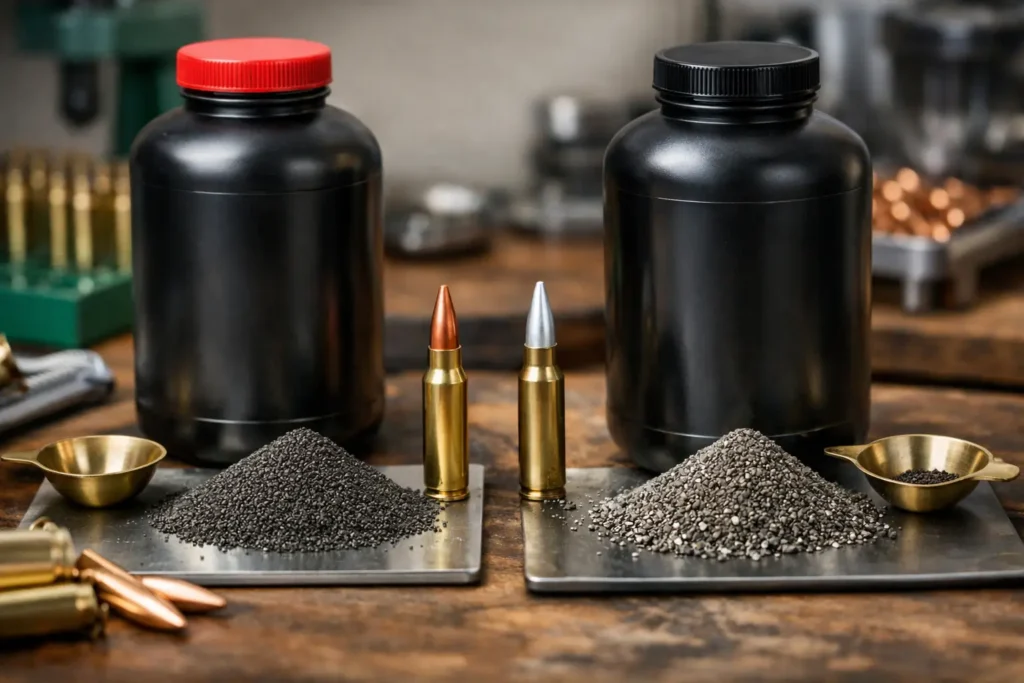
A powder label can look like a simple brand choice until a rifle starts showing vertical stringing, a measure throws inconsistently, or a trusted load is unavailable. The IMR versus Winchester powder question is better answered by looking at powder geometry, burn-rate range, cartridge application, and published data – not by treating either name as a single powder type.
Both brands have earned places on serious loading benches. IMR has long been associated with proven extruded rifle powders and cartridge-specific performance across hunting, target, and classic rifle applications. Winchester powder offerings include well-known ball powders and select propellants that appeal to reloaders who value efficient metering and versatile performance. The right choice depends on the exact powder, the cartridge, the firearm, and the data source governing the load.
IMR Versus Winchester Powder: Start With the Exact Propellant
The most useful comparison is not IMR against Winchester as two broad camps. It is IMR 4064 against the particular Winchester powder listed for a given cartridge, or IMR 4350 against a powder with a comparable published application and burn-rate range. Powders are not interchangeable merely because they carry the same brand name, appear close on a burn-rate chart, or work in similar cartridges.
A burn-rate chart is a helpful reference, but it is not load data. It can suggest where a powder generally belongs – faster pistol or shotshell applications, medium rifle cartridges, or large-capacity magnum cases – yet it cannot establish a safe substitution. Differences in energy, density, deterrent coatings, grain shape, primer sensitivity, and pressure behavior can be substantial.
For every load, use current published data from a reliable powder manufacturer or recognized manual. Confirm the exact powder designation, bullet weight and construction, case, primer, cartridge overall length, and starting charge. A close name is not the same product, and a similar burn rate is not permission to transfer charge weights.
Powder Shape Changes the Loading Experience
One practical difference reloaders often notice is how a powder handles in a measure. Many classic IMR rifle powders use an extruded, or stick, grain structure. These granules can offer excellent performance in suitable rifle cartridges, but longer grains may not meter as smoothly through some volumetric powder measures. A reloader seeking highly uniform throws may choose to trickle final charges for precision work, especially when the load is near a desired accuracy node.
Winchester has several ball-powder options in its history and lineup. Spherical powders commonly flow very well through a powder measure, making them attractive for high-volume loading where repeatable volumetric dispensing matters. That does not make ball powder automatically better. It simply makes metering behavior part of the decision.
Short-cut extruded powders narrow the gap. Their smaller grain dimensions can improve flow compared with traditional long-stick propellants while retaining the characteristics that make extruded powders popular for many rifle applications. Your measure, technique, and acceptable charge tolerance all matter. Check thrown charges with a dependable scale, particularly whenever changing lots, settings, or powder types.
Density Matters Before You Fill the Case
Bulk density affects how much room a charge occupies in the case. A denser spherical powder may leave more visible case capacity than an extruded powder producing a comparable ballistic result. That can matter in cartridges where seating depth, compressed charges, and usable case capacity influence performance.
Case fill is not a shortcut to safety or a guarantee of uniform ignition. Still, it is a meaningful loading characteristic. A powder that fits the case well with the intended bullet and overall length can simplify assembly and reduce surprises at the bench. Follow the tested recipe rather than trying to force a preferred powder into an unsuitable case-volume situation.
Choosing by Cartridge and Intended Performance
IMR powders are often favored by reloaders working with established rifle cartridges, especially where published data and decades of field experience support a particular pairing. Medium-burn-rate IMR options have a strong reputation in popular full-size rifle cases, while slower IMR choices are frequently considered for larger-capacity cartridges and heavier bullets. The appeal is familiar: predictable results, broad data availability, and a long history in accurate hunting and target loads.
Winchester powders can be equally compelling when their specific burn rate and physical form suit the cartridge. A ball powder may be a smart fit for a reloader assembling a larger volume of ammunition and wanting clean, consistent throws from a quality measure. Other Winchester powders may be selected because published data shows a useful velocity range, good accuracy potential, or an appropriate pressure profile for a particular cartridge.
Neither brand wins by default. A hunter may prioritize reliable cold-weather field performance and repeatable point of impact. A precision rifle shooter may accept slower dispensing in exchange for a powder that produces low velocity variation in a specific barrel. A high-volume shooter may value a powder that meters efficiently and is supported by dependable component availability. Each priority can lead to a different answer.
Temperature Behavior Is a Field Consideration
Ambient temperature can affect pressure and velocity, although the degree varies by powder, cartridge, load density, firearm, and component combination. For ammunition used across wide seasonal conditions, test in conditions that resemble the intended use whenever possible. A load developed on a mild day may not behave identically in summer heat or late-season cold.
Avoid assumptions based on powder shape or brand reputation alone. Review manufacturer information for the exact propellant, then verify performance carefully with your own firearm and documented load-development process. Chronograph data can reveal trends, but safe loading practices remain the foundation.
Primer Selection and Ignition Reliability
Primer choice is part of the system, not an afterthought. Different powders can respond differently to ignition characteristics, especially when comparing spherical and extruded rifle powders or loading in cold conditions. The primer listed in the published data should be the starting point because changing primer type, brand, or magnum designation can alter pressure and velocity.
This is particularly relevant when components are difficult to source. Substituting a primer because it is available may be reasonable only when current tested data specifically supports that combination. Do not assume a magnum primer is a universal upgrade for ball powder, or that any standard large rifle primer will produce equivalent results. Reliable ignition comes from a tested combination, consistent case preparation, correct seating, and proper storage of every component.
A Better Way to Compare IMR and Winchester Options
When you are deciding between available powders, start with the cartridge and bullet you actually plan to load. Then compare only powders that appear in current data for that exact application. Look at the listed charge range, velocity range, case-fill characteristics where provided, primer requirement, and notes relevant to bullet construction or barrel length.
Next, consider your loading process. If you load modest quantities of precision rifle ammunition and weigh every charge, the metering advantage of a spherical powder may carry less weight. If you load a larger volume and use a powder measure, granule shape and throw consistency deserve more attention. If the ammunition will be carried into demanding field conditions, component consistency and real-world verification become central.
Finally, account for supply without compromising the recipe. A powder that is consistently available from a specialist source such as Lee Reloading Canada can make it easier to maintain one proven load over time. When changing lots, reduce to a safe starting point in published data and work back up carefully. Lot-to-lot variation is a normal reason to confirm performance, even with the same powder name.
What Not to Do When Switching Powders
Do not transfer a charge weight from an IMR powder to a Winchester powder, or the other way around, based on a similar burn-rate position. Do not rely on internet anecdotes as a replacement for published data. Do not mix powders, pour unidentified powder back into a factory container, or use a powder after losing certainty about its identity.
Keep the original factory container on the bench while loading and label the measure if it contains powder. Store powders in their original containers, away from heat and ignition sources, and follow all applicable local rules. These habits are simple, but they protect the accuracy work that happens long before the cartridge reaches the range.
The strongest powder choice is the one supported by current data, matched to your cartridge and loading method, and proven safely in your firearm. Build that confidence one documented change at a time, and the label on the container becomes a performance decision rather than a guess.