
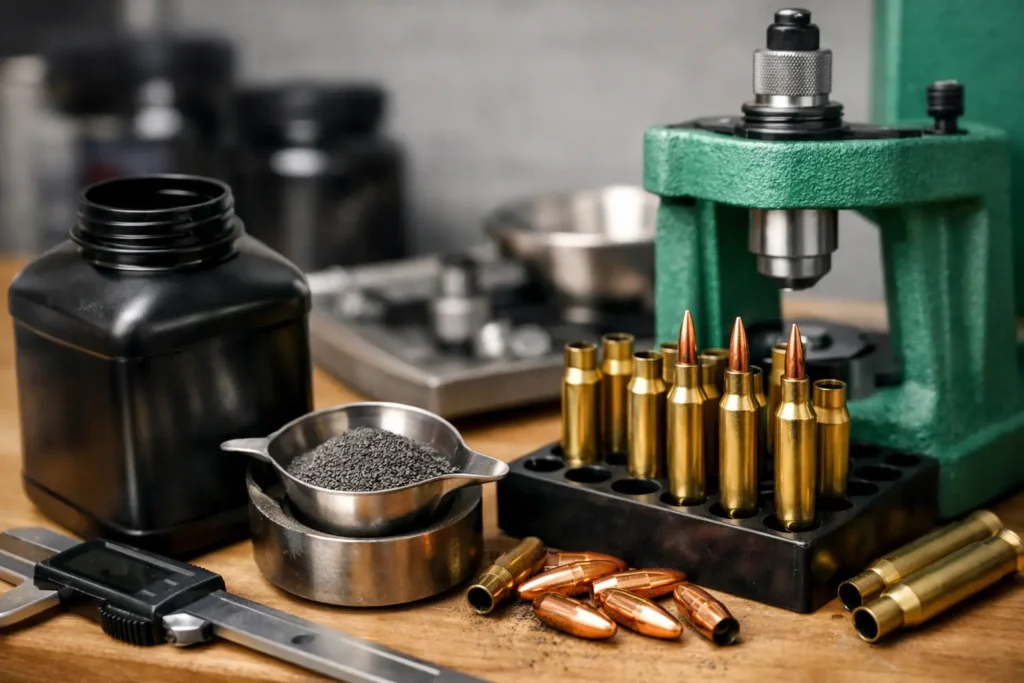
Some powders earn their place on the bench because they are available. Alliant earns it because many reloaders keep coming back after the chronograph, the target, and the field all say the same thing. This alliant powder review is written for reloaders who care less about marketing language and more about metering behavior, burn consistency, pressure characteristics, and whether a powder keeps delivering when the load matters.
Alliant has been part of handloading for a long time, and that history shows in the lineup. The brand is not built around one narrow strength. It covers pistol, rifle, and shotshell applications with powders that have established reputations for accuracy, useful velocity, and dependable ignition when paired correctly with the right primer, case, bullet, and published data. That breadth is a real advantage if you load for multiple platforms, but it also means the brand is best judged powder by powder rather than by broad claims.
Alliant powder review: where it stands
The short version is simple. Alliant powder is respected because many of its products do exactly what experienced reloaders ask them to do. They produce competitive velocity, often show very good shot-to-shot consistency, and have enough field history that you are rarely guessing about how a given powder behaves in a proven cartridge.
That said, Alliant is not automatically the best answer in every setup. Some powders meter better than others. Some shine near the top end of specific applications and are less flexible outside that window. Some loaders prefer other brands when they want extreme temperature stability, especially for precision rifle work where every small variable gets magnified at distance. The right read on Alliant is not that it is universally superior. It is that the lineup contains multiple proven performers that deserve serious consideration.
What makes Alliant popular on the loading bench
One reason Alliant stays relevant is practical performance. Powders like Bullseye, Unique, Power Pistol, Reloder 15, Reloder 16, Reloder 17, and Reloder 22 have all built followings because they solve real loading problems. Some offer broad cartridge utility. Others help chase velocity without stepping outside published data. Others still are chosen because they simply produce accurate, repeatable ammunition in rifles and handguns that are already tuned well.
Another strength is application coverage. If you load handgun rounds for volume shooting, hunt with centerfire rifle cartridges, and also keep shotshells in rotation, Alliant has options across the board. That does not mean every Alliant powder is interchangeable with a neighboring burn rate from another brand. It means the family is broad enough that experienced reloaders can often stay within one brand while still tailoring loads to the cartridge and intended use.
Performance by category
Pistol powders
Alliant’s pistol lineup includes some of the most familiar names in handloading. Bullseye remains a classic for target handgun loads, especially where economy and proven behavior matter. It has a long track record, ignites well, and can deliver excellent accuracy in the right recipes. Unique is another well-known option because it spans a wide range of handgun cartridges and even some light field and utility applications. Its appeal has always been versatility.
Power Pistol gets attention from reloaders who want strong performance in service pistol cartridges and magnum-capable applications where velocity matters. It can produce impressive results, but the trade-off is that some shooters notice sharper blast and flash depending on the cartridge and barrel length. That is not a flaw so much as a characteristic. If your priority is top-end energy within safe published limits, it can be very attractive. If your priority is the softest, cleanest indoor target load possible, another powder may fit better.
Rifle powders
The Reloder line is where many reloaders form their strongest opinion of the brand. Powders like Reloder 15 have an excellent reputation in cartridges that reward consistent burn and strong accuracy potential. It has been a serious contender in precision and service rifle circles for good reason. Reloder 16 and Reloder 23 have also drawn attention from reloaders looking for modern performance with good temperature behavior and competitive velocity in popular hunting and long-range cartridges.
Reloder 17 and Reloder 22 are often discussed by hunters and reloaders chasing velocity in certain medium and magnum rifle cartridges. In the right setup, they can be outstanding. The key phrase is in the right setup. Case fill, bullet weight, throat dimensions, barrel length, and ambient conditions all matter, and the same powder that looks exceptional in one cartridge may feel less forgiving in another.
Shotshell powders
Alliant also carries weight in shotshell loading, where consistency, clean function, and pressure-safe performance are non-negotiable. Red Dot, Green Dot, Blue Dot, and others have been widely used for years. For the shotshell reloader, Alliant’s value is less about novelty and more about trusted recipes with known behavior. That matters when the goal is not experimentation for its own sake, but repeatable loads that function correctly and pattern as expected.
Metering, cleanliness, and consistency
No honest alliant powder review should ignore handling on the bench. Some Alliant powders meter very well, while others can be less cooperative depending on grain shape and the type of powder measure being used. Ball and fine-grained powders usually make life easier when you are loading volume pistol ammunition. Larger extruded powders may call for more attention if you want minimal variation in thrown rifle charges.
Cleanliness also depends on pressure and application. A powder that seems dirty in a lightly loaded handgun round may clean up considerably when used at an appropriate pressure range. That is one reason blanket claims about a powder being clean or dirty are often less useful than they sound. The better question is how it behaves in your cartridge, at your intended load level, with your chosen primer and bullet.
Consistency is where Alliant often holds its ground well. Many reloaders report solid standard deviations and dependable downrange performance once the load is tuned. Still, consistency starts with disciplined assembly. Powder alone cannot fix inconsistent brass prep, poor neck tension, mixed cases, or loose seating depth control.
Trade-offs reloaders should keep in mind
Alliant powders are strong performers, but there are trade-offs. The first is sensitivity to application. Some powders have a broad comfort zone. Others are more impressive when used in narrower, well-matched roles. If you choose based only on burn rate charts or secondhand forum claims, you can miss a better option.
The second is availability strategy. Popular powders from any respected brand can be difficult to source consistently, especially when demand spikes. If you build a load around a powder that becomes hard to replace, that can disrupt training, competition, or hunting prep. Many experienced reloaders solve that by developing a primary recipe and a backup using another suitable published option.
The third is component pairing. Primer choice matters. So does brass capacity. So does bullet construction. Alliant powders can be excellent, but they reward the same disciplined component matching as any premium powder line. Serious reloaders already know this, but it is worth stating because performance claims without context can lead to poor decisions.
Who should buy Alliant powder
Alliant makes the most sense for reloaders who already know the performance window they want and are selecting powder with a specific outcome in mind. If you want proven handgun powders with a long service record, the brand has obvious appeal. If you are tuning rifle loads for hunting or precision work and need powders with strong reputations in established cartridges, the Reloder family deserves a close look. If you load shotshells and prefer tested, familiar recipes over guesswork, Alliant remains a practical choice.
It may be a less ideal starting point for reloaders who want one powder to do everything, or for those who prioritize maximum metering ease above all else in every application. In those cases, the right answer may come down to one specific powder rather than the brand as a whole.
Final take on this alliant powder review
Alliant powder has earned its reputation the right way – by delivering real performance across multiple disciplines of reloading. The lineup includes standout options for pistol, rifle, and shotshell use, and several products remain benchmark choices in their categories. The brand’s strength is not hype. It is repeatable results, strong load data history, and practical performance that experienced reloaders can verify on paper, over the chronograph, and in the field.
If you approach Alliant the way serious reloaders approach any component – start with published data, match the powder to the cartridge, watch pressure closely, and test with discipline – there is a good chance you will find at least one product that earns a permanent place on your bench. The smart move is not to ask whether Alliant is good in general. It is to ask which Alliant powder is right for the load you are building next.
