
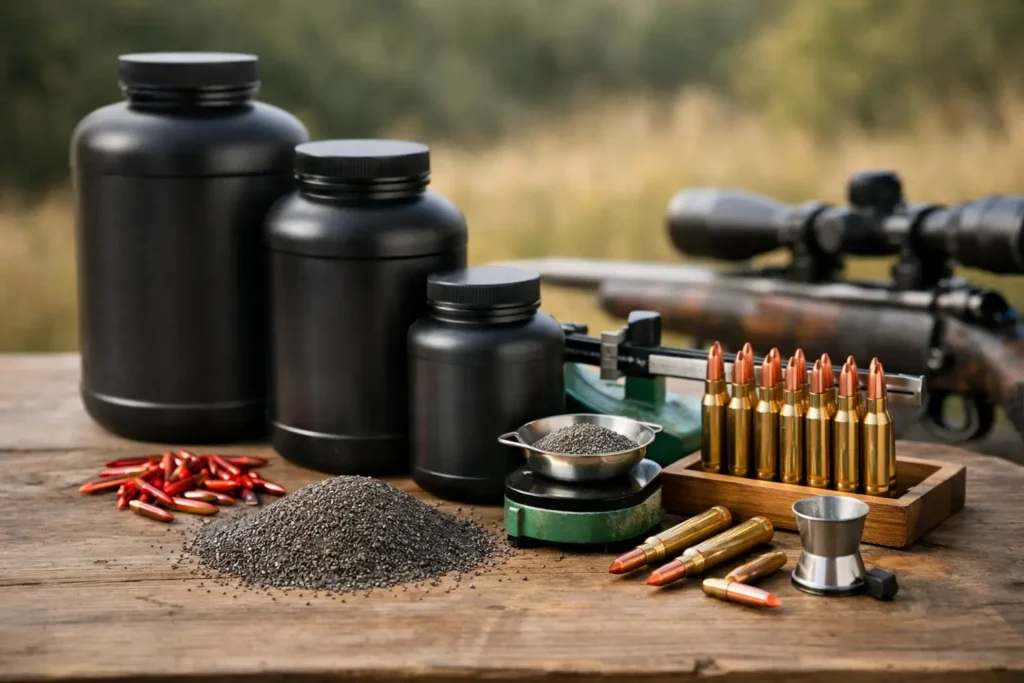
A prairie dog string does not forgive erratic velocity, and a coyote that pauses for only a few seconds does not reward a load that groups well only under ideal bench conditions. The best powders for varmint loads are the ones that deliver predictable ignition, useful velocity, and repeatable accuracy in your specific rifle – not simply the powder with the highest published speed.
Varmint cartridges cover a wide range, from .204 Ruger and .223 Remington through .22-250 Remington, .243 Winchester, and fast 6mm options. That range makes a single “best” powder unrealistic. Case capacity, bullet weight, barrel length, intended distance, and the temperatures you shoot in all influence the right choice. A disciplined approach starts with current published data for the exact cartridge, bullet, and powder combination, then evaluates what performs consistently in your rifle.
What Makes a Powder Right for Varmint Work
Varmint shooting places unusual demands on ammunition. Small targets and extended distances make vertical dispersion easy to see. High-volume colony shooting can heat a barrel quickly, while predator hunting may involve a cold rifle, a quick shot, and changing field temperatures. Powder selection should support the way you actually shoot.
The first consideration is burn rate. Smaller-capacity cartridges generally respond well to powders that reach efficient pressure levels without leaving excessive unused case capacity. Larger overbore cases often benefit from powders that sustain pressure farther down the bore. That does not mean slower is automatically better. A powder must remain within reliable, published charge ranges while producing the accuracy and velocity your rifle prefers.
Metering matters as well. Fine spherical powders can be exceptionally convenient for shooters loading significant quantities of .223 Remington or .204 Ruger ammunition. Short-cut extruded powders may not throw quite as uniformly through every measure, but they often have a strong reputation for consistency across temperature changes. For a carefully assembled long-range load, weighing charges may make that distinction less important. For a high-volume varmint session, easy metering can be a meaningful advantage.
Temperature behavior deserves serious attention. A load developed during mild weather can change when exposed to summer heat, winter cold, or rounds sitting in direct sun. Powders known for stable performance across temperatures are often worth prioritizing for hunters and precision-minded shooters. Any load should still be verified safely in the conditions where it will be used.
Best Powders for Varmint Loads by Cartridge Class
These powders are respected options because they appear in published data and have established field followings. They are starting points for research, not load recipes. Always use current manufacturer data and begin at the listed starting charge.
.204 Ruger and Other Small .20-Caliber Cases
The .204 Ruger rewards powders that combine consistent ignition with enough velocity potential to make its light bullets useful at distance. Hodgdon Benchmark and IMR 8208 XBR are frequently considered by reloaders seeking accuracy-focused extruded options. Their burn-rate range suits many small rifle applications, and their consistency can be attractive when small changes in velocity show up on target.
For reloaders who value smooth metering, Accurate 2230 and Ramshot TAC are also commonly researched for .204 Ruger applications where current data supports the bullet choice. Ball powders can make efficient work of a progressive or volumetric loading setup, but ignition components and ambient conditions should be treated as part of the complete system. Do not substitute primers or alter seating depth without returning to tested data.
.223 Remington and 5.56-Compatible Varmint Platforms
The .223 Remington offers one of the broadest useful powder selections in varmint reloading. Hodgdon H335 remains a familiar choice for lighter-bullet .223 loads, particularly for reloaders who appreciate spherical powder metering. Winchester 748 is another established option with published applications in this cartridge class.
Hodgdon Varget, Benchmark, and IMR 8208 XBR are often favored where accuracy and lot-to-lot consistency are higher priorities than maximum production speed. Their practical appeal is especially clear with medium-weight varmint bullets and rifles used for both target work and field shooting. The right selection depends on your chamber, twist rate, bullet construction, and the charge ranges shown in current manuals.
CFE 223 can be worth considering for shooters looking at velocity potential and dependable metering in appropriate .223 data. Its usefulness is cartridge- and bullet-dependent, so resist the temptation to choose it based on a single velocity claim. A chronograph and careful group evaluation reveal far more than internet averages.
.22-250 Remington and Swift-Class Cartridges
Larger .22-caliber varmint cartridges have enough capacity to benefit from powders that maintain efficient performance with longer barrels and bullets ranging from light, explosive varmint designs to heavier high-ballistic-coefficient choices. Varget is a proven reference point for many .22-250 reloaders because it offers a balanced combination of accuracy potential and temperature stability.
Hodgdon H380 has long been associated with the .22-250 Remington and remains relevant when supported by current data. Its practical performance can be excellent in rifles that respond well to it, although individual barrels may show different preferences. For shooters pursuing heavier bullets or specific velocity windows, powders such as IMR 4064, IMR 4895, or Ramshot Big Game may appear in suitable published data, depending on the exact combination.
The Swift family and similar high-capacity cartridges require extra discipline. Their velocity potential also raises the stakes for pressure management, throat wear, and barrel heat. Accuracy nodes often matter more than chasing the last increment of speed. A load that stays tight through a five-shot string is more useful than one impressive three-shot group from a cool barrel.
.243 Winchester and 6mm Varmint Rifles
The .243 Winchester and related 6mm cartridges extend varmint capability when wind, distance, or tougher predators call for a heavier bullet. Powders in the Varget, H4350, IMR 4350, and Alliant Reloder 16 range are widely researched for appropriate .243 Winchester bullet weights. The correct choice shifts as bullet weight increases and the usable case capacity changes.
For lighter 6mm varmint bullets, some shooters may find good published options among medium burn-rate powders. For heavier bullets intended to retain energy at longer range, slower powders are often more suitable. This is where cartridge-specific data matters most. A powder that performs exceptionally with a light 55-grain bullet may be entirely wrong for a longer, heavier 6mm projectile.
Choosing Between Extruded and Spherical Powders
Neither powder shape wins every time. Extruded powders are often selected for their reputation for consistency and broad temperature tolerance. They can be especially appealing for a bolt-action rifle where every charge is weighed and accuracy at distance is the primary goal.
Spherical powders offer excellent flow through many powder measures and can simplify loading for high-volume .223 Remington ammunition. They may also provide strong velocity in certain cartridge applications. Their performance depends on correct component selection and published pressure-tested data, particularly when temperatures vary. Reliable ignition is a complete load characteristic, not a promise made by any one component.
If you load both a bolt gun for open-country shooting and an AR-pattern rifle for fast follow-up shots, it can make sense to maintain different powders for each role. Trying to force one powder into every cartridge may create unnecessary compromises in metering, accuracy, or availability.
Test Methodically, Not Emotionally
A good varmint load is built with controlled comparisons. Change one variable at a time. Keep brass preparation, primer type, bullet lot, seating depth, and shooting conditions as consistent as practical. Record velocity, group size, extreme spread, standard deviation, and any pressure indicators observed during firing.
Do not treat visible pressure signs as a complete safety system. They can appear late, and the absence of obvious signs does not prove a load is safe. Follow published minimum and maximum data, use the exact component substitutions permitted by the data source, and stop if anything looks or feels abnormal.
Barrel heat should be part of your testing plan. Many varmint rifles print differently after several shots, especially lightweight sporters and high-intensity cartridges. Let the barrel cool enough to learn whether a promising load is genuinely stable or merely benefiting from a cold bore. The field does not always provide a perfect cooling schedule, so honest testing produces more useful ammunition.
Supply Matters, but Data Comes First
Component availability can influence a practical choice, especially for reloaders maintaining a supply for an entire season. Buying a suitable powder in a quantity that allows consistent lot use can reduce one source of variation. Still, never switch powders simply because another option is on the shelf. Every powder change requires a return to published starting data and a fresh workup.
Lee Reloading Canada focuses on the powders and primers serious reloaders look for when dependable field performance matters. Whether you favor Hodgdon, IMR, Winchester, Ramshot, Accurate, Alliant, Vihtavuori, or Shooters World, select by verified data first, then build a consistent component plan around what your rifle proves on target.
The load worth carrying into the field is not the one with the boldest velocity number. It is the one that feeds reliably, holds its point of impact, and gives you confidence when the shot is finally there.