
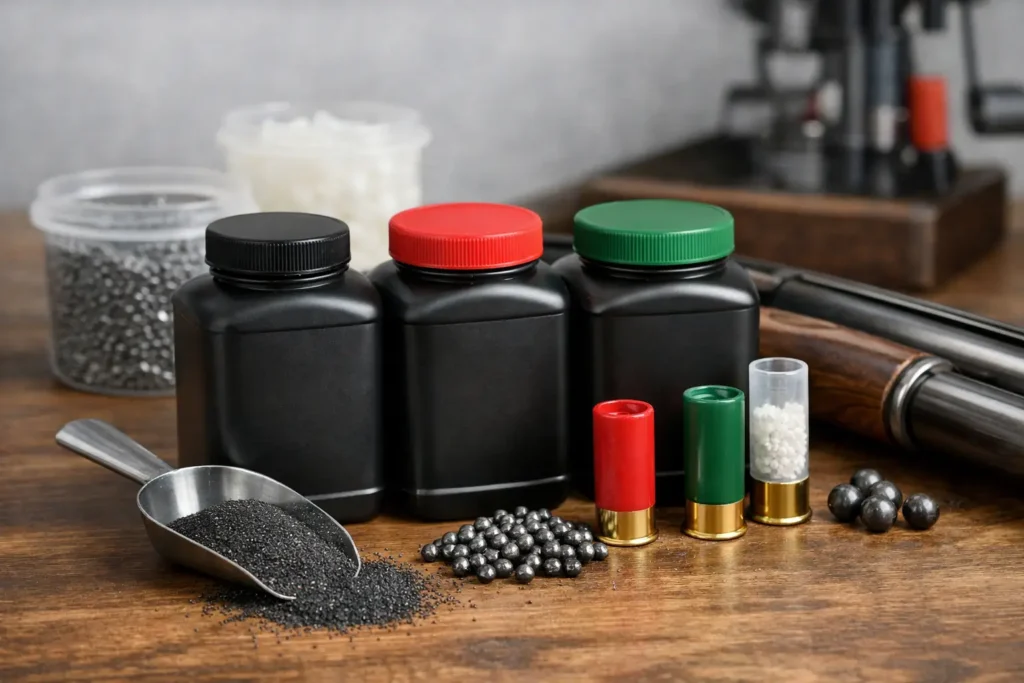
A shotshell can look simple on the loading bench: hull, primer, powder, wad, shot, and crimp. In practice, powder selection determines how those pieces work together. The best reloading powders for shotguns are not defined by a single brand or burn rate. They are the powders that produce the intended pressure, velocity, and pattern performance with your exact tested hull, primer, wad, payload, and crimp.
For serious clay shooters and hunters, that distinction matters. A powder that is excellent for a light 1-ounce 12-gauge target load may be entirely unsuitable for a heavy field load or a compact 20-gauge recipe. The right choice starts with published shotshell data, then comes down to the performance traits that matter at the range or in the field: clean burning, consistent metering, reliable ignition, suitable charge density, and availability when it is time to replenish your bench.
Best Reloading Powders for Shotguns by Load Type
Rather than chasing a universal favorite, match the powder family to the job. Fast-burning powders generally suit light target loads and smaller gauges. Medium-rate powders cover a broad range of 12-gauge target and field applications. Slower shotshell powders are commonly used where heavier payloads or higher velocity recipes require more gas volume while remaining within tested pressure limits.
Light target loads and smaller gauges
Fast powders are a common starting point for 3/4-ounce, 7/8-ounce, and many 1-ounce target recipes, particularly in 12 gauge, 20 gauge, and 28 gauge. These powders can provide efficient combustion in lower-charge applications and may leave less residue when loaded within their intended pressure range.
Alliant Red Dot and Promo have long been familiar choices for economical target shooting, especially in 12-gauge applications supported by published data. Hodgdon Clays is also well regarded for clean-burning target loads, while Winchester 244 offers useful flexibility across popular light and mid-range shotshell recipes. For reloaders building light 20-gauge or 28-gauge loads, powders such as Hodgdon Universal, Alliant Unique, and Accurate No. 5 may appear in approved data depending on the hull and payload.
The trade-off with faster powders is narrow application range. They can be highly effective in light loads, but they are not a shortcut to heavier payloads or higher velocity. Do not assume a faster powder can simply be increased to achieve a different result. Pressure can rise sharply in shotshells, often without a visible warning at the press.
Versatile 12-gauge target and field loads
For many reloaders, the most useful powder is one that covers dependable 1-ounce and 1 1/8-ounce 12-gauge loads while offering options for moderate field use. This is where powders with a medium burn rate earn their reputation.
Alliant Green Dot has a strong following for heavier target loads, including 1 1/8-ounce applications where a shooter wants manageable recoil and consistent performance. Hodgdon Universal remains a versatile option across several shotgun gauges, provided the exact combination is listed in current data. Winchester WSF has also been used in a range of 12-gauge target and field applications, with its suitability determined by the specific recipe rather than the label alone.
These powders can offer a practical balance of charge weight, velocity potential, and shot-to-shot consistency. They are especially relevant for reloaders who want one powder that serves a focused set of proven recipes instead of maintaining several partial containers for every possible load.
Heavy field loads and higher-velocity applications
Heavier 12-gauge hunting loads, including some 1 1/4-ounce and higher payload recipes, often call for powders with a slower burn rate. Alliant Blue Dot and Steel are well-known examples in their respective data applications. Hodgdon Longshot is another widely recognized powder for high-performance shotshell loads, including certain heavier lead and non-toxic shot recipes.
These are not powders to treat casually. Their purpose is not simply to make a shell faster. In an approved load, the powder, wad, primer, hull capacity, and crimp depth work as a system to manage pressure and produce a repeatable result. A high-velocity load with poor component fit can deliver neither the consistency nor the field performance a hunter expects.
For waterfowl or other non-toxic shot applications, use data developed specifically for the shot type and payload being loaded. Steel, bismuth, and tungsten-based materials behave differently from lead, and the proper wad is often as critical as the powder choice. Never substitute components because they appear similar in size or function.
What Separates a Good Shotshell Powder From the Right One
A powder can have an excellent reputation and still be the wrong selection for your load. Start with the exact gauge, hull make and length, primer, wad, shot weight, and intended velocity. Then select only from combinations shown in current, manufacturer-published data.
Metering is an important practical consideration. Fine-grain or ball powders may flow consistently through many powder measures, while larger flake powders can require more attention to charge verification. A smooth operating measure does not replace a scale. Check thrown charges when setting up, after adjustments, and at regular intervals throughout a loading session.
Cleanliness also depends on pressure. A powder described as clean-burning may leave more residue when used in a low-pressure application outside its preferred operating range. Conversely, a powder that leaves some residue may still provide outstanding patterns, consistent velocities, and dependable ignition in the load it was designed to support. Field performance comes before cosmetic cleanliness.
Temperature sensitivity deserves consideration for hunting ammunition. A load assembled in mild conditions may perform differently during a late-season hunt. Reliable ignition begins with the correct primer specified in the data, not with a primer substitution made to compensate for cold weather. Shotshell primers are not interchangeable, even when they fit the same pocket.
Component Fit Is Part of Powder Selection
Shotshell reloaders sometimes focus on powder while overlooking the hull and wad. That is where many avoidable problems begin. Internal hull capacity varies among designs, and wad dimensions influence stack height, pressure behavior, and the final crimp. A load with a dished crimp, excessive bulge, or poor closure is not merely untidy. It may indicate that the components do not match the published recipe.
Use the listed hull type, including its construction where specified. A straight-wall hull and a tapered-wall hull can require different wad designs and cannot be assumed interchangeable. Maintain the published primer and wad, use the listed shot charge, and confirm a properly formed crimp before producing quantity.
For high-volume target shooters, consistency often favors a small number of proven load combinations. A reliable 1-ounce practice load built with readily available components is more valuable than a complicated recipe that cannot be repeated when a particular powder or primer is unavailable.
Choosing Between Popular Powder Brands
Hodgdon, Alliant, Winchester, Accurate, Ramshot, IMR, Vihtavuori, and Shooters World each offer powders with distinct burn characteristics and data coverage. Brand loyalty is understandable, but published compatibility should lead the decision.
If you already have a preferred hull and wad, begin with current data for those exact components and see which powders support the payload and velocity you want. If you are starting from scratch, consider component supply before committing to a recipe. Selecting a load around powders and primers you can source consistently helps keep your loading routine efficient and your ammunition uniform over time.
Lee Reloading Canada focuses on the powders and primers serious reloaders depend on, with recognizable brands and a component-first approach to reliable ammunition assembly. Inventory changes, but the principle does not: buy components with a tested load in mind, not because a container happens to be available.
Safe Selection Starts With Published Data
Use only current data from the powder manufacturer or another recognized ballistic source. Follow charge ranges exactly, and never exceed listed maximums. Do not substitute a different powder, primer, wad, hull, or shot weight. Do not rely on internet anecdotes, old handwritten notes, or a recipe designed around components that no longer match what is on your bench.
Keep powders in their original labeled containers, use one powder on the bench at a time, and verify the powder measure before charging hulls. If there is any uncertainty about the recipe, stop and confirm it before proceeding. Reliable ignition and predictable pressure are built through disciplined component control.
The best powder is the one supported by tested data for the shell you intend to build, meters consistently in your equipment, and delivers the performance your shooting demands. Choose that combination carefully, record it clearly, and let every shell earn its place at the range or in the field.
