
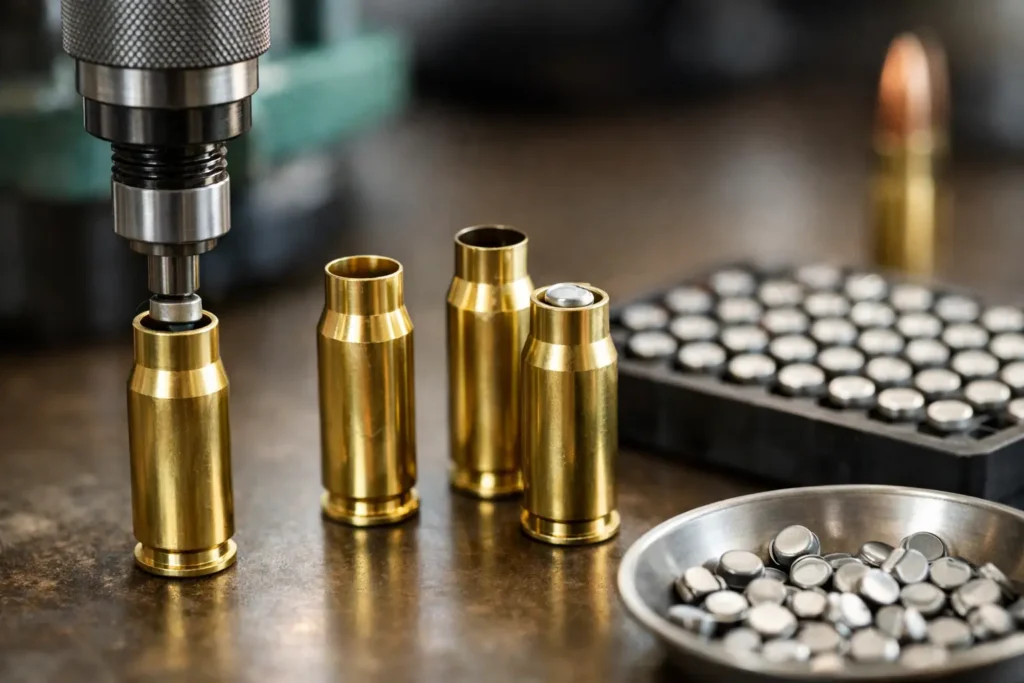
A load can have the right powder charge, the right bullet, and proven brass prep, then still give you inconsistent ignition because the primer was not seated correctly. That is why primer seating depth explained matters to serious reloaders. It is a small detail with outsized effects on reliability, pressure consistency, and confidence at the bench or in the field.
Primer seating depth is simply how far the primer sits below the case head after seating. In practical terms, a properly seated primer is usually just below flush and firmly against the bottom of the primer pocket. That last part matters more than many new reloaders realize. The goal is not just to make the primer look even. The goal is to seat it fully so the anvil is set correctly and the priming mix can ignite as intended when struck by the firing pin.
Primer seating depth explained in practical terms
If a primer is high, even by a small amount, it can create problems immediately. You may get light strikes, misfires, inconsistent ignition, or in some firearms a risk of slamfire. If a primer is seated firmly to the bottom of the pocket and sits a few thousandths below flush, ignition is generally more consistent because the primer is supported properly and the firing pin strike is doing its intended job.
That does not mean deeper is always better. Crushing a primer excessively can damage components, distort the cup, or create erratic performance. Reloading is full of tolerances, and this is one of those areas where feel, consistency, and pocket condition matter as much as the number itself.
Most experienced reloaders look for a primer seated about 0.003 to 0.005 inch below flush. That range is a useful reference, not a law of physics. Brass brand, primer brand, pocket uniformity, and the seating tool all affect what proper seating feels like. In real-world bench work, what you want is repeatable firm contact at the bottom of the pocket without forcing the primer beyond that point.
Why seating depth affects ignition
A boxer primer contains a cup, priming compound, foil or paper disc, and an anvil. During seating, the primer is pressed into the pocket and the anvil is set into position. A proper seat preloads the internal parts slightly. When the firing pin hits the cup, the priming compound is crushed between the cup and anvil with enough force to ignite reliably.
If the primer is not fully seated, part of the firing pin energy can be spent finishing the seating process instead of igniting the primer cleanly. That can show up as a weak report, a delay, or a dead round. In a precision rifle load, even small variations in ignition can widen velocity spreads. In a pistol load, they can show up as inconsistent feel and function. Reliable ignition, every time, starts with mechanical consistency.
There is also a safety angle. High primers are not just an annoyance. In some semi-auto platforms with free-floating firing pins, they can raise the risk of an unintended discharge when the bolt closes. That is one reason experienced reloaders pay close attention to primer feel during seating instead of treating it like a simple lever pull.
What proper primer seating feels like
Most hand priming tools and press-mounted priming systems communicate seating through feel. At first, that can seem vague. With experience, it becomes one of the clearest signals in the loading process.
You should feel the primer enter the pocket, resistance increase, and then a distinct stop as it bottoms out. The motion should be smooth and controlled. If you feel unusual crunching, abrupt resistance, or a primer that goes in too easily, stop and inspect the brass. Dirty pockets, crimped pockets, oversized pockets, and damaged primer cups all change the feel.
This is where consistent case prep pays off. Mixed brass with different pocket dimensions can make it harder to seat by feel alone. For match ammo, some reloaders uniform primer pockets to reduce variation. For general-purpose ammunition, clean pockets and sorted brass often get you most of the benefit without adding unnecessary steps.
Common causes of incorrect seating depth
The most common issue is a dirty or partially obstructed primer pocket. Carbon buildup can prevent the primer from reaching the bottom of the pocket, leaving it high even when it feels tight. Military brass with an intact primer crimp is another classic culprit. Until that crimp is removed properly, seating pressure rises and primers can deform before they seat fully.
Tool setup also matters. Some priming systems offer excellent feel, while others favor speed. Neither is automatically better. A progressive press can produce very good results, but it gives you less tactile feedback than a dedicated hand priming tool. If you are chasing very consistent ignition, especially for rifle loads, that difference may matter.
Primer and brass dimensions vary by manufacturer as well. A primer that seats perfectly in one brand of brass may feel tighter in another. That is normal. What is not normal is forcing a primer into a pocket that clearly feels wrong. Consistency comes from understanding the range of normal and stopping when something falls outside it.
How to check primer seating depth
The simplest check is tactile. Run a fingertip across the case head. A properly seated primer should feel slightly below flush. If it catches your finger, it is too high. This method is quick and effective for routine loading.
For more exact checks, use a straightedge across the case head or a caliper depth feature if you want to confirm your process. Many reloaders do not measure every round, but they will measure a few when setting up a new tool, switching primer brands, or working with unfamiliar brass. That is a smart habit. It turns guesswork into a repeatable standard.
Visual inspection helps too, but it should not be the only method. A primer can look acceptable and still not be fully bottomed out. Feel tells you more than appearance in most cases.
Primer seating depth explained for different applications
Not every loading goal puts the same weight on primer seating consistency. For high-volume pistol ammo, the priority is usually safe, reliable function. That means every primer below flush, every pocket appropriate for the primer, and no shortcuts on inspection.
For precision rifle loads, seating depth becomes part of a larger consistency chain that includes case prep, neck tension, powder charge uniformity, and bullet seating. Will primer seating depth alone transform a load? Usually not. But poor primer seating can absolutely undermine a load that is otherwise built carefully.
Hunting ammunition sits somewhere in the middle. It may not be loaded to benchrest standards, but it has to fire without question in field conditions. Cold weather, repeated chambering, and rough handling all make proper primer seating more important, not less. When the shot matters, dependable ignition is non-negotiable.
Best practices for consistent primer seating
Use clean, correctly prepared brass. Remove military crimps fully, discard cases with loose primer pockets, and do not try to salvage brass that no longer holds primers with proper tension. Choose a priming method that gives you enough control for your application. Speed has value, but not if it hides seating problems.
Stay consistent with components whenever possible. Switching between primer brands or brass lots can change seating feel and depth slightly. That does not mean you should avoid switching. It means you should recheck your setup and not assume everything will behave the same way.
It also helps to buy quality primers from trusted sources and keep enough of your preferred type on hand when availability allows. Serious reloaders know that component consistency is part of load consistency.
When to stop and troubleshoot
If primers are seating high, crushing, tilting, or going in with unusual force, stop loading and find the cause. The usual fixes are straightforward: clean the pockets, remove the crimp properly, inspect the priming tool, or sort out suspect brass. If pockets feel loose, retire the case. A loose primer pocket is not a minor defect. It is a sign the brass is done.
The same applies if you start seeing ignition oddities on the range. Misfires, weak ignition, or unusual velocity variation can have several causes, but primer seating should be near the top of the checklist. It is easy to focus on powder and bullets because they get more attention. Reliable ignition begins one step earlier.
Primer seating depth is one of those details that separates assembled ammo from well-built ammo. It does not need mystique, and it does not need overthinking. Seat the primer fully to the bottom of the pocket, keep it slightly below flush, and pay attention when the feel changes. Small details like this are where accuracy, safety, and field performance start to line up.