
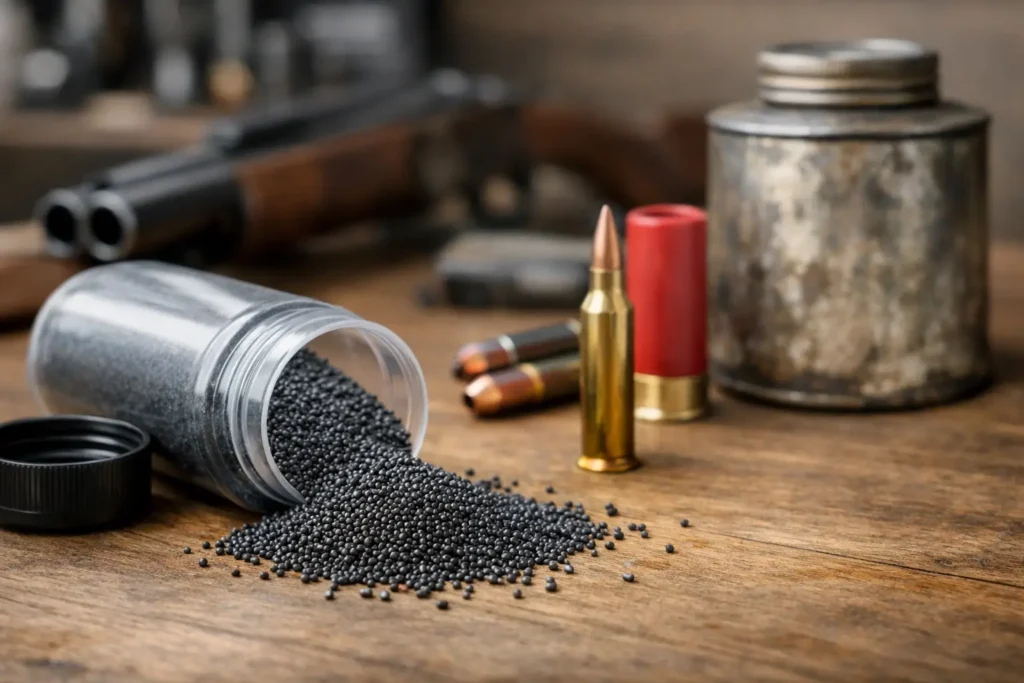
A reloader usually asks can smokeless powder expire at exactly the wrong moment – when opening an older jug on the bench, checking a long-stored backup supply, or trying to decide whether a hard-to-find powder is still fit for precise work. The short answer is yes. Smokeless powder does not last forever, and its condition matters far more than the date printed on the container.
That said, age alone is not the whole story. Properly stored powder can remain stable for many years. Poorly stored powder can deteriorate much sooner. For anyone who cares about ignition reliability, consistent pressure, and safe field performance, the real question is not simply how old the powder is. It is whether the powder is still chemically stable.
Can smokeless powder expire, or just go bad slowly?
In practical terms, smokeless powder expires when it begins to break down enough that it is no longer safe or dependable to use. This is not like food where there is a clean expiration date. Powder degradation is chemical, gradual, and heavily influenced by storage conditions.
Smokeless powder contains stabilizers that help control the natural breakdown of nitrocellulose and, in some formulations, nitroglycerin. Over time, those stabilizers are consumed. Once that process advances too far, the powder can shift from stable and predictable to degraded and unsafe. That change may be slow, but it is real.
For serious reloaders, this matters because a deteriorating powder lot may not simply lose performance. It can become erratic. Pressure behavior may change. Ignition consistency may suffer. In advanced stages, the powder can produce strong acidic fumes and attack the inside of its own container.
What causes smokeless powder to deteriorate?
Heat is the biggest enemy. Powder stored in a cool, stable environment generally lasts much longer than powder kept in a garage attic, vehicle trunk, uninsulated shed, or any place with repeated temperature spikes. High heat accelerates chemical breakdown, and repeated cycling does not help.
Humidity is another factor, though less in the sense of direct moisture exposure and more in the sense of poor overall storage conditions. Original factory containers are designed to protect the powder and allow safe venting characteristics. Once powder is moved into unapproved containers, exposed to contamination, or stored where moisture and heat fluctuate together, shelf life gets less predictable.
Contamination is often overlooked. Powder that has been exposed to oils, solvents, penetrating sprays, bore cleaners, or even mixed accidentally with another powder should be treated with caution. Reliable ignition every time starts with uncontaminated components. Once powder integrity is compromised, precision is gone.
How long can smokeless powder last?
There is no universal clock. Some properly stored smokeless powders remain usable for decades. Others show signs of instability much sooner if they were exposed to poor storage conditions. Manufacturer guidance often emphasizes inspection over age, and that is the right approach.
An unopened factory container stored in a cool, dry area with stable temperatures is in a very different category from an opened bottle that has lived through years of summer heat and winter freezing. One may still be completely serviceable. The other may be a disposal candidate even if the label looks fine.
For reloaders who keep reserve inventory, rotation helps. Use older, still-sound stock first, keep containers sealed when not in use, and avoid buying more than you can store correctly. Supply availability can be uneven, so it makes sense to keep backup powder, but only if the storage standard matches the value of the component.
Signs that old powder may no longer be safe
The most important inspection tool is still your senses, especially smell and appearance. Fresh smokeless powder usually has the normal solvent-like odor associated with its formulation. Deteriorating powder often develops a sharp acidic smell. Many reloaders describe it as harsh, sour, or distinctly different from normal powder odor.
Appearance matters too. If the granules show rust-colored dust, reddish residue, clumping, unusual sheen changes, or obvious breakdown in shape, that is a warning sign. Check the inside of the container as well. Corrosion around the cap, staining inside the bottle, or residue that was not there before can indicate chemical decomposition.
If the powder container is bulging, leaking fumes, or shows obvious internal reaction, do not use it. At that point the issue is no longer just load consistency. It is a safety problem.
Can expired powder still fire normally?
Sometimes, yes – and that is part of the risk. A degraded powder may still ignite, which can tempt reloaders into assuming it is fine. But “still goes bang” is not the standard. The standard is stable, repeatable performance within known load data.
Powder that is starting to break down may produce inconsistent burn characteristics. That could mean velocity variation, poor metering behavior, odd residue, or pressure changes that are not obvious until you are already outside the margin you intended to work within. Precision work exposes these issues quickly, but casual testing does not always catch them before a problem appears.
That is why experienced reloaders do not try to salvage questionable powder through trial loads. If stability is in doubt, performance testing is the wrong way to answer the question.
Storage practices that extend powder life
If you want long service life from smokeless powder, store it in its original factory container and keep that container tightly closed when not in use. The original packaging is part of the safety system. It is not just branding.
Choose a cool, dry, dark location with minimal temperature fluctuation. A climate-controlled interior space is better than a detached shed or garage in most regions. Keep powder away from direct sunlight, open flame, heaters, furnaces, and anything that could introduce contamination.
It also makes sense to separate powder from cleaning chemicals and oils. On a busy bench, cross-contamination happens faster than people think. Good organization protects both safety and load consistency.
For reloaders maintaining multiple powders from brands like Hodgdon, IMR, Winchester, Alliant, Accurate, Ramshot, Vihtavuori, or Shooters World, label discipline matters too. Keep original lot information visible and never combine leftover powder from different containers, even if the product name appears identical. Lot-to-lot variation is real, and mixing powders creates unnecessary uncertainty.
What about powder inherited from someone else?
This is where caution should outweigh thrift. If you do not know how the powder was stored, you do not know much that matters. A sealed factory bottle from a clean indoor storage setup may be worth evaluating carefully. A partial container from a basement shelf, workshop drawer, or hunting camp bin deserves much more skepticism.
Unknown history is a major variable. If there is any odd smell, residue, corrosion, or uncertainty about what is actually in the bottle, do not load with it. Component cost is small compared to the value of a rifle, a match, or your safety margin.
This is also why buying from a specialized source matters. A focused retailer such as Lee Reloading Canada understands that reloaders are not shopping for generic supplies. They are buying for controlled performance, trusted brand identity, and confidence that components have moved through a reliable channel.
When should you dispose of smokeless powder?
Dispose of it when there are clear signs of deterioration, when the identity of the powder is uncertain, or when storage history makes its condition impossible to trust. If the odor is acidic, the granules look wrong, or the container shows internal reaction, the answer is simple – do not use it.
Disposal should follow manufacturer guidance and local regulations. Methods can vary by jurisdiction, so the right process depends on where you are. What does not vary is the principle: questionable powder is not worth gambling on.
The real answer reloaders can use
Can smokeless powder expire? Yes. But the better answer is that smokeless powder ages according to chemistry and storage, not just calendar time. Well-kept powder can remain dependable for years. Neglected powder can become unsafe long before anyone expects it.
For reloaders chasing clean ignition, stable pressures, and repeatable results, the standard is simple. If the powder is properly stored, correctly identified, and shows no signs of deterioration, it may still be serviceable. If anything about it raises doubt, treat that doubt as useful information. Precision starts long before the first charge hits the case.