
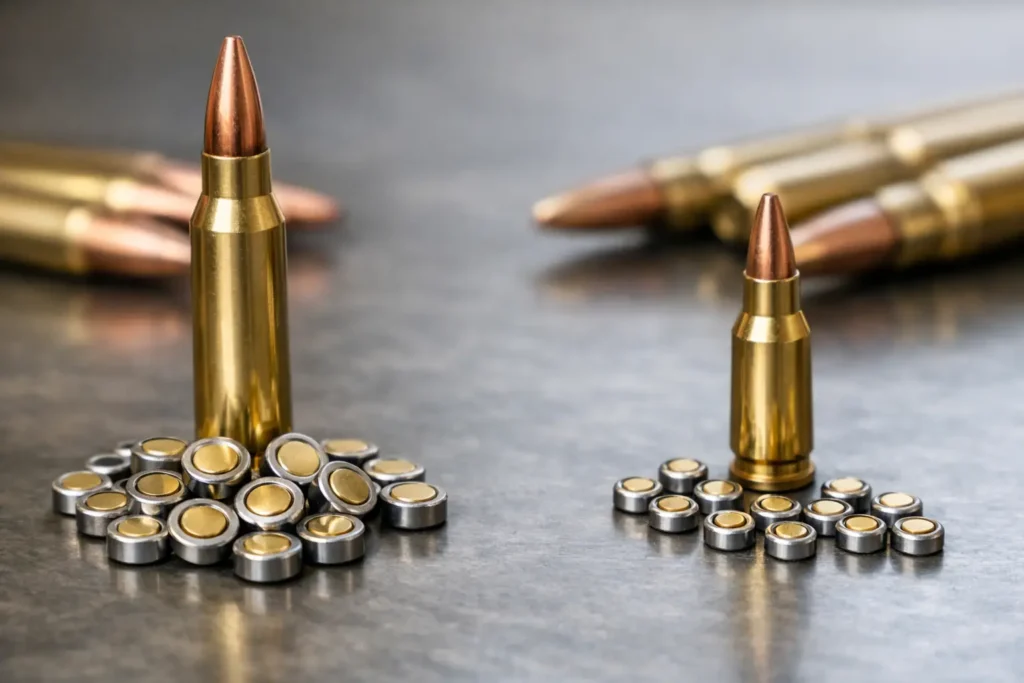
A primer pocket tells the truth faster than the box label. If the case is cut for a large rifle primer, a small rifle primer is not an alternative. If it takes a small rifle primer, a large rifle primer is out of the question. That may sound obvious, but large rifle vs small rifle primers is still one of the most common points of confusion for reloaders sorting brass, chasing consistency, or trying to understand why one cartridge family uses one size and another uses the other.
This is not a matter of preference in the way powder charge tuning or seating depth can be. Primer size starts with case design, and from there it affects ignition behavior, pressure response, and the margin for reliable performance. Serious reloaders know that primer selection is part of the load, not an afterthought.
Large rifle vs small rifle primers – what changes
The first and most obvious difference is physical size. Large rifle primers are larger in diameter than small rifle primers, and the case must be made with the correct primer pocket to match. There is no safe crossover. You do not substitute one for the other unless the brass itself was specifically designed for that primer size.
The second difference is ignition character. In broad terms, large rifle primers typically deliver a different flame profile than small rifle primers. That can matter when you are lighting larger powder charges, certain extruded powders, or loads used in colder hunting conditions. Small rifle primers, on the other hand, are often associated with cartridges built around smaller case capacity, faster cycling platforms, or pressure ranges where cup strength and primer construction become a major part of reliable function.
That does not mean large rifle is stronger and small rifle is weaker. It means each was engineered for a specific pocket size and a specific class of rifle cartridges. Primer performance always depends on the full combination – brass, powder, bullet, pressure, firing pin energy, and ambient conditions.
Why cartridge design decides the answer
The cleanest way to think about primer choice is this: the cartridge case decides what fits, and the load data decides what works. A .308 Winchester case cut for a large rifle primer must use large rifle primers. A .223 Remington case uses small rifle primers. Plenty of confusion comes from comparing cartridge size rather than primer pocket size, but those are not the same thing.
Some cartridges also exist with different primer pocket configurations depending on the brass manufacturer or intended use. That is where careful sorting matters. Reloaders working with precision brass already know this, especially in calibers where manufacturers have offered small primer and large primer versions of the same case. Mixing those cases on the bench is an easy way to create delays at best and mistakes at worst.
If you are processing once-fired brass, verify every lot before priming. Do not assume all brass in a given caliber uses the same rifle primer size. Case head inspection is part of the job.
Large rifle primers in practical use
Large rifle primers are common in many traditional full-size rifle cartridges. They are often paired with medium to large powder charges and proven hunting or target loads where dependable ignition across temperature swings matters. In these applications, reloaders usually value a steady pressure curve and uniform ignition more than any theoretical advantage attached to a smaller primer.
This is why long-established cartridge data often centers around large rifle primers from trusted brands. The components were developed together over decades of practical use. When a manual specifies a large rifle primer, that recommendation is based on tested pressure behavior, not guesswork.
Small rifle primers in practical use
Small rifle primers dominate in cartridges such as .223 Remington and many other modern small-bore rifle rounds. They are also common in platforms where higher operating pressures, semi-auto cycling demands, or free-floating firing pins make primer cup characteristics especially relevant.
Not all small rifle primers are built the same. Some have thicker or harder cups than others, and that matters. For example, a load that runs perfectly with one small rifle primer may show different pressure signs or ignition behavior with another. That is especially true when moving between standard and magnum versions, or between general-purpose primers and those marketed for benchrest or AR-style applications.
Pressure, cup strength, and ignition reliability
Reloaders sometimes focus on primer size first and primer construction second. In real use, both matter.
Cup strength affects how a primer handles pressure and firing pin impact. In a bolt gun, you may have a wider range of acceptable primer choices within published data. In a semi-auto rifle, especially one with a floating firing pin, primer sensitivity and cup thickness can become more important. A primer that is too soft for the application can increase the risk of slamfires or show flattening earlier, which can muddy your pressure reading.
Ignition reliability is the other half of the equation. A primer has to light the powder charge consistently, and that becomes more noticeable with harder-to-ignite powders, reduced temperatures, or loads near the edges of a cartridge’s normal operating window. Magnum primers exist because some combinations need a hotter or more forceful ignition event. That is separate from primer size. You can have large rifle magnum and small rifle magnum primers, and they are not interchangeable with standard primers unless your data supports the change.
Can one produce better accuracy than the other?
Sometimes, but not in the simplistic way forum debates suggest.
A well-built cartridge using a small rifle primer can be extremely consistent. So can a traditional large rifle primer load. Accuracy gains usually come from the entire load system working together – brass uniformity, neck tension, powder choice, bullet seating, and velocity spread. Primer size alone is rarely the magic variable.
Where reloaders do see meaningful differences is in primer brand, lot consistency, and primer type within the correct size class. A change from one large rifle primer to another may alter velocity spread enough to matter at distance. The same goes for small rifle primers. That is why experienced loaders rework the load when they change primers, even if the new primer appears equivalent on paper.
The right question is not which size is better. It is which primer the cartridge was designed for, and which tested option delivers the most stable results in your rifle.
Large rifle vs small rifle primers in load development
During load development, treat any primer change as a real component change. If you switch from one brand of large rifle primer to another, back off and work up again. If you switch from a standard small rifle primer to a magnum small rifle primer, do the same. Pressure can move, velocity can move, and group shape can change.
This matters even more when components are hard to source and reloaders are tempted to substitute based on availability. Reliable inventory is valuable, but safe load work still starts with compatible components and published data. The art of reloading is not improvisation for its own sake. It is controlled repeatability.
If you are evaluating new primers, change one variable at a time. Keep brass lot, powder charge, bullet, and seating depth constant. Watch velocity spread, extreme spread, group dispersion, and pressure signs together. A primer that gives slightly higher velocity is not automatically better if the load becomes less forgiving across temperatures or starts showing pressure early.
Common mistakes reloaders make
The biggest mistake is assuming primer size follows cartridge popularity or case length. It does not. The second is treating standard and magnum primers as interchangeable without load adjustment. The third is ignoring brand-to-brand differences within the same primer size.
Another common issue is poor brass segregation. If you load calibers where both primer pocket sizes may exist in the market, mixed brass can interrupt the process and create preventable errors. Keep lots separated from the moment they hit the bench.
Finally, avoid reading too much into appearance alone. Flattened primers are only one pressure indicator, and primer appearance varies with cup design. Compare results within the same primer family before drawing conclusions.
What to buy when you need dependable results
Buy for the cartridge first, then for the application. Match the primer size to the brass, match the primer type to published data, and match the construction to the rifle’s operating characteristics. Hunters may prioritize cold-weather ignition. Precision shooters may chase lower spread and lot consistency. High-volume semi-auto shooters may focus on reliable seating, cup strength, and dependable cycling.
That is where a specialist supplier earns its place. Stock depth matters, but so does carrying the primer classes reloaders actually need – standard, magnum, and the right rifle sizes from brands with proven field performance. For reloaders who value precision, reliability, and real-world availability, that is more than convenience. It is part of keeping a load stable over time.
The smartest primer choice is usually the least dramatic one: the correct size, the correct type, and the one your rifle has already shown it can trust.