
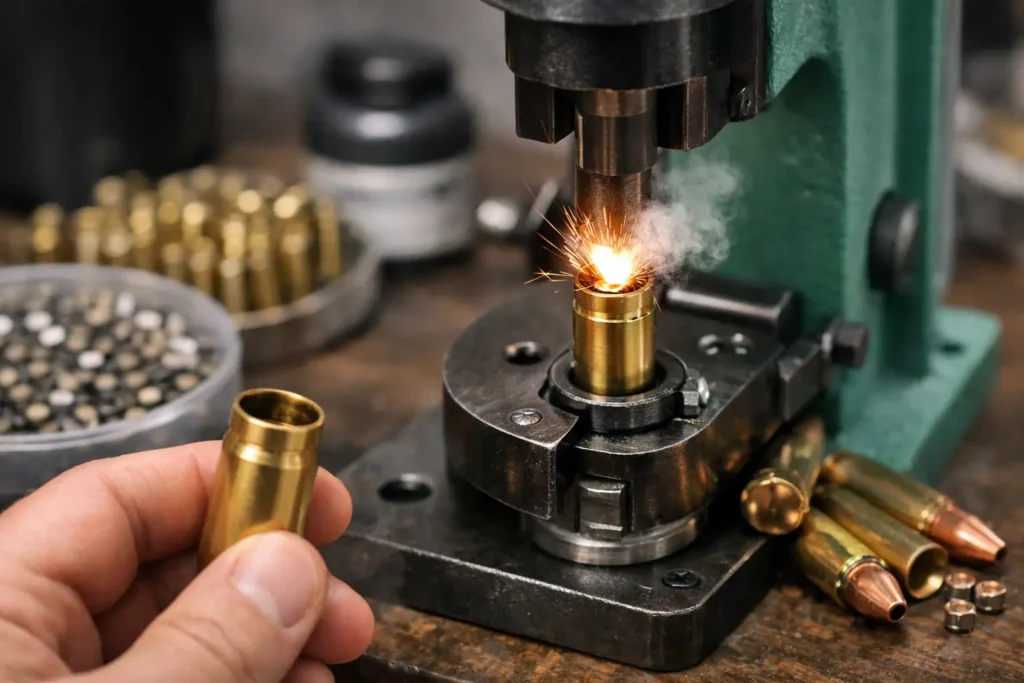
A misfire gets your attention fast. Whether it happens on the firing line or in the field, it raises the same question every serious handloader asks next: what failed in the ignition chain? If you want to know how to avoid primer misfires, the answer is rarely one single fix. Reliable ignition comes from consistent primer seating, clean case prep, correct component selection, and disciplined storage and handling.
Why primer misfires happen
A primer has one job – ignite the powder charge when struck with adequate force. When that does not happen, the cause usually falls into one of three categories: the primer was compromised, the primer was installed incorrectly, or the firearm did not deliver a proper strike.
Reloaders often focus on the primer itself first, but that can be misleading. A dead primer is possible, especially if it has been contaminated by oil, moisture, or rough handling. Still, many so-called primer failures trace back to high primers, inconsistent seating depth, dirty primer pockets, or brass that was not fully prepared for a new primer.
This matters because ignition reliability is cumulative. A small inconsistency at each step can add up until the round becomes unpredictable. Reliable ignition, every time, starts well before the cartridge reaches the chamber.
How to avoid primer misfires at the bench
The bench is where most ignition problems are either created or prevented. Good loading practices do more for reliability than trying to diagnose problems after the fact.
Seat primers to the correct depth
Improper seating is one of the most common causes of misfires in reloaded ammunition. A primer that sits proud of the case head can absorb part of the firing pin’s energy as it finishes seating under impact. Instead of crushing the priming compound sharply enough to ignite, the strike gets partially wasted.
The fix is straightforward but demands consistency. Seat each primer fully until it is slightly below flush and firmly bottomed in the pocket. You should feel the primer contact the bottom of the pocket and settle in. If seating pressure feels inconsistent from case to case, that is a sign to stop and inspect your brass rather than forcing the operation.
Over-seating can also be a concern if excessive force distorts the primer cup or compound. In practice, the bigger issue for most reloaders is not seating deeply enough, not seating too deeply.
Keep primer pockets clean and uniform
Carbon buildup in the primer pocket can prevent full seating. So can brass shavings, media residue, or a crimp that was not removed correctly. If the primer cannot sit squarely at the bottom of the pocket, ignition reliability suffers.
For high-volume pistol brass, some reloaders are comfortable with minimal pocket cleaning if results stay consistent. For precision rifle loads, pocket condition matters more. Uniform depth and clean contact surfaces help the primer seat predictably, which helps the firing pin do its job predictably.
Military brass deserves extra attention. If a crimp remains, even partially, the new primer may seat crooked, stop short, or get damaged during insertion. Swaging or reaming the crimp correctly is not optional if you want dependable ignition.
Inspect brass before priming
Loose primer pockets are a different problem, but they can still lead to failures. If a primer seats with suspiciously little resistance, the pocket may be worn. That round might fire fine, or it might not. Either way, it is no longer giving you the level of consistency a serious reloader should accept.
Look for pockets that feel too tight, too loose, or uneven. Check for case head damage, burrs around the pocket, and signs of repeated high-pressure use. Brass condition directly affects primer performance.
Match the primer to the load
Primer selection is not interchangeable across every application, even when dimensions match. Cup thickness, brisance, and intended use all affect ignition behavior.
Use the correct primer class
Small rifle and small pistol primers are not simply substitutes for one another. The same goes for large rifle and large pistol. Dimensions may appear close enough in some discussions, but performance and safety are not the same. Cup hardness and pressure characteristics differ, and using the wrong primer can create either ignition issues or pressure issues.
Magnum primers also deserve respect. They are useful where data calls for them, especially with harder-to-ignite powder charges or certain environmental conditions. But swapping a standard primer for a magnum primer without published load data is not a reliability upgrade. It is a component change that can alter pressure and velocity.
The practical rule is simple: use the exact primer type your load data specifies whenever possible. If substitution becomes necessary, work from trusted data and treat the change as a fresh load development variable.
Consider your firearm’s ignition system
Some rifles and pistols have lighter hammer or striker springs, especially competition-tuned guns. That setup may run well with softer primer cups but struggle with harder cups. In that case, the issue is not poor primer quality – it is a mismatch between the firearm and the primer.
If misfires cluster around one firearm and one primer brand or class, pay attention to that pattern. A precision rifle with a healthy firing pin strike should not have recurring ignition problems with properly seated, suitable primers. A tuned pistol with a reduced-power spring might.
This is where serious reloaders separate component quality from system compatibility. Reliability depends on both.
Handling and storage affect primer reliability
A primer is a durable component when stored properly, but it is not indestructible. Contamination remains one of the easiest ways to create a misfire.
Keep primers dry, clean, and in original packaging
Solvents, penetrating oils, excessive humidity, and loose bench debris all create risk. Primers should stay in their factory packaging until use, stored in a cool, dry space away from contamination and away from casual handling.
Dumping primers into random containers, bins, or trays for long-term storage is poor practice. Original packaging protects the primers and keeps lot information intact. That matters if you need to trace performance changes or isolate a problem.
Touching primers with clean hands during loading is generally fine. Touching them after handling case lube, oil, or solvents is not. Priming compound and contamination do not mix well.
Avoid rough seating practices
Primers are built to withstand normal handling, but crushing, tilting, or forcing them into resistant pockets can damage the cup or anvil. If priming feels rough, stop and diagnose the cause. A stubborn primer pocket is a brass prep issue, not a force issue.
Good tools help here. A priming tool with solid feel and repeatable leverage makes it easier to detect when something is wrong. You are not just installing a component. You are building the first stage of the ignition system.
When the primer is not the real problem
If you have done everything right at the bench and still see misfires, shift your attention to the firearm.
A weak mainspring, fouled firing pin channel, shortened firing pin protrusion, excessive headspace, or bolt not fully in battery can all mimic a primer problem. The clue is often in the primer strike itself. A shallow or inconsistent dent points toward the gun. A normal dent on a properly seated primer that still does not fire points back toward the component or handling history.
There is also the human factor. A round that misfires once but fires on a second strike often suggests a high primer or marginal seating issue. A round that shows repeated solid strikes and never ignites is more likely a dead or contaminated primer. The difference matters because the corrective action is different.
Build a process that catches errors early
The most effective answer to how to avoid primer misfires is process control. Not theory, not guesswork, and not blaming one component before checking the rest.
Seat primers with consistent feel. Prep brass so the pocket accepts the primer correctly. Match primer type to published data and to the firearm’s ignition characteristics. Store components like precision parts, not shelf clutter. Then pay attention to patterns. If one lot of brass, one firearm, or one setup starts producing anomalies, isolate the variable before loading more.
That is the practical side of reloading done right. Precision is not only about group size or velocity spread. It starts with ignition, and ignition starts with standards you can repeat every time you sit down at the bench.
For reloaders who expect performance from every round, the goal is not just fewer misfires. It is a loading process solid enough that misfires become genuinely unusual.