
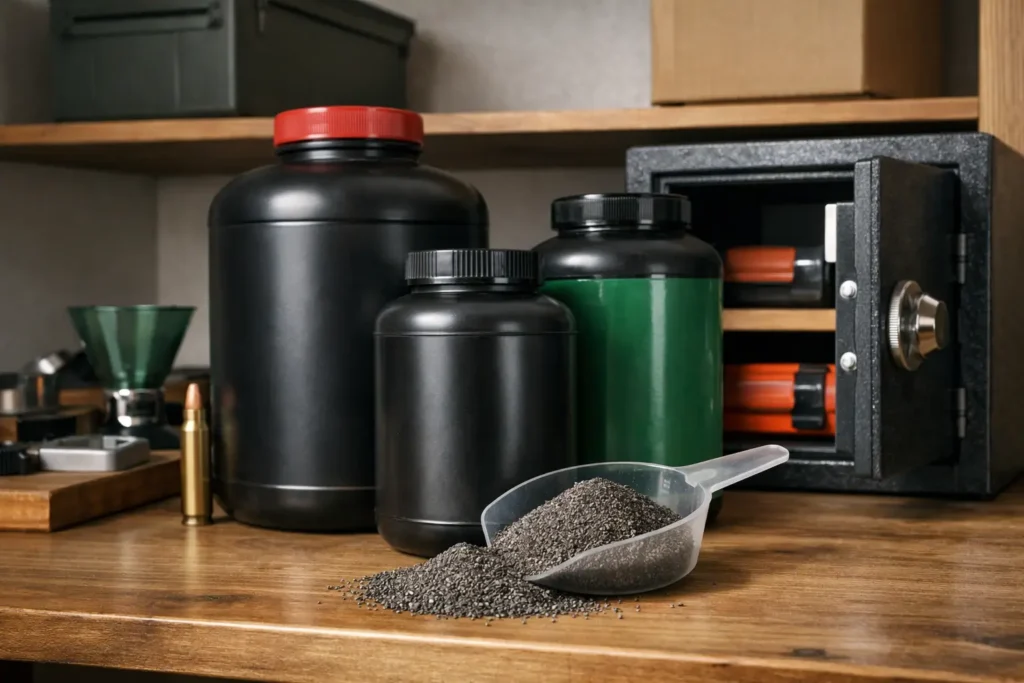
A powder charge can deliver excellent consistency on the bench, but only if the powder behind it has remained stable, clearly identified, and protected from avoidable hazards. Knowing how to store reloading powder safely is not just a housekeeping detail. It protects component integrity, prevents costly mix-ups, and gives you more confidence every time you set up to reload.
Smokeless powder is a propellant, not an ordinary garage chemical. Treat its storage area as part of your loading process: controlled, organized, and designed to prevent a small problem from becoming a serious one.
Start With the Original Powder Container
Keep smokeless powder in its original manufacturer container whenever possible. The factory container carries the product name, lot information, warnings, and handling guidance that let you confirm exactly what is on your bench. That label is a safety control, especially when several powders may use similar-looking granules.
Do not combine partial containers, even when the labels appear to match. Lot-to-lot variation can exist, and a container that is not fully verified should never become a guessing game. If a label is damaged, replace it with clear identification before returning the container to storage. Include the powder name, manufacturer, and any lot details you still have.
Avoid transferring powder into unmarked jars, food containers, drink bottles, or improvised bulk containers. These choices can create misidentification risks and may not be suitable for propellant storage. The original container is designed for the product and remains the most reliable option.
Choose a Cool, Dry, Stable Location
Powder storage works best in a location with stable, moderate conditions. Heat, prolonged direct sunlight, moisture, and major temperature swings can all work against long-term component condition. A dedicated interior closet, cabinet area, or storage room away from daily traffic is generally a better choice than an attic, vehicle, shed, or damp basement.
The goal is not to create a laboratory. It is to avoid extremes. A garage may be acceptable in some climates if it stays dry and reasonably temperate, but it is often a poor choice where summer heat, winter cold, or humidity are severe. If the space regularly becomes uncomfortable for people, it is not ideal for a powder inventory.
Keep powder away from furnaces, water heaters, stoves, electrical panels, open flames, welding areas, battery chargers, and other heat or ignition sources. Do not store it beside gasoline, solvents, aerosol products, propane cylinders, or other flammable household materials. Separation reduces the chance that an unrelated fire or spill turns into a larger hazard.
Use Storage That Does Not Create Extra Pressure Risk
The cabinet matters as much as the room. Powder should be protected from casual handling, but it should not be stored in a heavy, tightly sealed metal box that could contain pressure in a fire. A purpose-built powder cabinet or a cabinet designed around applicable fire-safety guidance is the better approach.
Many experienced reloaders use a wooden cabinet because it protects containers while avoiding the pressure-confinement concerns associated with rigid sealed storage. The cabinet should be sturdy, kept clear of heat sources, and located where it is not exposed to water leaks, direct sun, or frequent impact. A lock may be appropriate where children, guests, or unauthorized adults could access the area.
Do not treat a safe designed for firearms as an automatic solution for powder. A firearm safe may be excellent for securing firearms, but its construction and sealing characteristics may not be appropriate for storing propellant. Evaluate powder storage separately, based on manufacturer recommendations and local fire code requirements.
Keep Powder and Primers Separate
Powder and primers serve different roles in the loading process and should not share the same immediate storage compartment. Store primers in their original packaging and keep them separated from powder by distance or by distinct cabinets. This makes inventory easier to manage and helps limit the number of energetic components concentrated in one spot.
The same principle applies to loaded ammunition, empty cases, and active loading tools. A clean division between storage and the loading bench prevents accidental mix-ups. Your powder cabinet should hold powder, not a random collection of cleaning chemicals, loose bullets, paperwork, and old shop supplies.
For reloaders who keep several powder types on hand, organization is part of safety. Arrange containers so labels face forward, group them in a consistent way, and avoid stacking that makes it easy to knock containers over while reaching for another one. Inventory discipline improves accuracy before a charge is ever thrown.
Follow Quantity Limits and Local Requirements
Storage limits and construction requirements can vary by jurisdiction, building type, and whether the powder is kept in a residence, workshop, or other structure. Fire codes, insurer requirements, and local rules may establish limits on the amount of smokeless powder that can be stored and how it must be contained.
This is one area where “more capacity” is not automatically better. Buying enough of a proven powder to support consistent loading can make practical sense when supply is uneven. However, stocking beyond what your storage area and local requirements can support creates unnecessary risk. Maintain an inventory that fits your actual loading volume, your available storage, and the applicable rules where you live.
If you are uncertain, verify the requirements with your local authority having jurisdiction and review the powder manufacturer’s current guidance. Regulations should shape the cabinet and inventory plan from the start, not after the shelf is already full.
Inspect Powder Before It Goes Back on the Shelf
Safe storage includes periodic inspection. When you return a powder container after a loading session, make sure the cap is secured, the label is readable, and no powder has collected around the threads or on the outside of the container. Wipe up minor residue carefully according to the manufacturer’s guidance and keep the storage area clean.
Watch for signs that a product may no longer be suitable for use, such as an unusual odor, visible deterioration, rusting around a metal cap, or unexplained discoloration. If powder appears questionable, do not load with it and do not attempt to salvage it by mixing it with fresh powder. Follow manufacturer guidance and local disposal rules for any suspect material.
A simple rotation system also helps. Put newly purchased containers behind older, properly stored stock so your inventory moves in an orderly direction. This is not about rushing to use powder that remains in good condition. It is about knowing what you have, avoiding duplicate purchases, and reducing the chances of an old container being forgotten at the back of a cabinet.
Build Better Habits at the Loading Bench
The safest powder cabinet can be undermined by poor bench habits. Return the powder container to storage as soon as the loading operation is complete. Do not leave open containers on the bench overnight, and never keep multiple open powder containers in the same work area unless your process genuinely requires it.
When changing powders, finish the current task, empty and verify the powder measure as appropriate, and put the previous container away before opening the next one. One powder on the bench at a time is a practical standard that prevents many avoidable errors. It also keeps your work area focused on the load currently being assembled.
A disciplined storage routine should cover four checks: correct original container, secure cap, readable label, and proper cabinet placement. These are small actions, but they reinforce the same standards that produce dependable ignition and consistent field performance.
How to Store Reloading Powder Safely Over the Long Term
Long-term storage is less about doing something elaborate and more about maintaining control. Keep the powder in its original container, in a dry and temperature-stable area, away from heat and incompatible materials. Use appropriate storage furniture, separate primers from powder, and respect the quantity limits that apply to your location.
For serious reloaders, powder is a performance component. IMR, Hodgdon, Winchester, Alliant, Vihtavuori, Ramshot, Accurate, and other trusted brands earn their place on the bench through consistency, but that consistency depends on proper handling after purchase. Lee Reloading Canada customers who plan storage before placing a larger order are better positioned to protect both their components and their loading routine.
Before your next loading session, take two minutes to look at the cabinet rather than the bench. Clear out unrelated materials, confirm every label is visible, and make sure each container is where it belongs. That quiet bit of discipline supports safer loading and more confidence when the shot matters.
