
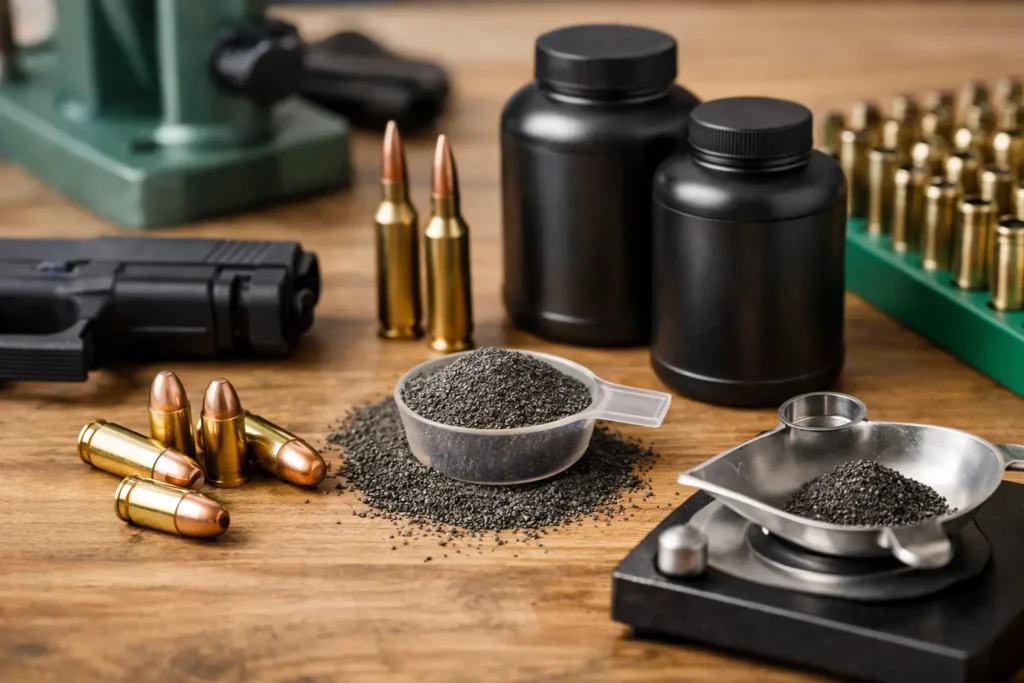
The first mistake most new reloaders make is treating powder like a generic ingredient. It is not. Smokeless powder is the engine of the load, and small differences in burn rate, charge weight, and application can change pressure, velocity, accuracy, and reliability in a hurry. A good smokeless powder guide for beginners starts there: powder choice is not about what is available first, but about what matches your cartridge, bullet, primer, and intended use.
If you are just getting into reloading, the goal is not to learn every powder on the market at once. The goal is to understand how powder behaves, how published data keeps you inside safe limits, and why consistency matters more than chasing speed. Power and precision in every load starts with disciplined component selection.
What smokeless powder actually does
Smokeless powder is a propellant designed to burn progressively and generate gas at a controlled rate. That gas drives the bullet down the barrel. Different powders burn at different speeds, and that burn rate has to fit the cartridge case capacity, bullet weight, barrel length, and pressure window of the round you are loading.
This is why a pistol powder and a rifle powder are not interchangeable, even if the charge weights look close on paper. Faster powders reach peak pressure quickly and are suited to many handgun and some shotshell applications. Slower powders build pressure over a longer curve and are commonly used in rifles and magnum handgun loads. Use the wrong powder in the wrong application and pressure can spike well beyond safe limits.
For beginners, that means one simple rule matters more than anything else: load only from current published data for the exact powder you are using. Brand name matters. Product name matters. Even powders that seem similar are not substitutes unless the load data says so.
Smokeless powder guide for beginners: start with the cartridge
New reloaders often shop powder by brand first. Experienced reloaders usually start with the cartridge and the bullet. That is the better approach.
If you are loading .223 Remington for range use, your powder choices will look different than if you are loading .308 Winchester for precision work or 9mm for high-volume pistol training. The right powder is the one that gives predictable pressure, good case fill, dependable ignition, and the performance you actually need.
A few practical examples make this easier to understand. A high-volume handgun shooter usually benefits from a clean-burning powder that meters consistently through a powder measure and produces reliable function at standard velocities. A precision rifle shooter may lean toward powders known for lot-to-lot consistency and stable performance across temperature changes. A hunter may prioritize dependable velocity and field accuracy over sheer volume or cost per round.
It depends on what the load is supposed to do. There is no universal best powder, only the best fit for the job.
Burn rate matters, but it is not the whole story
Burn rate charts are useful, but they are only a starting point. They show general speed relationships between powders, not direct substitutions. Two powders that sit near each other on a chart can still produce very different results in the same cartridge.
Case fill is another factor. Some powders leave a lot of empty space in certain cartridges, while others provide a fuller case and more consistent ignition. Metering also matters. Ball powders often meter very well through volumetric measures, while some extruded powders may need more attention if you want highly uniform charges. Neither is automatically better. One may simply be better suited to your equipment and your loading volume.
Single-base and double-base powders
You do not need a chemistry background to reload safely, but it helps to know the basic distinction. Single-base powders use nitrocellulose as the primary energetic ingredient. Double-base powders include nitroglycerin as well. In practical terms, double-base powders often deliver more energy for a given charge weight, while single-base powders are often favored in applications where temperature behavior and consistency are a priority.
That said, broad categories only get you so far. Actual performance comes down to the specific powder and the published data for your cartridge.
How to choose your first powder
For most beginners, the smartest move is to pick one cartridge you shoot often and choose one proven powder with abundant published data. That keeps the learning curve manageable and makes it easier to spot problems before they become habits.
Look for powders from established lines such as Hodgdon, IMR, Winchester, Ramshot, Accurate, Alliant, Vihtavuori, or Shooters World when they are supported by reliable data for your exact application. Trusted brands matter because consistency, documentation, and availability matter. A powder that performs well but is hard to source regularly can complicate load development and lot tracking.
When comparing powders, ask a few direct questions. Is there current data for your bullet weight and cartridge? Does the powder fit the velocity range you want? Does it meter well in your setup? Is it commonly used for your application by experienced reloaders with similar goals? Those questions will take you farther than shopping by marketing claims alone.
Read load data like a reloader, not a browser
A manual or manufacturer data page is not background reading. It is the operating standard.
Start at the listed starting charge and work up carefully, watching for pressure signs and checking performance as you go. Never begin at the maximum charge. Maximum loads are not a target. They are a ceiling established under specific test conditions, and your firearm, brass, primer, seating depth, and ambient temperature may shift results.
Pay attention to the full recipe. Powder charge is only one piece. Primer type, overall length, bullet construction, and case brand can all influence pressure. Swapping a standard primer for a magnum primer, or changing from one bullet design to another at the same weight, can alter the load enough that you need to step back and rework it safely.
Reliable ignition, every time, comes from respecting the entire system.
Common beginner mistakes with smokeless powder
The most serious mistakes are usually simple ones. Mixing powders, using unidentified powder, substituting one product for another because the name looks familiar, or loading from memory instead of published data are all avoidable and potentially dangerous.
Another common issue is poor bench discipline. Only keep one powder container open at a time. Return unused powder to the original labeled container when you are done. Never store powder in an unmarked bottle or jar. If you lose track of what it is, you cannot use it safely.
Measurement errors are also common early on. A powder measure can throw consistent charges, but that does not remove the need to verify weight on a scale. Especially when you begin, check often. Fine process control beats confidence based on assumption.
Then there is the temptation to chase velocity. New reloaders sometimes assume faster is better. Often it is not. Many of the best loads are built around consistency, manageable pressure, and accuracy, not top-end speed. A stable load that groups well and cycles reliably is a better result than an unstable load that only looks impressive on paper.
Storage and handling
Smokeless powder should be stored in a cool, dry location away from heat sources, direct sunlight, open flame, and ignition hazards. Keep it in the original factory container. Those containers are designed and labeled for safe storage and identification.
Avoid humidity, avoid contamination, and avoid bulk transfer into other packaging. If powder develops an unusual odor, shows rust-colored dust, or the container condition raises concern, do not use it. Follow local regulations for safe handling and disposal.
This is also where buying from a specialist retailer helps. Product authenticity, proper packaging, and dependable inventory handling are not small details in reloading. They are part of load confidence.
Smokeless powder guide for beginners: what success looks like
Success is not having six powders on the shelf. It is knowing why you chose the one in your measure. It is building loads from verified data, documenting your results, and producing ammunition that performs the same way from one session to the next.
For some beginners, that means a versatile powder that covers one rifle cartridge and one secondary application. For others, it means a dedicated powder selected for match accuracy or clean handgun cycling. Trade-offs are normal. A powder that meters beautifully may not give the best velocity spread in your rifle. A powder known for excellent precision may be harder to find consistently. The right answer is usually the one that supports safe, repeatable performance in your setup.
If you keep your approach disciplined, powder selection becomes less confusing very quickly. Learn the role of burn rate, trust current published data, and make changes one variable at a time. That is how beginners become careful reloaders, and careful reloaders are the ones who keep improving with every batch.
