
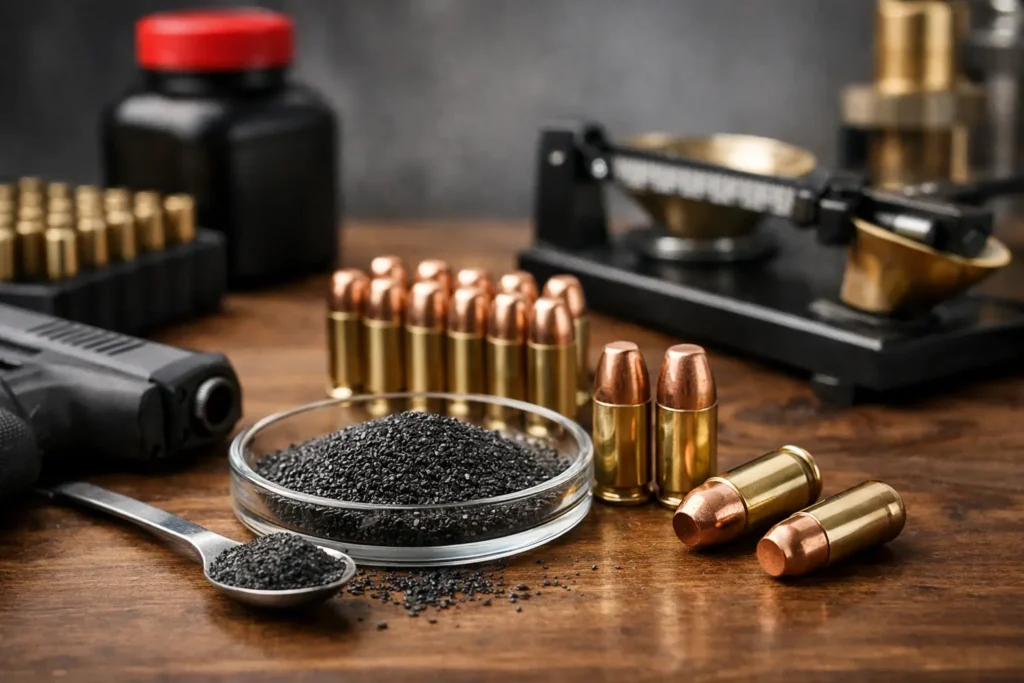
Two powders can sit close together on a chart and still produce meaningfully different results in the same handgun cartridge. A pistol powder burn rate guide is useful because it gives reloaders a starting point for understanding that relationship – but it is not a substitute for current, cartridge-specific published load data.
Burn rate helps explain how a smokeless powder releases energy, how it behaves across pressure ranges, and why one propellant may be well suited to a compact target load while another is better aligned with full-power handgun performance. For reloaders who expect consistent ignition, clean field performance, and repeatable velocity, understanding the chart is part of choosing components with purpose.
What a Pistol Powder Burn Rate Guide Actually Tells You
Burn rate charts arrange powders from relatively fast to relatively slow. In practical terms, a faster powder reaches its useful gas-producing phase sooner, while a slower powder burns more progressively and generally requires a different pressure and case-capacity environment to perform as intended.
The critical word is generally. Burn-rate rankings are comparative references, not fixed measurements of universal performance. Different publishers may place a powder slightly differently because charts are assembled from manufacturer information, test data, and relative behavior across many applications. A chart can show that one powder is faster or slower than another, but it cannot tell you that the two are interchangeable.
That distinction matters most in handgun cartridges. Their smaller case capacities and operating pressures can leave little room for casual substitutions. Powder shape, density, coating, lot variation, primer selection, bullet construction, seating depth, and firearm chamber dimensions all influence the final result. The burn-rate chart provides context. Published data provides the safe recipe.
Fast, Medium, and Slow Pistol Powders
Faster-burning powders
Fast pistol powders are often associated with lower-volume target cartridges, economical practice loads, and applications where relatively small powder charges are used. They can provide efficient performance, but that efficiency calls for careful measurement. A small variation represents a larger percentage of the total charge than it would in a higher-capacity application.
These powders can also leave more unused room in some cases. That is not a cue to increase a charge or treat visual case fill as a pressure indicator. It is a reminder to maintain a disciplined loading process, use the exact data source for the components at hand, and verify every charge with appropriate equipment.
Medium-rate powders
Medium-rate propellants often occupy the broad middle ground of pistol reloading. Depending on the cartridge and published data, they may support a useful balance of metering, velocity potential, recoil character, and load density. This versatility is why many experienced reloaders keep more than one powder in this range available for different handgun platforms and bullet weights.
Still, versatility does not mean universality. A powder that performs well in one 9mm, .38 Special, .40 S&W, or .45 Auto load may not be the right choice for another bullet profile or performance goal. Match the powder to the exact cartridge, bullet, and data set rather than relying on a familiar name alone.
Slower-burning powders
Slower pistol powders are commonly considered for higher-energy handgun applications where the cartridge has sufficient capacity and the published recipe is designed to use that powder’s progressive burn characteristics. They may be selected when a load calls for greater velocity potential, a particular recoil impulse, or more favorable case fill within the tested setup.
They also demand realistic expectations. A slower powder is not automatically better because it sits lower on a burn-rate chart. In a cartridge that does not provide the right operating conditions, it may produce incomplete combustion, inconsistent velocity, excess flash, or poor accuracy. The best powder is the one that delivers reliable, documented performance in the intended cartridge and firearm.
How to Read Burn Rate Without Making Bad Substitutions
The most useful way to read a chart is to start with your loading manual, not with the chart itself. Identify powders listed in current published data for your exact cartridge, bullet weight, bullet type, and intended performance range. Then use the chart to understand where those approved options sit relative to one another.
For example, if several published powders are listed for the same bullet and cartridge, burn rate can help explain their different characteristics. A faster option may use less powder and fit a lower-velocity or target-oriented role. A slower option may be listed for a different performance window. Neither is automatically the correct choice without considering the manual’s tested components and the role of the ammunition.
Treat close chart placement with caution. Powders that appear adjacent may differ in density, grain geometry, deterrent coating, ignition behavior, and pressure response. Do not replace a listed powder with a nearby powder based solely on its position in a burn-rate guide. Brand names, marketing labels, and apparent similarity do not establish safe equivalence.
The Factors Burn Rate Charts Cannot Show
A chart is one useful reference, but it cannot account for the full load system. The following factors affect the performance of any handgun load and must align with the published data you are using:
- The exact cartridge, case capacity, and firearm chamber
- Bullet weight, diameter, bearing surface, and construction
- Cartridge overall length and the resulting usable case volume
- Primer type, powder lot, crimp, and the specified test conditions
Seating depth deserves particular attention because it changes the volume available inside the case. A seemingly minor difference can affect pressure behavior significantly in many pistol cartridges. Use the cartridge overall length and component specifications provided by the data publisher, and do not assume that two bullets of the same weight will behave alike.
Primer selection also belongs in the same conversation. Standard and magnum pistol primers are not blanket substitutes, and a primer change can alter ignition characteristics. Follow the tested primer specification whenever possible. If a data source provides approved alternatives, use only those alternatives under the stated conditions.
Choosing Powder for the Result You Want
Before comparing labels on a burn-rate chart, define the job your ammunition needs to do. For a high-volume range load, you may prioritize dependable metering, manageable recoil, and consistency from lot to lot. For a competition setup, accuracy and repeatable velocity may carry more weight. For a field handgun, the priority may be dependable function and performance within a clearly published loading range.
Powder availability is a practical part of this decision, especially when a preferred product is difficult to source. The smart response is not to force a substitute. It is to identify several powders that are specifically listed in reputable current data for your cartridge and bullet combination. That gives you responsible options without compromising the standards that safe reloading requires.
When evaluating a new powder, keep records. Document the exact components, published data source, cartridge overall length, firearm, observed function, accuracy results, and chronograph information when available. Clear records turn component testing into useful knowledge and make it easier to recognize meaningful changes between lots or setups.
A Reliable Workflow for Pistol Powder Selection
Start with current published data from the powder manufacturer or a recognized loading manual. Confirm the exact cartridge and bullet details, then choose from powders expressly listed for that combination. Use the pistol powder burn rate guide afterward to compare those valid choices, not to create a new recipe from neighboring entries.
From there, inspect your components carefully, meter and verify charges consistently, and stay within the listed data range. If anything about a component, measurement, firearm function, or pressure sign raises a question, stop and resolve it before continuing. Reliable ammunition is built through controlled processes, not assumptions.
Burn rate is a valuable part of the reloader’s vocabulary because it connects powder selection to pressure behavior and intended performance. Keep the chart in its proper role: a knowledgeable reference that helps you ask better questions, while published data supplies the answers worth loading.